




For Japanese art and craft exhibitions in summer 2026, three shows provide the clearest points of entry: “Edo in Focus: Japanese Treasures from the British Museum” at the Tokyo Metropolitan Art Museum, the Japan Folk Crafts Museum’s anniversary exhibition on Yanagi Soetsu and Mingei, and the 60th Japan Traditional Kogei Textiles Exhibition.
A list of summer exhibitions — venues and dates alone — makes it easy to feel uncertain about what to prioritize. The right entry point differs depending on whether you are visiting a Japanese craft exhibition for the first time, looking to engage with art and craft in depth, traveling to Japan from abroad, or researching exhibition design and regional promotion.
This article organizes the Japanese craft and art exhibitions worth attending in summer 2026 not only by venue and schedule, but by materials, technique, provenance, and what each exhibition actually means. The aim is not to consume these works as signs of “Japanese style” or markers of cultural identity, but to think through where they were made, how they moved across time and geography, and what their history of preservation and display tells us.
Table of Contents
Which Japanese craft exhibitions are worth seeing in summer 2026? Three shows to know
The three exhibitions to follow in summer 2026 are “Edo in Focus” at the Tokyo Metropolitan Art Museum, “Yanagi Soetsu and the Japan Folk Crafts Museum — 90th Anniversary” at the Japan Folk Crafts Museum, and the 60th Japan Traditional Kogei Textiles Exhibition.
The show with the highest public profile is “Edo in Focus: Japanese Treasures from the British Museum,” running at the Tokyo Metropolitan Art Museum as part of the museum’s 100th anniversary program. The Tokyo venue runs from July 25 to October 18, 2026. After closing in Tokyo, the exhibition travels to the Osaka Nakanoshima Museum of Art, where it is scheduled to run from October 31, 2026 through January 31, 2027.
(Source: Exhibition Overview | Edo in Focus Official Site)
For those interested in the philosophy and material life behind craft, the Japan Folk Crafts Museum’s “Yanagi Soetsu and the Japan Folk Crafts Museum — 90th Anniversary” is equally important. Running from June 6 to August 12, 2026, the exhibition marks two milestones: a century since the publication of the founding prospectus of the Japan Folk Crafts Museum, and ninety years since the museum itself was established.
(Source: Special Exhibition: Yanagi Soetsu and the Japan Folk Crafts Museum, 90th Anniversary | Japan Folk Crafts Museum)
For those wanting to engage specifically with senshoku — Japanese textile dyeing and weaving — the 60th Japan Traditional Kogei Textiles Exhibition is the dedicated venue. According to the Japan Kogei Association’s official information, the Fukuoka venue runs from July 15 to July 20, 2026, at the Mitsukoshi Gallery on the ninth floor of Fukuoka Mitsukoshi, with free admission.
(Source: 60th Japan Traditional Kogei Textiles Exhibition | Japan Kogei Association)
| Exhibition | Venue | Dates | Key content | Best suited for |
|---|---|---|---|---|
| Edo in Focus: Japanese Treasures from the British Museum | Tokyo Metropolitan Art Museum | July 25 – October 18, 2026 | Edo-period painting, ukiyo-e, works shown in Japan for the first time, British Museum Japan collection | First-time visitors, international guests, Japanese art enthusiasts |
| Yanagi Soetsu and the Japan Folk Crafts Museum — 90th Anniversary | Japan Folk Crafts Museum (Mingeikan) | June 6 – August 12, 2026 | Yanagi Soetsu, the Mingei movement, history of the museum, beauty in everyday objects | Those interested in Mingei, ceramics, and craft as a way of life |
| 60th Japan Traditional Kogei Textiles Exhibition | Mitsukoshi Gallery, Fukuoka Mitsukoshi 9F (touring venues) | Fukuoka: July 15 – July 20, 2026 | Kimono, obi, kumihimo braided cord, dyeing and weaving technique | Those interested in textiles, kimono, materials, and technique |
Kogei Japonica has also published a related article covering craft exhibitions from June 2026 onward. For a broader comparison of summer shows, that piece is worth reading alongside this one.


What is “Edo in Focus: Japanese Treasures from the British Museum”?

“Edo in Focus” is a large-scale Japanese art exhibition drawn from the British Museum’s Japan collection, centered on Edo-period painting and ukiyo-e woodblock prints.
According to the official site, the exhibition presents selected works from the British Museum’s Japan collection of approximately 40,000 objects — including paintings in the form of byobu folding screens, kakejiku hanging scrolls, and emaki picture scrolls, as well as prints by major ukiyo-e artists including Utamaro, Sharaku, Hokusai, and Hiroshige.
(Source: Highlights | Edo in Focus Official Site)
Some visitors approaching “craft exhibitions” may expect ceramics, lacquerware, metalwork, or textiles. But byobu, kakejiku, emaki, and prints are deeply entangled with craft knowledge — in paper, silk, mounting (hyoso), printing (suri), preservation, and restoration. In that sense, “Edo in Focus” is a Japanese art exhibition that craft-focused visitors will also find substantial.
Dates, venues, and practical information
100th Anniversary of the Tokyo Metropolitan Art Museum
Edo in Focus: Japanese Treasures from the British Museum
- Venue: Tokyo Metropolitan Art Museum (Ueno Park, Tokyo)
- Dates: Saturday, July 25 – Sunday, October 18, 2026
- Opening hours: 9:30–17:30
- Closed: Mondays, and Tuesday, October 13
- Organized by: Tokyo Metropolitan Art Museum (Tokyo Metropolitan Foundation for History and Culture), the British Museum, The Asahi Shimbun, NHK, NHK Promotions
- Official site: https://daiei-ten2026.exhibit.jp/
Edo in Focus: Japanese Treasures from the British Museum
- Venue: Osaka Nakanoshima Museum of Art
- Dates: Saturday, October 31, 2026 – Sunday, January 31, 2027
- Opening hours: 10:00–17:00 (last entry 16:30)
- Closed: Mondays; Tuesday, November 24; Thursday, December 31; Friday, January 1, 2027; Tuesday, January 12, 2027
- Organized by: Osaka Nakanoshima Museum of Art, the British Museum, The Asahi Shimbun, NHK Osaka Broadcasting Station, NHK Enterprises Kinki
- Official site: https://daiei-ten2026.exhibit.jp/
The full official title at the Tokyo venue is “100th Anniversary of the Tokyo Metropolitan Art Museum: Edo in Focus: Japanese Treasures from the British Museum.” The venue is the Tokyo Metropolitan Art Museum, located in Ueno Park — one of Tokyo’s main cultural districts — and the exhibition runs from July 25 to October 18, 2026.
Ticket pricing has been announced on the official site. Advance tickets are available from June 25 (10:00) through July 24 (23:59). General admission is ¥2,100 advance / ¥2,300 at the door. University and vocational school students: ¥1,100 advance / ¥1,300 at the door. Visitors aged 65 and over: ¥1,400 advance / ¥1,600 at the door. Those aged 18 and under, and high school students and younger, are admitted free.
The official site currently states that timed-entry reservations are not required. However, entry restrictions or a shift to timed ticketing may be introduced depending on crowd levels. Check the official site directly before your visit.
(Source: Tickets | Edo in Focus Official Site)
After the Tokyo run, the exhibition travels to the Osaka Nakanoshima Museum of Art, where it is scheduled from October 31, 2026 through January 31, 2027. The Tokyo and Osaka venues run on different dates, so if you are traveling from a distance, take care not to confuse the two.
What to look for — nikuhitsu-ga appearing in Japan for the first time, and fusuma paintings reunited after 150 years
“Edo in Focus” is not simply an opportunity to see a concentration of major Edo paintings and ukiyo-e in one place. The exhibition also rewards attention to the history of the works themselves — the fact that they have traveled across oceans and long spans of time before appearing in Japan again.
The official site highlights Utamaro’s nikuhitsu-ga (an original hand-painted work, as distinct from a printed edition) titled “Woman Reading a Letter,” described as appearing in Japan for the first time. Ukiyo-e is most readily associated with woodblock prints, but nikuhitsu-ga — one-of-a-kind paintings executed directly by the artist’s hand — carry a different quality of line and surface tension from printed works.
(Source: Highlights | Edo in Focus Official Site)

Hokusai’s hanshita-e — preparatory drawings used by woodblock carvers, applied directly to the printing block — are also among the works drawing attention. Hanshita-e are distinct from the finished prints they generated; they make visible the artist’s line and the process of production in ways the completed print does not.
The exhibition also includes fusuma paintings — sliding-door panels that have long been separated from one another — brought together again in the exhibition’s structure. Byobu and fusuma are paintings, but they are also spatial objects: devices for dividing and defining space. Looking at them means thinking not only about the painted surface but about architecture, the movement of bodies through rooms, preservation, and how these objects have traveled.
Editor’s note
“Edo in Focus” can be experienced as a major exhibition — visually rich, historically broad. But it also carries a question worth holding: how do we look at Japanese art that has been held outside Japan for a long time? At Kogei Japonica, we would rather not simply celebrate the return of significant works without also asking who collected them, how they were preserved, and why they are being shown now. Keeping both things in view — the quality of the works and the complexity of their history — is what it means to engage seriously with Japanese art and craft.
Glossary — ukiyo-e, nikuhitsu-ga, and hanshita-e
Ukiyo-e (浮世絵)
A genre of painting and printmaking that developed during the Edo period. Subject matter frequently reflects the popular culture of the time — kabuki actors, beauties, famous places, narrative scenes, and daily life.
Nikuhitsu-ga (肉筆画)
Original hand-painted works, executed directly by the artist rather than printed. Unlike woodblock prints — which could be produced in multiple impressions from the same block — nikuhitsu-ga are singular works, and the brushwork and layering of pigment can be seen directly.
Hanshita-e (版下絵)
Preparatory drawings used in woodblock print production: the artist’s design, which was pasted onto the printing block for the carver to follow. Hanshita-e survive as independent documents of the artist’s line and of the production process, distinct from the finished print.
Why does the British Museum hold so much Japanese art?
The British Museum’s Japan collection was built over a long history of acquisition, research, and conservation. Understanding that history is part of what makes “Edo in Focus” more than an exhibition of celebrated works — it is also an occasion to consider how Japanese art came to be received and held outside Japan.
The official site explains that the British Museum’s Japan collection encompasses approximately 40,000 objects, and that items of Japanese origin were part of the museum’s holdings from its earliest years. The collection spans works from the Jomon period to the present, and includes paintings, woodblock prints, ceramics, lacquerware, metalwork, and textiles.
(Source: The British Museum | Edo in Focus Official Site)
Part of the background here is Japonisme — the broad influence of Japanese aesthetics on European art and design that spread from the latter half of the nineteenth century onward. Japanese prints, ceramics, lacquerware, and textiles left a significant mark on European artists, collectors, and scholars. But framing that simply as “Japanese art recognized by the world” does not tell the full story.
The movement of works abroad happened through many different channels: trade, collecting, gifts, purchases, scholarly exchange, and the asymmetries of different historical moments. No single narrative can account for all of it. That is precisely why exhibitions like this one require attention not only to the works themselves but to the histories of how they were collected and preserved.
The editorial position here is not to see overseas-held Japanese art only as something taken, nor only as works endorsed by international recognition, but to engage with the provenance of each work on its own terms. Provenance — the record of where a work was made, whose hands it passed through, where it was held, and how it has been shown — is part of what a work means. Art and craft carry meaning not only from the moment of making but through the subsequent history of their movement and care.
Why Mingei and textile exhibitions also matter this summer
The public attention around “Edo in Focus” will dominate the summer 2026 exhibition season, but the Mingei and textile shows are equally important for anyone who wants to engage with craft seriously.
Large-scale Japanese art exhibitions tend to foreground known artists, named works, and the prestige of holding institutions. Mingei and textile exhibitions show something different: craftspeople whose names are often not recorded, objects of everyday use, choices of material, and accumulated technique. To think about craft without reducing it to the viewing of celebrated objects — to keep the relationship between making and using, between material and body, in focus — these two perspectives are necessary.
Japan Folk Crafts Museum — “Yanagi Soetsu and the Japan Folk Crafts Museum, 90th Anniversary”

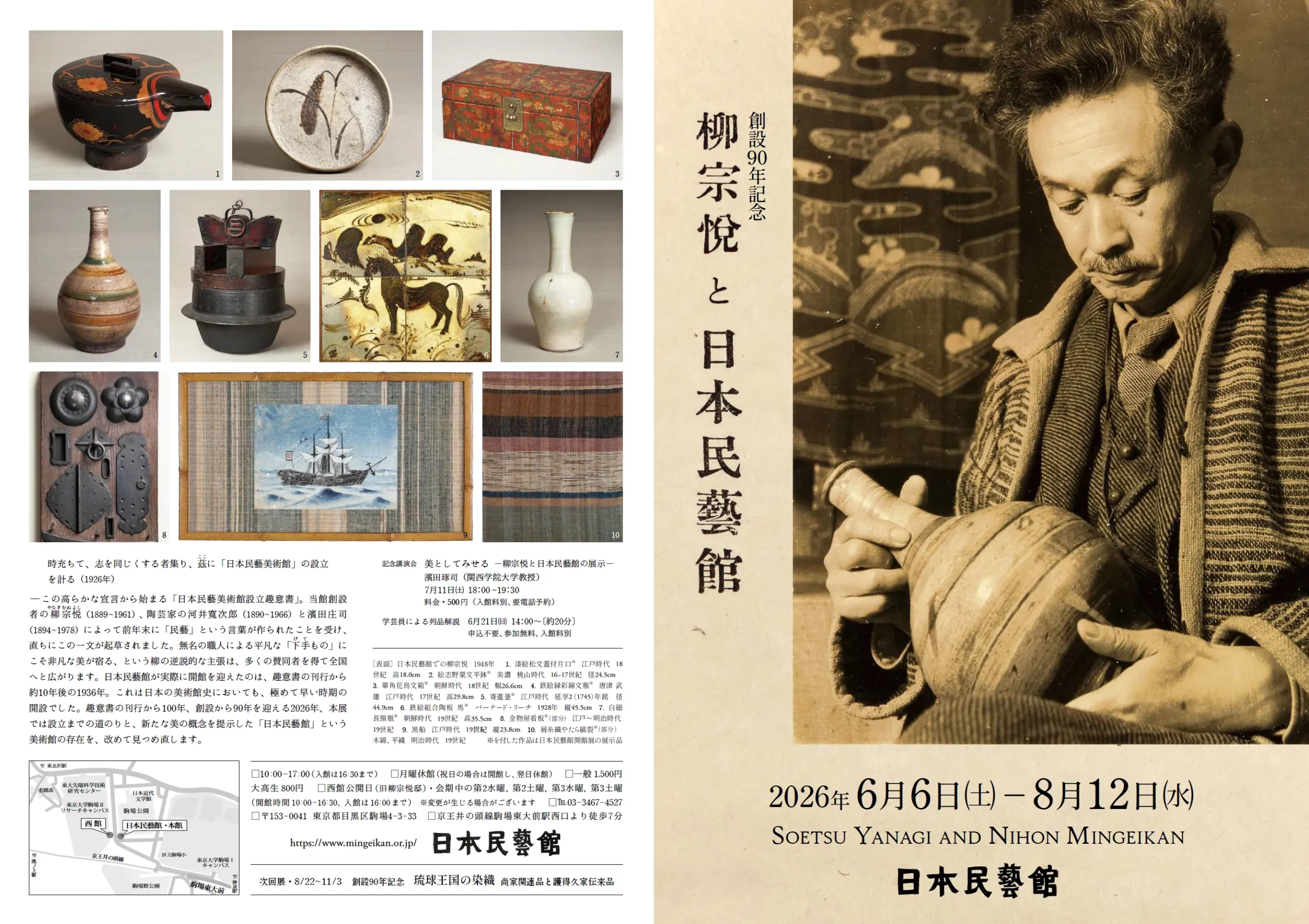
The Japan Folk Crafts Museum’s “Yanagi Soetsu and the Japan Folk Crafts Museum — 90th Anniversary” runs from June 6 to August 12, 2026. According to official information, the exhibition marks the ninety years since Yanagi Soetsu established the Japan Folk Crafts Museum in 1936, and takes the occasion to revisit the museum’s history and the thinking behind the Mingei movement.
(Source: Special Exhibition: Yanagi Soetsu and the Japan Folk Crafts Museum, 90th Anniversary | Japan Folk Crafts Museum)
Mingei (民藝) refers to the philosophy and movement, proposed by Yanagi Soetsu and others, of finding beauty in everyday objects made by anonymous craftspeople. The term is often translated as “folk craft,” but that translation flattens a more specific intellectual project — a modern challenge to the hierarchies of fine art over the applied arts, and an argument that beauty is found in use, in the object’s relationship to the body, and in the collective practice of craft rather than in individual artistic authorship.
When looking at a Mingei exhibition, it is worth attending not only to the shape and color of vessels but to why these particular objects were selected, how they are presented, and what language is used to frame their value. The layers here are multiple: the maker, the user, the collector, and the curator each bring different frames to the same object.
For international visitors explaining Mingei, translating it simply as “folk craft” risks losing what Yanagi was actually proposing. A more accurate frame is: a modern Japanese aesthetic movement that located beauty in everyday objects made by unnamed craftspeople — part of a broader argument about art, function, and social value.
On the Japanese textile kogei exhibition


For those wanting a dedicated encounter with textile work, the 60th Japan Traditional Kogei Textiles Exhibition is the essential venue. According to the Japan Kogei Association’s official information, the exhibition was established to support the preservation, development, and creative extension of textile kogei techniques. Works presented include kimono, obi sashes, and kumihimo braided cord — each representing the full application of dyeing and weaving craft.
(Source: 60th Japan Traditional Kogei Textiles Exhibition | Japan Kogei Association)
The Fukuoka venue runs from July 15 to July 20, 2026, at the Mitsukoshi Gallery on the ninth floor of Fukuoka Mitsukoshi, open from 10:00 to 19:00, with free admission. Guided talks on the exhibited works are also scheduled during the run. For current information, check the Japan Kogei Association’s official site.
When looking at a textile exhibition, attending to thread, dye, weave density, pattern placement, and how the cloth reads when worn deepens the experience considerably beyond the surface of the finished garment. Dyeing is the technique of introducing color and pattern into fabric; weaving is the technique of constructing cloth through the interlacing of warp and weft threads.
Textile work may appear flat to the eye, but it carries time, technique, and the body. Thread is chosen, dyed, woven, patterned, and designed to be worn. That full arc is where the depth of senshoku lies.
Choosing by purpose — which exhibition fits your interests?
First-time visitors to Japanese art and craft exhibitions will find “Edo in Focus” the clearest starting point. For those wanting to understand the thinking behind craft, the Japan Folk Crafts Museum is the right destination. For materials and technique in depth, the Japan Traditional Kogei Textiles Exhibition is the dedicated venue.
Rather than choosing by profile and schedule alone, it helps to clarify in advance what you are looking for: specific works, the philosophy behind craft, materials and technique, or an exhibition to share with international visitors. The right order of priority shifts depending on that.
Comparison table — major exhibitions, summer 2026
| Purpose | Recommended exhibition | Reason | What to confirm before going |
|---|---|---|---|
| First visit to a Japanese art or craft exhibition | Edo in Focus | The British Museum’s Japan collection and Edo painting provide a clear, well-documented entry point | Tickets, opening hours, crowd levels, timed-entry status |
| Bringing international guests | Edo in Focus | English-language title and materials are available; the context of Japanese art held overseas is easy to frame for non-Japanese visitors | English information, access, dates, admission |
| Understanding Mingei and craft as a way of life | Yanagi Soetsu and the Japan Folk Crafts Museum, 90th Anniversary | Brings together the Mingei movement and the museum’s history in a single frame | Opening hours, closed days, admission, related talks |
| Seeing dyeing and weaving technique in depth | 60th Japan Traditional Kogei Textiles Exhibition | Dedicated to textiles; presents kimono, obi, and kumihimo work for direct comparison | Venue, guided talks, touring schedule, admission |
| Exhibition design or spatial presentation research | All three | The three shows represent large-scale art museum, philosophical craft institution, and specialist technique exhibition — useful for comparison across formats | Visitor flow, lighting, caption writing, display furniture, catalogues |
For those visiting as representatives of corporate organizations, local authorities, hotels, or hospitality businesses, it is worth attending not only to the works but to the logic of the exhibition: visitor flow, lighting, interpretive text, catalogues, and accompanying events. Craft does not communicate itself simply by being placed in a room. The quality of what a visitor takes away depends on how materials, space, language, and experience are coordinated.
Kogei Japonica also accepts inquiries relating to craft-informed exhibition and event planning, international-facing communication, and collaboration with craft artists and studios. For those looking to connect a visit to a larger project — whether spatial, curatorial, or promotional — see the Kogei Japonica official site.
Pre-visit checklist
Before attending a Japanese art or craft exhibition, it is worth confirming the following.
- Have you confirmed the exhibition dates and closed days on the official site?
- Have you checked opening hours and last entry time?
- Have you checked ticket prices, advance tickets, and free admission categories?
- Have you confirmed whether timed-entry reservation is required?
- Have you checked for any entry restrictions during busy periods?
- Have you checked for work rotations or limited display periods?
- Have you confirmed photography policy?
- Have you confirmed whether a catalogue or related publications are available?
- Have you checked for lectures, guided gallery talks, or workshops?
- If bringing international guests, have you confirmed English-language information and relevant terminology?
“Edo in Focus” is expected to attract considerable attention. The official site currently states that timed-entry reservation is not required, but this may change depending on crowd levels — confirm just before your visit.
(Source: Tickets | Edo in Focus Official Site)
Frequently Asked Questions
Answers to common questions about Japanese art and craft exhibitions in summer 2026.
- Q1. If I can only go to one exhibition this summer, which should I choose?
- For a first visit, “Edo in Focus” at the Tokyo Metropolitan Art Museum offers the clearest entry point: Edo-period painting, ukiyo-e, and the British Museum’s Japan collection provide a well-documented context.
- Q2. Is “Edo in Focus” a craft exhibition or a Japanese art exhibition?
- Its center is a Japanese art exhibition presenting Edo-period painting and ukiyo-e. That said, byobu folding screens, kakejiku hanging scrolls, emaki picture scrolls, and prints all involve deep craft knowledge — in paper, silk, mounting, printing, and conservation.
- Q3. Has ticket information been released for “Edo in Focus”?
- Yes. The official site lists advance and standard admission prices as well as limited tickets. Advance sales run from June 25 (10:00) through July 24 (23:59).
- Q4. Can I see “Edo in Focus” outside Tokyo?
- After the Tokyo run, the exhibition travels to the Osaka Nakanoshima Museum of Art, scheduled from October 31, 2026 through January 31, 2027.
- Q5. Is the Mingei exhibition accessible to first-time visitors?
- Yes. Rather than approaching it through the philosophy first, looking at the form, material, and practical purpose of the vessels and objects on display makes for a natural way in.
- Q6. What should I focus on at the textiles exhibition?
- Thread, dye, weave density, pattern placement, and how the cloth reads when worn are all worth attending to. The finished garment is only part of the picture — imagining the time involved in making it deepens the experience.
- Q7. Which exhibition works best for international guests?
- “Edo in Focus” has an established English-language title and supporting materials, and the context of Japanese art held in an overseas institution is one that international visitors can follow readily. For Mingei and textile exhibitions, having some terminology prepared in advance makes the experience considerably clearer.
- Q8. Where should I confirm dates and admission?
- Always check directly with the museum, the exhibition’s official site, the organizing body, or the venue’s official site. Aggregator articles and social media posts can be outdated — always verify at the primary source.
For international visitors — cultural context worth knowing
For those visiting Japanese craft and art exhibitions from outside Japan, approaching terms like Kogei, Mingei, senshoku, and ukiyo-e with some cultural context rather than direct translation makes for a richer experience.
“Kogei” is sometimes translated as “Japanese craft,” but it is not a term for souvenirs or decorative objects. It refers to a field of practice in which materials, technique, region, use, and the judgment of the maker converge in a made object.
“Mingei” is often written without translation even in English, and for good reason. “Folk craft” captures only the surface of what Yanagi Soetsu and his colleagues were proposing: a modern Japanese aesthetic argument about where beauty resides, and about the relationship between daily use and artistic value. The fuller frame is a twentieth-century philosophical movement that challenged established hierarchies in art and craft.
“Senshoku” can be translated as “textile dyeing and weaving.” The field encompasses not only kimono but thread, dyes, the architecture of weave structures, pattern placement, and the relationship between cloth and the body that wears it.
“Satogaeri” — the word used in Japan to describe works held overseas that are temporarily shown in Japan again — is often translated as “homecoming.” But as this article has tried to hold clearly: each work’s history of collection, conservation, and display is its own, and a single frame of return or homecoming is not always adequate. The Tokyo Metropolitan Art Museum’s English-language site presents this exhibition under its official English title, “Edo in Focus: Japanese Treasures from the British Museum.” For sharing information with international colleagues or guests, the English official materials are the reliable starting point.
(Source: Edo in Focus: Japanese Treasures from the British Museum | Tokyo Metropolitan Art Museum)
At Kogei Japonica, we hope the summer 2026 exhibitions serve as more than event destinations — as occasions to encounter the provenance, materials, technique, and thinking behind Japanese art and craft. The public energy around “Edo in Focus,” the quiet propositions of Mingei, and the accumulated skill of textile craft each offer a different entrance into the same field. Check the official information for each before you go, and let your own interests guide which door you open first.


