

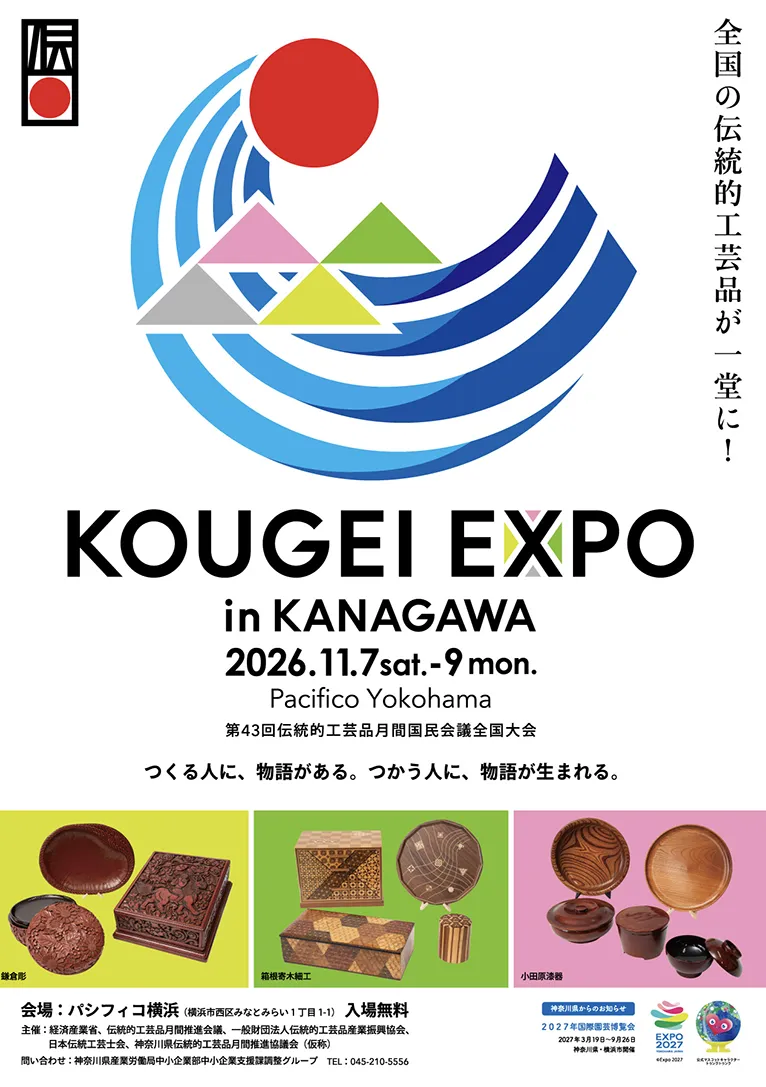
In November 2026, KOUGEI EXPO in KANAGAWA, the national exposition of Japan’s designated traditional crafts, comes to Kanagawa Prefecture for the first time. The main event, open to the general public, runs from Saturday 7 to Monday 9 November at Pacifico Yokohama, and admission is free.
If you have seen the name but are unclear on when, where and what actually happens, or if you want to know what to look for when crafts from across the country are gathered in one hall, this guide is for you. For people working in local government or in a craft-producing region, there is also the question of how a national exposition can help raise the profile of a local craft.
Drawing on primary sources published by Kanagawa Prefecture, the Ministry of Economy, Trade and Industry (METI) and the KOUGEI EXPO organisers, this article sets out the difference in dates and venues between the awards ceremony and the main event, the three crafts the organisers present as Kanagawa’s designated traditional crafts, the pre-events held across the prefecture, and the points worth considering for regions and public bodies thinking about the exposition as a platform.
Individual programmes and workshops may be updated from here on. The event information in this article is current as of 16 September 2026.
Table of Contents
What is KOUGEI EXPO in KANAGAWA 2026?
KOUGEI EXPO is the public-facing name of the National Convention for Traditional Craft Month, an exposition held in a different part of Japan each year to broaden understanding and use of designated traditional crafts. It has run since 1984, and the 2026 edition is the 43rd. This is the first time Kanagawa Prefecture has hosted it.
METI has designated November as Traditional Craft Month every year since 1984, and stages the national exposition as its centrepiece, moving the host region annually. For 2026, the awards ceremony takes place in Odawara and the main public event in Yokohama.
(Source: 2026 National Convention for Traditional Craft Month – event outline | KOUGEI EXPO)
The official outline lists the organisers as METI, the national organising council for Traditional Craft Month, The Association for the Promotion of Traditional Craft Industries, the national association of certified traditional craftspeople, and the Kanagawa prefectural organising committee for Traditional Craft Month.
Kanagawa Prefecture describes the national exposition as an event that has typically drawn between 50,000 and 100,000 visitors. It is less a retail event than a large-scale occasion for visitors to encounter crafts, makers and production regions from across Japan.
(Source: Kanagawa selected as host of the 2026 National Convention for Traditional Craft Month | Kanagawa Prefecture)
The history of the National Convention for Traditional Craft Month (KOUGEI EXPO)
The event’s formal name is the National Convention for Traditional Craft Month. It is presented publicly as KOUGEI EXPO, and 2026 marks its 43rd edition.
The important point is not to read KOUGEI EXPO simply as an occasion where crafts from around the country are put on display. The event also has a broader policy purpose: to make designated traditional crafts better known, and to carry that awareness through into future demand and future makers.
What “designated traditional craft” means
In Japan, dentōteki kōgeihin, or designated traditional craft, is not simply a loose synonym for traditional handicraft. It refers to a craft formally designated by the Minister of Economy, Trade and Industry under the Act on the Promotion of Traditional Craft Industries.
Designation carries requirements: the item must be used principally in daily life, the main stages of production must be carried out by hand, traditional techniques and traditional materials must be used, and a production district must have formed in a defined area. With the designation of Tokyo hand-carved seals in October 2025, the national total stands at 244 designated items.
(Source: Tokyo hand-carved seals designated as a traditional craft | METI)
KOUGEI EXPO and Kanagawa Prefecture both present Kamakura-bori carved lacquerwork, Hakone yosegi-zaiku marquetry and Odawara lacquerware as the prefecture’s three designated traditional crafts.
The 2025 designation for Tokyo hand-carved seals, meanwhile, covers production areas in both Tokyo and Kanagawa.
To avoid confusing two different things, this article refers throughout to the three crafts the organisers present as Kanagawa’s designated traditional crafts.
(Source: KOUGEI EXPO in KANAGAWA | Kanagawa Prefecture)
(Source: Tokyo hand-carved seals designated as a traditional craft | METI)
When and where? The awards ceremony and the main event are not in the same place
KOUGEI EXPO in KANAGAWA uses two venues: the awards ceremony on 6 November, and the main event from 7 to 9 November. For anyone coming to see the exhibitions, the sales areas or the demonstrations, the venue to head for is Pacifico Yokohama.
| Item | Awards ceremony | Main event |
|---|---|---|
| Dates | Friday 6 November 2026 | Saturday 7 – Monday 9 November 2026 |
| Venue | Odawara Sannomaru Hall 1-7-50 Honcho, Odawara, Kanagawa |
Pacifico Yokohama 1-1-1 Minatomirai, Nishi-ku, Yokohama, Kanagawa |
| Main content | Awards for service to the traditional craft industries, and related items | Exhibitions, sales, craft demonstrations, workshops |
| Admission | Check the official guidance for attendance conditions | Free |
Opening hours for the main event are 10:00 to 17:00 on Saturday 7 and Sunday 8 November, and 10:00 to 16:00 on Monday 9 November.
(Source: KOUGEI EXPO in KANAGAWA | Official site)
The awards ceremony (Odawara Sannomaru Hall)
The ceremony on 6 November is held at Odawara Sannomaru Hall. The official outline lists awards for service to the traditional craft industries among the proceedings.
Odawara is also the production area for Odawara lacquerware, one of the three crafts the organisers present as Kanagawa’s designated traditional crafts.
The ceremony itself is not a regional promotion programme, and the two should not be read as the same thing. Even so, the decision not to hold the whole exposition in Yokohama, and to place a venue in a craft-producing area in the west of the prefecture, is worth noting in understanding how this edition has been put together.
The main event (Pacifico Yokohama)

The main event runs from 7 to 9 November at Pacifico Yokohama. Admission is free.
The official site lists the main stage, Takumi no Hibiki Stage, alongside live craft demonstrations and workshops, a KOUGEI collaboration gallery with Touken Ranbu ONLINE, and a section titled The Future and the World of Kōgei.
(Source: KOUGEI EXPO in KANAGAWA | Official site)
If this is your first visit, rather than trying to give every display equal attention, it helps to decide in advance which one of these matters most to you: seeing finished work, watching the making process, taking part in something, or buying.
Demonstrations are especially worth watching closely. Instead of registering only that the handwork is skilled, look at which stage of the whole process you are watching, and at what materials and tools are in use. Those are the things a finished object on a plinth cannot tell you about a technique.
An editor’s note
At events where crafts from across the country are gathered together, it is easy to be drawn to the sheer number of things on show.
If you want to look more closely, pick one axis of comparison and hold to it: material, process, tools, or finish. Even within woodwork or within lacquer, how a region approaches its material and where it creates value in the process can differ considerably.
What can you see? Kanagawa’s three designated traditional crafts
The three crafts KOUGEI EXPO presents as Kanagawa’s designated traditional crafts are Kamakura-bori, Hakone yosegi-zaiku and Odawara lacquerware.
All three use wood as a primary material, which they have in common, but the processes that give each its character are quite different.
| Craft | Principal materials | Characteristic process | What to look at in the hall |
|---|---|---|---|
| Kamakura-bori | Wood and urushi lacquer | Carving into the wooden base, then lacquering | Depth of carving, tool marks, the surface the lacquer creates |
| Hakone yosegi-zaiku | Several timber species | Composing patterns from the natural colours of different woods | The joins between colours, the grain, the precision of the geometry |
| Odawara lacquerware | Wood and urushi lacquer | Making the wooden base, turning, suri-urushi wiped lacquer | The form of the vessel, and how clearly the grain remains visible through the lacquer |
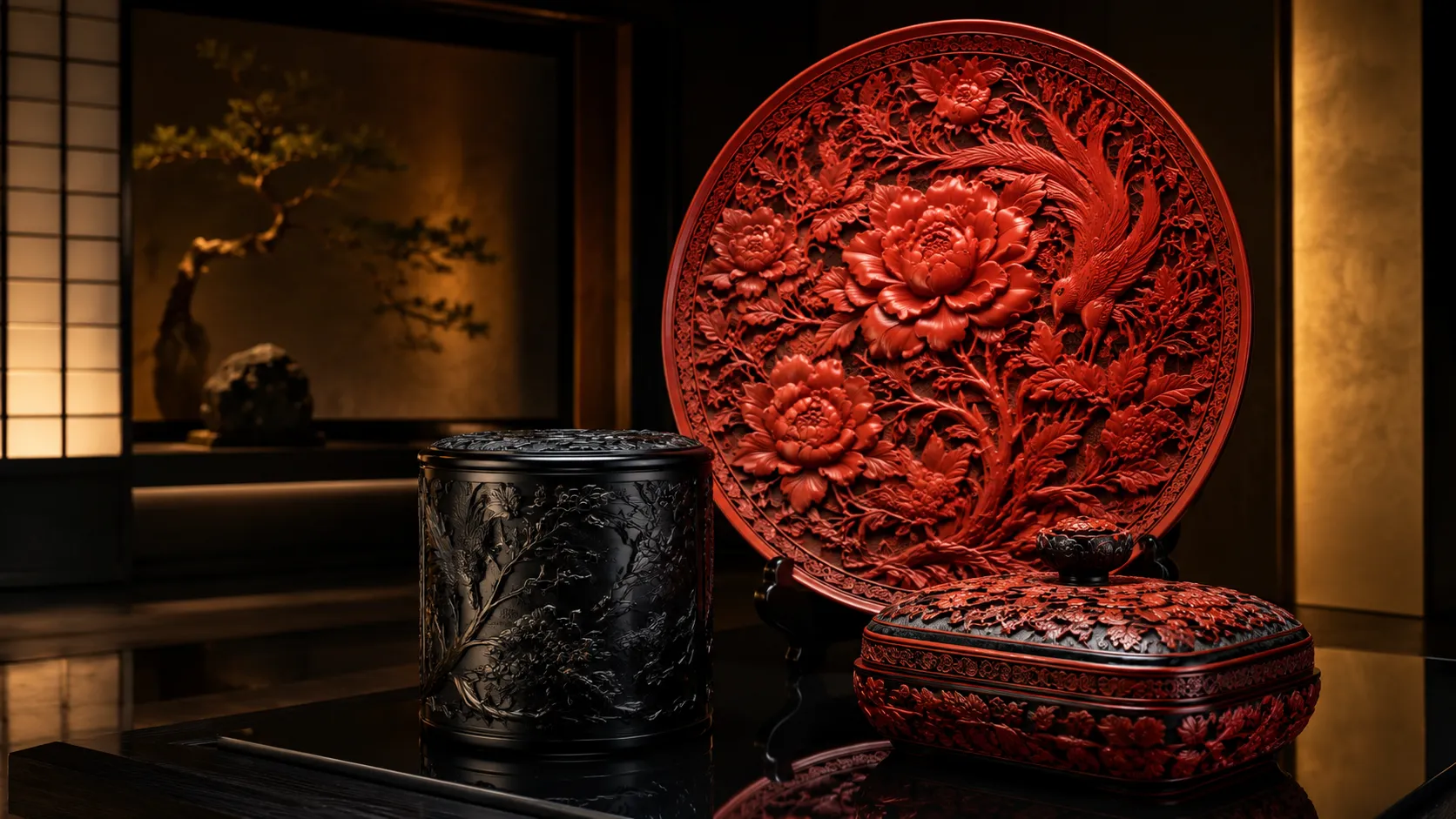
Kamakura-bori is made by carving a design into a wooden base and then building up coats of urushi lacquer over it. That is a different sequence from chōshitsu, carved lacquer, where thick layers of lacquer are built up first and the carving is done into the lacquer itself. When you watch a demonstration, asking what exactly is being carved makes the distinction easy to see.


Hakone yosegi-zaiku is a woodworking tradition that draws on the natural colours of different timber species, assembling them into geometric patterns. The pattern is not the only expressive element: the colour and grain of the woods themselves are part of the work.
Looking at a piece in person, consider more than whether the pattern is finely worked. Look at where two different woods meet, and at the unit from which the pattern has been built up.

Odawara lacquerware is known for lacquer that works with the beauty of the wooden base.
The organisers describe its characteristics as including accomplished hikimono lathe-turning to produce the base, and finishes such as suri-urushi, in which raw ki-urushi lacquer is rubbed into the surface repeatedly so that the grain remains visible.
Kamakura-bori carves the wood. Hakone yosegi-zaiku assembles it. Odawara lacquerware builds on the form of the turned wood and its natural grain, then finishes the surface with lacquer. Set out that way, it becomes clear how differently three woodworking traditions within one prefecture think about technique.
The exposition’s catchphrase translates as: the maker has a story, and a story begins for the user. Kanagawa Prefecture also explains that the logo took its inspiration from Katsushika Hokusai’s Under the Wave off Kanagawa.
(Source: KOUGEI EXPO in KANAGAWA | Kanagawa Prefecture)
An editor’s note
At a national exposition, attention naturally gravitates towards well-known production areas and visually striking work. That is precisely why, for the Kanagawa edition, the question is whether the three local crafts are treated simply as a showcase for the host prefecture, or placed in a broader conversation with craft traditions from across Japan.
Beyond the work itself, we will be paying attention to the words makers use when they describe their own materials, techniques and regions.
Are there pre-events? Related programmes around the prefecture
KOUGEI EXPO in KANAGAWA does not begin and end with the main event in November. Through 2026, related pre-events have been held in craft-producing areas across the prefecture.
In the Kamakura area, the Kamakura-bori Fureai Exhibition ran from 26 to 28 June 2026 at Lumine Wing Ofuna, with displays and sales of Kamakura-bori, demonstrations by makers, and hands-on making sessions. That programme has now finished.
(Source: KOUGEI EXPO in KANAGAWA | Kanagawa Prefecture)
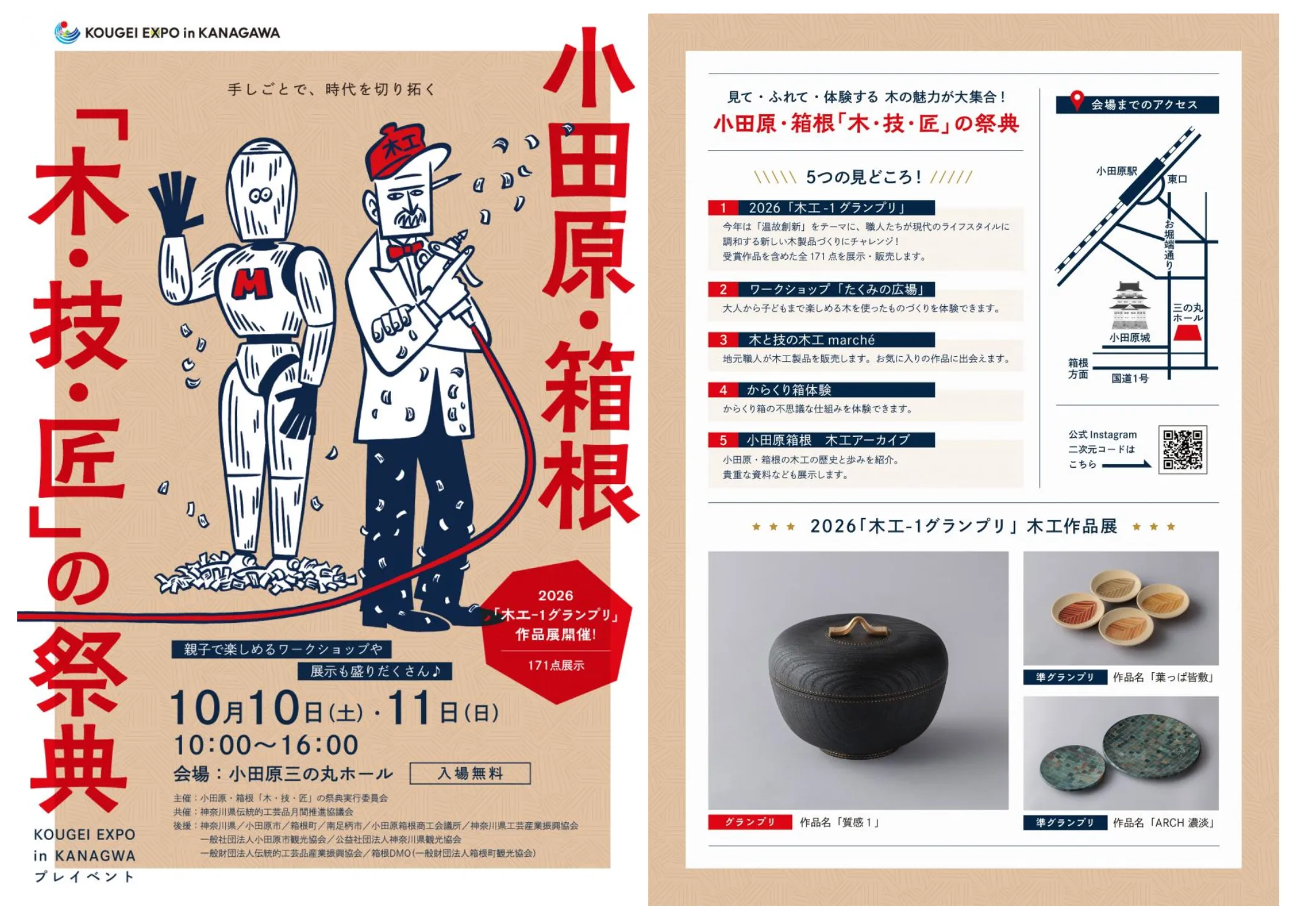
Next, in the Odawara and Hakone area, the Odawara and Hakone Wood, Technique and Craftsmanship Festival takes place over two days, Saturday 10 and Sunday 11 October 2026, at Odawara Sannomaru Hall. Opening hours are 10:00 to 16:00 on both days.
The programme includes the 2026 Mokkō-1 Grand Prix, woodworking workshops, a woodwork market with local makers, karakuri puzzle box sessions, and an exhibition on the history of woodworking in Odawara and Hakone. The Mokkō-1 Grand Prix takes as its theme the idea of drawing on the past to create something new, and 171 works in total, including the prizewinners, are due to be shown.
(Source: Odawara and Hakone Wood, Technique and Craftsmanship Festival | Kanagawa Prefecture)
This pre-event is a chance to see the woodworking culture of Odawara and Hakone together in one place without waiting for November. Beyond Hakone yosegi-zaiku and Odawara lacquerware, it also shows the broader range of woodworking traditions that have developed in the region, karakuri puzzle boxes among them.
Reading the theme: craft in the present tense
Conversations about traditional crafts tend to lean on the language of preservation. But carrying a technique forward is not the same thing as making only what was made before. Understanding the core of a material and a technique, then working out how it connects to life as it is lived now: that trial and error is also part of what allows a craft-producing region to remain active today.
How can regions and public bodies take part? Sponsorship and exhibiting
KOUGEI EXPO in KANAGAWA is an event for the general public. It is also, for local authorities, regional craft associations and businesses, an opportunity to introduce a regional craft to a national audience.
Kanagawa Prefecture opened sponsorship applications for the exposition to companies, organisations and individuals on 15 July 2026. Details of what sponsorship involves and how to apply are available on the official application page.
(Source: KOUGEI EXPO in KANAGAWA sponsorship applications | Kanagawa Prefecture)
The official site for the main event also carries an application route for prospective exhibitors.
Conditions, eligibility and current application status should be checked against the latest official guidance in each case.
(Source: KOUGEI EXPO in KANAGAWA | Official site)
That said, presenting a region does not end when the stand comes down.
After a visitor has seen the work, can they find out about the maker and the workshop? If they want to visit the region, will they reach the information? If a buyer or designer overseas searches for it, is there anything in English to find? The information that remains after the exposition is part of the planning, not an afterthought.
At a national event in particular, it is more effective to connect what visitors see at the event with what they can find online afterwards. An article or an English-language page that sets out the region, the technique, the makers and workshops, the materials, and where to buy or ask, makes it easier to carry an exposition beyond a one-off publicity moment and into enquiries and continued interest in the area.
From Kogei Japonica, to regions and public bodies
Kogei Japonica works with local authorities, regional craft associations and craft businesses on interview features, regional profiles, content for domestic and international readers, and English-language articles. Alongside one-off announcements timed to a national exposition or an exhibition, we can look at the information design that helps a region remain discoverable through search and AI search afterwards.
KOUGEI EXPO in KANAGAWA: frequently asked questions
The following sets out what is worth checking before visiting KOUGEI EXPO in KANAGAWA, based on official information as of 16 September 2026.
- Q1. When is KOUGEI EXPO in KANAGAWA held?
- The awards ceremony is on Friday 6 November 2026, and the main event, which is open to the public, runs from Saturday 7 to Monday 9 November.
- Q2. Where is it held? Are the ceremony and the main event in the same place?
- They are in different places. The awards ceremony is at Odawara Sannomaru Hall, and the main event at Pacifico Yokohama.
- Q3. Is admission free? Is booking required?
- The main event at Pacifico Yokohama is free to enter. Individual programmes such as workshops may have booking requirements or conditions of participation, so check the latest guidance on the official site for anything you want to join.
(Source: KOUGEI EXPO in KANAGAWA | Official site) - Q4. What are Kanagawa Prefecture’s designated traditional crafts?
- KOUGEI EXPO and Kanagawa Prefecture present three: Kamakura-bori, Hakone yosegi-zaiku and Odawara lacquerware. The 2025 designation for Tokyo hand-carved seals covers production areas in both Tokyo and Kanagawa.
- Q5. When and where are the pre-events?
- The Kamakura-bori Fureai Exhibition in the Kamakura area was held in June 2026 and has finished. In the Odawara and Hakone area, the Odawara and Hakone Wood, Technique and Craftsmanship Festival takes place on Saturday 10 and Sunday 11 October at Odawara Sannomaru Hall.
(Source: Odawara and Hakone Wood, Technique and Craftsmanship Festival | Kanagawa Prefecture) - Q6. Can you buy work, or only look at it?
- You can buy. The official outline lists exhibitions, sales and demonstrations among the content of the main event. Individual exhibitors, products, stock and prices should be checked with the exhibitors themselves or against the latest official guidance.
- Q7. How can local authorities, regions and businesses take part?
- Sponsorship applications are open to companies, organisations and individuals, and the official site carries guidance for prospective exhibitors. Conditions and current status should be checked against the latest application documents.
Before you go: a checklist
- Have you kept the awards ceremony and the main event venues clear in your mind?
- Have you checked how to get to Pacifico Yokohama?
- Have you checked times and booking conditions for any workshop or demonstration you want to join?
- Have you decided which comes first for you: looking, watching the process, taking part, or buying?
- Have you read up briefly on Kamakura-bori, Hakone yosegi-zaiku and Odawara lacquerware?
- Have you a way to note down the maker, workshop or region when something catches your eye?
KOUGEI EXPO in KANAGAWA 2026 is the 43rd National Convention for Traditional Craft Month, and the first to be held in Kanagawa Prefecture.
Dates and exhibitor information matter. But what interests us more is this: because the crafts of the whole country are in one hall, the differences in materials, processes and regional traditions become much easier to see.
Kamakura-bori carves the wood and then builds up the lacquer. Hakone yosegi-zaiku sets the colours of different woods against each other. Odawara lacquerware works from the turned form and the grain, and finishes in lacquer. Three woodworking traditions from one prefecture, thinking about their material in three different ways.
If something in the hall catches your attention, follow it one step further: where is this made, by whom, from what, and how?
Meet the work at the event, learn the technique, then turn back towards the region it came from.
Once that sequence starts, KOUGEI EXPO stops being an exhibition and sales floor, and becomes a way into the places across Japan where things are still being made.
