

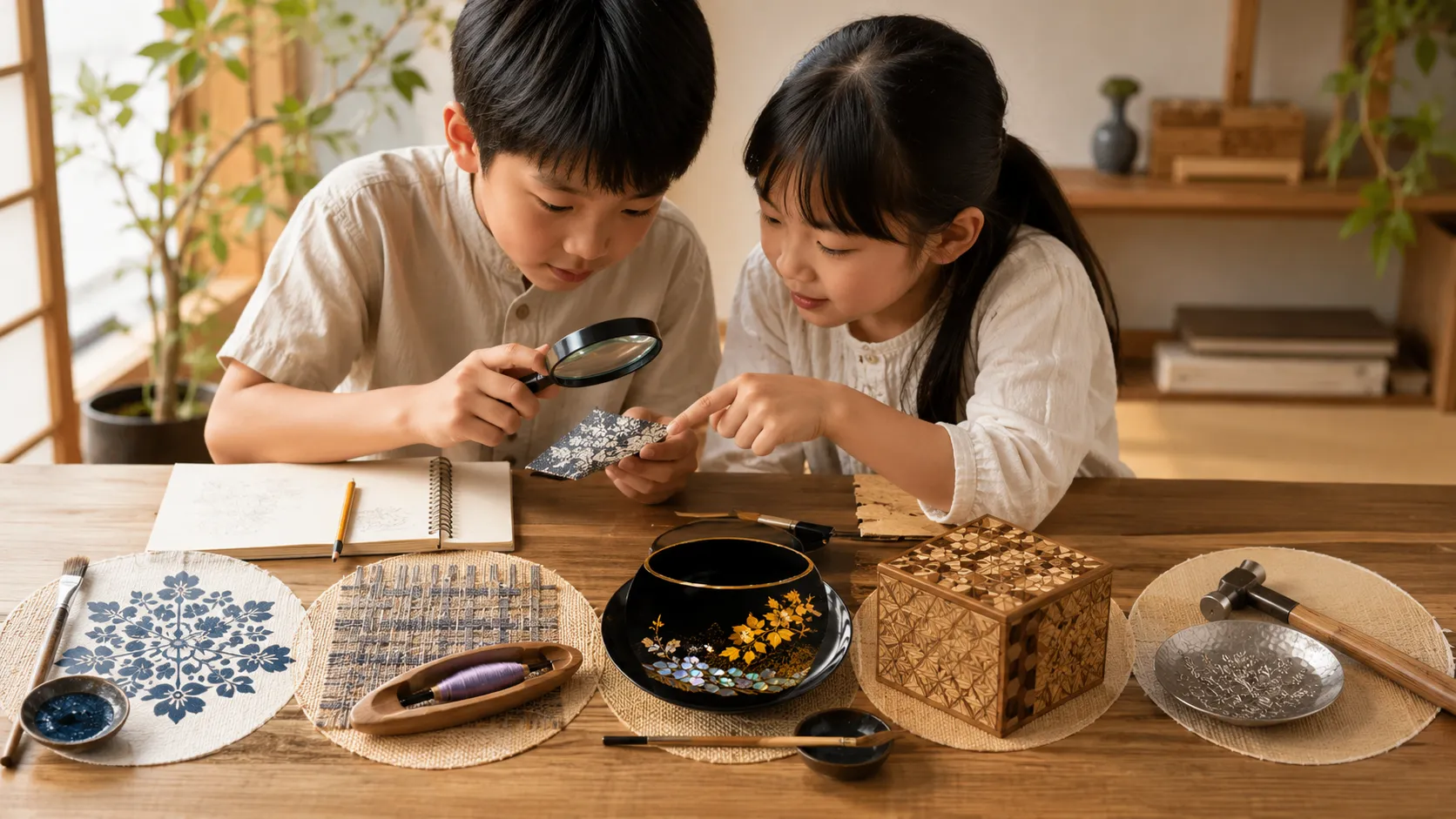
In Japanese craft, patterns become far more interesting when viewed through material, tools, process, and regional context. This perspective also makes them an excellent subject for close observation and structured inquiry.
Finding the right topic for a summer research project — jiyū kenkyū, Japan’s summer independent study assignment for students — can take a while. If you’ve been looking for craft-related project ideas, you may have noticed the patterns in traditional Japanese craft objects: textiles, lacquerware, wooden pieces, metalwork. But once you try to research them seriously, the specialist terminology can make it hard to know where to begin.
This article covers five craft disciplines — katazome resist-dyeing, weaving, lacquerware, woodcraft, and metalwork — and explains how to observe the patterns each technique produces from the perspective of close observation.
The short answer is that craft patterns are not simply decoration. In katazome, the pattern emerges from the relationship between a paper stencil and paste-resist. In weaving, it is formed by the interlacing of warp and weft threads. In lacquerware, makie (scattered metal powder decoration) and other techniques build up on the lacquer surface. In woodcraft, the pattern comes from wood grain, carving, joinery, or yosegi marquetry. In metalwork, hammer texture (tsuchime), engraving, and zogan inlay each leave their own characteristic marks. In every case, what you are really looking at is the relationship between material and technique.
By the end of this article, you should have a clear sense of why patterns make a good project topic — and specifically what to observe and how to record what you find.
Table of Contents
When You Study Craft for a Research Project, What Should You Actually Observe?
Craft patterns emerge from the constraints and accumulated knowledge of a specific material, tool, production process, and place of origin. For an independent study project, the key question is “why does this pattern look the way it does?” — not just “what does it look like?”
When you approach craft as a research subject, trying to cover all of its history from the beginning makes the scope unmanageable very quickly. For students working on a project, the most practical starting point is looking carefully at a single pattern first.
For example: you see a repeated motif on a piece of cloth. Rather than stopping at “it’s beautiful” or “it’s cute,” try asking: “why can the same shape be repeated so precisely?”, “was this drawn by hand, or made with a stencil?”, “is the pattern built into the weave of the cloth itself?” These questions are the entry point to a real inquiry project.
Japan’s Ministry of Economy, Trade and Industry (METI) defines nationally designated traditional crafts as those meeting five conditions: primary use in daily life, substantially handmade production, use of traditional techniques and raw materials, manufacture within a defined production region, and designation under the Act for the Promotion of Traditional Craft Industries. As of October 27, 2025, there are 244 nationally designated traditional crafts.
(Source: Traditional Crafts | Ministry of Economy, Trade and Industry)
One important note: not every craft object is a “nationally designated traditional craft” under this system. Contemporary craft works by individual artists, unique pieces held in museum collections, and new forms of craft expression that have emerged in a region all exist outside the designation framework. In a student project, it is worth verifying through official sources before making specific claims about a craft’s status.
Kogei Japonica Editorial Note
Describing a craft pattern as “very Japanese” or “cute and traditional” and leaving it there makes the material, the production process, and the maker’s decisions invisible. What matters in an observation project is not consuming the pattern as a symbol, but observing how it was produced — which material and which process brought it into being.
Japan’s Agency for Cultural Affairs describes intangible cultural properties as intangible cultural products of high historical or artistic value — including performing arts, music, and craft techniques. Crucially, an intangible cultural property is the skill itself, embodied by an individual or group who has mastered it.
(Source: Intangible Cultural Properties | Agency for Cultural Affairs)
This matters for students working on a project. You can produce a pattern during a short workshop — but behind the work of a professional maker or artisan lies years of practice: reading materials, handling tools, managing drying times and temperature, calibrating the pressure of the hand. A brief hands-on session and a professional’s lifetime of craft expertise are not the same thing.
To produce an observation record rather than just a personal response, keeping these four points in mind helps:
- Record the name of the work, maker, and production region as precisely as possible
- Identify what the material is — cloth, wood, lacquer, metal, or other
- Consider whether the pattern was dyed, woven, carved, or built up through layering
- Separate your personal impressions from the factual observations you can record
How Are Patterns Different Across Katazome, Weaving, Lacquer, Wood, and Metalwork? [Comparison Table]
The five craft disciplines each produce patterns through different processes, tools, and materials. This comparison table gives you the overall picture before looking at each in detail.
| Craft Discipline | How the Pattern Forms | Primary Tools | Primary Materials | What to Observe | Representative Examples |
|---|---|---|---|---|---|
| Katazome (resist-dyeing) | A paper stencil is placed on cloth or paper; paste-resist is applied and the piece is then dyed | Paper stencil, paste-resist, brush | Cloth, washi paper, dyes | Sharpness of edges; how the same motif repeats | Tokyo Komon, Edo Komon, kata-yuzen, bingata, and others |
| Weaving | Patterns are woven through the combination of warp and weft threads | Loom, design draft | Silk, cotton, linen, and other yarns | Thread direction, weave structure, unit of repeat | Nishijin ori, Hakata ori, and others |
| Lacquerware | Decoration is applied to the lacquer surface using makie, raden (mother-of-pearl inlay), and similar techniques | Lacquer brush, powder tube, shell, polishing tools | Lacquer, gold powder, silver powder, shell, wood base | Gloss, layering, how the appearance shifts with angle | Wajima-nuri, Kyo-shikki, makie works, and others |
| Woodcraft | Patterns emerge through wood grain, carving, joinery, or yosegi marquetry | Plane, chisel, saw, jig | Natural timber | Grain, carving marks, color variation between woods | Hakone yosegi-zaiku, sashimono joinery, wood carving, and others |
| Metalwork | Patterns are created on the surface through hammering, engraving, inlay, or joining | Hammer, chisels, files, engraving tools | Copper, silver, iron, brass, and others | Hammer texture (tsuchime), engraving, zogan inlay, metal color | Chasing and repoussé, zogan inlay works, and others |
The point of this comparison is not to decide which is best. The same flower motif — rendered in katazome, woven into cloth, executed in makie lacquer, carved in wood, or worked in metal — will look different and will have been made differently in every case.
Being able to explain that difference in your own words is what gives a student project substance.
How Does a Katazome Pattern Form?
Katazome is a dyeing technique in which a paper stencil and paste-resist (bosen-nori) are used to apply a pattern to cloth or paper.
Edo-Taito Traditional Crafts Center describes katazome as a technique that uses shibugami — washi paper treated with persimmon tannin — as the stencil, and applies either paste-resist or colored paste to create the pattern. Representative forms of katazome listed include kata-yuzen from Kyoto, Edo Komon, and bingata from Okinawa.
(Source: Katazome | Edo-Taito Traditional Crafts Center)
The defining characteristic of katazome worth paying attention to is how well-suited it is to repeating a pattern precisely. Because a stencil is used, the same form can be applied at consistent intervals. At the same time, because it is made by hand, close inspection often reveals slight bleeding at the edges or subtle variation — evidence of the process.
For an observation-based project, the following points are especially useful:
- Whether the edges of the pattern are sharp and defined
- How the same shape repeats — and at what interval
- Whether there are areas where colors overlap
- Whether the undyed spaces function as part of the pattern itself
Cultural Heritage Online (Japan’s Agency for Cultural Affairs) describes the documentary film “Katazome: Edo-Komon and Nagaita-Chugata” as a record of the process: placing a stencil on fabric, applying paste-resist to transfer the pattern, and then dyeing the cloth to produce fine, detailed motifs.
(Source: Katazome: Edo-Komon and Nagaita-Chugata | Cultural Heritage Online)
For a broader overview of dyeing traditions and dyeing techniques in Japan, the related article on Kogei Japonica is a useful reference.


How Does a Woven Pattern Form?
In woven textiles, the pattern is generated by the combination of warp and weft threads. Rather than being drawn or applied to the surface afterward, the pattern is built into the structure of the cloth itself.
On the subject of Nishijin ori, the Nishijin Textile Industry Association describes it as the collective term for pre-dyed figured textiles produced in Kyoto, characterized by small-batch, varied production. Nishijin ori was designated a nationally designated traditional craft on February 26, 1976.
(Source: What Is Nishijin Ori? | Nishijin Textile Industry Association)
In Nishijin ori, a design draft is produced from the original design, and the interlacing of warp and weft is planned before weaving begins. Where katazome produces a pattern through the placement of dye, a woven textile’s pattern is the interlacing of threads.

For this kind of independent study, try looking closely at the surface of the cloth. Whether the pattern’s edges look flat and continuous, like print, or whether they appear as an accumulation of colored thread points and lines, is one of the clearest ways to distinguish dyeing from weaving.
- Whether the pattern is made up of thread colors rather than applied dye
- Whether the same unit repeats
- Whether the pattern looks different on the front and the reverse
- Whether there are differences in thread density or sheen
For those who want to go further with woven patterns, the article on Hakata ori is also a useful reference. In Hakata ori, the qualities that repay attention extend beyond the pattern to include the firmness and resilience of the textile as an obi sash.

How Does a Lacquerware Pattern Form?
In lacquerware, the pattern is produced by applying decorative techniques to the lacquer surface. The most widely known of these are makie, a lacquer decoration technique using sprinkled metal powder, and raden, mother-of-pearl inlay.
Cultural Heritage Online (Japan’s Agency for Cultural Affairs) describes makie as a decorative lacquer technique in which an under-drawing in lacquer is dusted with gold powder, silver powder, or colored powder to build up the design. Within makie, distinct approaches include togidashi-makie (in which the surface is polished to reveal the design within the lacquer layers), hira-makie (flat makie), and taka-makie (raised makie).
(Source: Makie | Cultural Heritage Online)

When looking at a lacquerware pattern, it is important not just to look straight on but to shift the angle. Gold powder, silver powder, and shell catch the light differently depending on how the light falls. What looks flat in a photograph can reveal layers and depth in the actual object.
That said, it is not accurate to say that all lacquerware patterns are three-dimensional. Different techniques — makie, raden, chinkin, inlay using engraved gold — produce very different surface qualities. The more useful question for a student project is: “which decorative technique produced this pattern?”
- How the gold or silver areas change in different light
- Whether there is an iridescent quality, like the shimmer of shell
- Whether the pattern appears to sit on top of the surface or to sink within the lacquer film
- How the pattern relates to the ground color — typically black or vermilion
For those who want to understand more about lacquer layering and the quality of urushi surface gloss, the article on kyushitsu (lacquer application technique) on Kogei Japonica provides useful context.

How Does a Woodcraft Pattern Form?
In woodcraft, patterns can emerge from the wood grain itself, from carving, from joinery, or from combining different wood species — yosegi marquetry. It is important to avoid treating woodcraft as a single technique with a single method.
Hakone yosegi-zaiku, produced in and around Hakone in Kanagawa Prefecture, is a woodcraft tradition in which the natural colors and grain of timber species are combined to create precise geometric patterns. Hakone yosegi-zaiku was designated a nationally designated traditional craft on May 31, 1984.
(Source: Hakone Yosegi-zaiku | Aoyama Square Traditional Crafts Center)
In Hakone yosegi-zaiku, the pattern is not painted or dyed onto the surface — it is produced by combining woods of naturally different colors. Geometric designs are particularly common: seigaiha (overlapping wave circles), hemp-leaf, checkerboard, and arrow-feather patterns appear frequently.

Woodcraft more broadly, of course, extends well beyond yosegi. Vessels that let the grain speak for itself, sculptures where carved lines are the point of interest, and sashimono joinery work where the construction logic is visible are all distinct approaches.
- Whether the grain runs straight or curves and undulates
- Whether the pattern comes from the wood’s natural color, from carving, or from a combination of different species
- Whether there is visible variation in color or line within what appears to be the same piece of wood
- Whether the pattern relates to the structure of the object as well as its surface
Observing woodcraft patterns leads to the recognition that “drawn” patterns are not the only kind of patterns. The lines and colors inherent in the material itself are an equally significant form of visual expression in craft.
How Does a Metalwork Pattern Form?
In metalwork, patterns emerge through hammering, engraving, filing, inlay, and joining. Metalwork often makes the trace of the tool and the hand especially visible, through the marks each of these processes leaves on the surface.
Three ways of looking at metalwork patterns are worth knowing: tsuchime (hammer texture), chokin (engraving), and zogan, inlay using contrasting metals or materials. Tsuchime is the surface quality produced when the continuous marks of a hammer on metal are made into a pattern. In chokin, lines and designs are cut directly into the metal surface. Zogan is a decorative technique in which grooves are cut into a metal surface and a different metal or material is inlaid into them.
The Kogei Japonica glossary describes zogan as a decorative technique that creates patterns by combining different metals or materials.

For a student project, metalwork supports these specific observations:
- Whether hammer marks are visible on the metal surface
- Whether engraved lines vary in depth and direction
- Whether a metal of a different color has been inlaid into the surface
- Whether the pattern shifts in appearance as the light angle changes
Metalwork may seem difficult for younger students. But asking “why does this metal surface look soft when metal is hard?” or “why does the light seem to move across what appears to be a flat surface?” is all you need to start looking closely.
How Should You Observe and Record for a Research Project?
For any craft-based inquiry project, recording both the overall pattern and its details — and keeping observations about material, technique, and personal impressions clearly separated — produces a more complete and credible result.
The approach to observation starts with the overall pattern, then moves to the details that make it up. Recording the weight of lines, the unit of repetition, the way colors overlap, whether there is dimensionality, and how the light reflects will make the write-up much easier afterward.
Where photography is permitted, taking both a full view of the pattern and a close-up of its detail will be useful. That said, many exhibitions and collections prohibit photography of some or all works. Even where photography is allowed, there may be restrictions on flash, video, or posting to social media. Always check the venue’s posted guidelines or official website.
Research Project Observation Checklist
- Recorded the name of the craft object or work being observed
- Verified the maker’s name, workshop name, and production region
- Identified whether the material is cloth, wood, lacquer, metal, or other
- Considered which discipline — dyeing, weaving, lacquerware, woodcraft, metalwork — the technique most closely belongs to
- Recorded the edges of the pattern, its repetition, its negative space, and its behavior in light
- Separated personal impressions from observed facts in writing
- Noted the official sources consulted
When writing up the project, the following structure tends to produce clear results:
| Section | What to Write |
|---|---|
| Research title | One sentence describing what the project is investigating |
| Reason for choosing this topic | What drew your attention to this particular pattern |
| Work observed | Name of the work, maker, and where you saw it |
| Material | Cloth, wood, lacquer, metal, or other |
| Technique | Katazome, weaving, makie, yosegi, zogan inlay, or other |
| Pattern characteristics | Form, color, repetition, negative space, and how the appearance changes in light |
| Research findings | Information verified through official websites or exhibition catalogues |
| Analysis | What you understood from your observations, in your own words |
A narrower title is easier to work with than a broad one. “About traditional craft” is too wide to write well. “How does a katazome pattern repeat?” or “How does a woven pattern emerge from thread?” or “How does light change a lacquerware pattern?” are all in the form of a question — which is the form of a real inquiry project.
- How does a katazome pattern repeat?
- How does a woven pattern emerge from thread?
- How does light change a lacquerware pattern?
- Can wood grain itself be considered a pattern?
- What techniques are used to create patterns on a metal surface?
Where Can You Actually Observe and Try These Crafts?
Museums, craft halls, and traditional industry museums sometimes host exhibitions where you can observe craft patterns in person, along with hands-on workshops for children and families.
A notable opportunity in summer 2026 is the National Crafts Museum’s exhibition “Jiyū Kenkyū for Children and Adults: Patterns, Patterns, Patterns².” The exhibition is scheduled to run from July 3 to September 23, 2026, at the National Crafts Museum in Kanazawa, Ishikawa Prefecture, and is announced as comprising approximately 140 modern and contemporary craft objects. A special feature exhibition of works by Keisuke Serizawa is also scheduled to run concurrently.
(Source: Jiyū Kenkyū for Children and Adults: Patterns, Patterns, Patterns² | National Crafts Museum)
| Item | Details |
|---|---|
| Exhibition title | Jiyū Kenkyū for Children and Adults: Patterns, Patterns, Patterns² |
| Venue | National Crafts Museum |
| Dates | July 3 to September 23, 2026 |
| Content | Approximately 140 modern and contemporary craft objects. Special feature on Keisuke Serizawa also planned |
| Research project approach | Observe pattern form, repetition, material, and process |
The exhibition is announced to include a “Tankken Kit” for children — a workbook and an observation aid called “Jirome-gane,” designed to help children look closely at details. As availability, age eligibility, and conditions may be subject to change, please verify through official sources before your visit.
A related event, a “Kata-e-zome Workshop,” is also planned. According to the official information, the workshop is scheduled for July 11, 2026 in the multipurpose room of the National Crafts Museum, and will offer participants the experience of making a greeting card using the distinctive forms and colors of kata-e-zome dyeing. Please verify enrollment procedures, age requirements, capacity, and any participation fees on the official page before applying.
(Source: Patterns, Patterns, Patterns² Related Event: Kata-e-zome Workshop | National Crafts Museum)
For those in the Kyoto area, Kyoto Museum of Crafts and Design is also worth considering. The museum’s permanent collection presents 74 designated traditional craft categories from Kyoto in a structured format, with production process panels and visual materials available. It is a facility where the pattern differences across Nishijin ori, Kyo-yuzen, and Kyo-shikki (Kyoto lacquerware) can be observed comparatively.
(Source: Permanent Collection | Kyoto Museum of Crafts and Design)
For finding facilities in your area, check the official websites of local authorities, production region associations, art museums, general museums, and craft halls. Open dates, age requirements, participation fees, enrollment procedures, and photography rules differ between facilities.
Aoyama Square Traditional Crafts Center, operated by Japan Traditional Crafts Association, provides a searchable resource for nationally designated traditional crafts organized by region and category.
(Source: Aoyama Square Traditional Crafts Center | Japan Traditional Crafts Association)
For those planning craft-based programming for schools, municipalities, or cultural institutions, combining time to look at objects, time to understand materials and techniques, and time to record observations produces a richer experience than a hands-on session alone.
Why Patterns Are More Than Decoration
Observing a pattern carefully means reading a craft object not as decoration but as evidence of material, process, and the maker’s decisions.
Editor’s Note
Looking at craft through the lens of pattern, something becomes clear that is easy to overlook otherwise. A pattern is not an ornament added to a finished object. It is something that emerges from within the constraints of the material, the tools, and the process knowledge of a production region.
The sharp outlines of a katazome pattern are a property of the paper stencil. The appearance of a woven pattern as an accumulation of thread points is because the warp and weft structure is the pattern. The way a lacquerware pattern shifts in light is because there are layers of lacquer film and decoration underneath. Woodcraft patterns come from working with the color and grain of the wood itself. In metalwork, patterns carry the trace of hammering, engraving, and inlay.
A summer research project is an opportunity not to describe a pattern as “pretty” or “Japanese-looking,” but to ask, one step further, why that pattern takes the form it does. That way of looking is also a form of respect toward the people who make these objects — and it is a way of seeing that will be useful long after the project itself is done.
In every craft object, there are aspects of the pattern that reflect a maker’s deliberate choices, and aspects that are determined by the material and the process. Trying to distinguish between them is what changes the time spent in front of a work.
“What is this pattern?” is an important question. But so is “how was this pattern made?” The first is a question about meaning. The second is a question about process. Both are worth asking.
At Kogei Japonica, what we try to hold onto is an approach that neither treats craft as something forbiddingly specialist nor consumes it lightly — but begins, simply, by looking carefully. A summer research project is an excellent starting point for that kind of engagement.
Frequently Asked Questions About Craft-Themed Research Projects
A brief Q&A covering common questions about using craft patterns as a project topic.
- Q. Why is craft a good subject for a research project?
- A. There is a concrete, observable subject — the pattern — that can be recorded through photography and sketching, and that also opens up to investigation of material, tool, and process. This makes it well-suited to the structure of an inquiry-based study.
- Q. What is the difference between a katazome pattern and a woven pattern?
- A. Katazome uses a paper stencil and paste-resist to dye a pattern onto cloth or paper. In a woven textile, the pattern is formed by the interlacing of warp and weft threads.
- Q. How is a lacquerware pattern made?
- A. Decorative techniques such as makie (scattered metal powder) and raden (mother-of-pearl inlay) are applied to a lacquered surface to produce the pattern. The angle of light significantly affects what you see, which is part of what makes lacquerware patterns interesting to observe.
- Q. How should you observe a woodcraft pattern?
- A. Focus on grain, carving marks, and the combination of different wood colors. In Hakone yosegi-zaiku, for example, geometric patterns are created by combining timbers of naturally different colors — no dye is used.
- Q. Can younger students observe metalwork patterns?
- A. Yes. Looking at hammer texture (tsuchime), engraving, zogan inlay, and how the light reflects off the surface gives a clear basis for observing how pattern and surface quality are created on metal.
- Q. What photographs or sketches are most useful to keep?
- A. Recording both an overall view of the pattern and a close-up of its detail is most useful. Photography rules vary by venue and exhibition — always verify official information before your visit.
- Q. Are there facilities or workshops where you can experience these crafts in person?
- A. Hands-on programs are held at art museums, craft halls, traditional industry museums, and municipal and regional production facilities. Dates, age requirements, fees, and enrollment procedures should be checked on official websites.
- Q. Is this article only useful for children, or does it have value for adults?
- A. Understanding the differences between craft patterns is a useful foundation for looking at craft objects at any age. The student project framework is directed at younger learners, but the technique explanations connect to adult appreciation of craft as well.
Summary: From Observing Patterns to Understanding Craft
For a summer research project on craft patterns, the most practical starting point is looking carefully at one pattern, then thinking about its relationship to material, tool, and process.
In katazome, the pattern is produced through a paper stencil and paste-resist. In woven textiles, the combination of threads is the pattern. In lacquerware, the pattern appears in the light through layers of lacquer, makie, raden, and other decorative techniques. In woodcraft, grain, yosegi marquetry, and carving each become visual expression. In metalwork, the processes of hammering, engraving, and inlay create pattern on the metal surface.
Observing and recording these differences — through photographs, sketches, and checklists — produces a project that stands apart from a generic craft introduction.
At Kogei Japonica, what we want to encourage is looking past the label of “Japanese design” to the production process and the regional knowledge behind the pattern. A summer research project can be the beginning of that kind of looking — one that carries a genuine respect for the people who make these objects, and a way of seeing craft that stays useful for a long time.
For schools, municipalities, cultural institutions, and businesses considering craft-themed exhibitions, family workshops, regional programming, or editorial coverage, Kogei Japonica can serve as a contact point for moving from a simple experience event to programming that communicates the material, technique, and maker context behind what participants are engaging with.
The edge of a katazome pattern. The thread that makes up a woven design. The light that moves across a lacquered surface. The grain of a piece of wood. The mark a hammer leaves in metal. Looking at any of these closely, a summer research project becomes a small encounter with the material and the time of the person who made it.
