

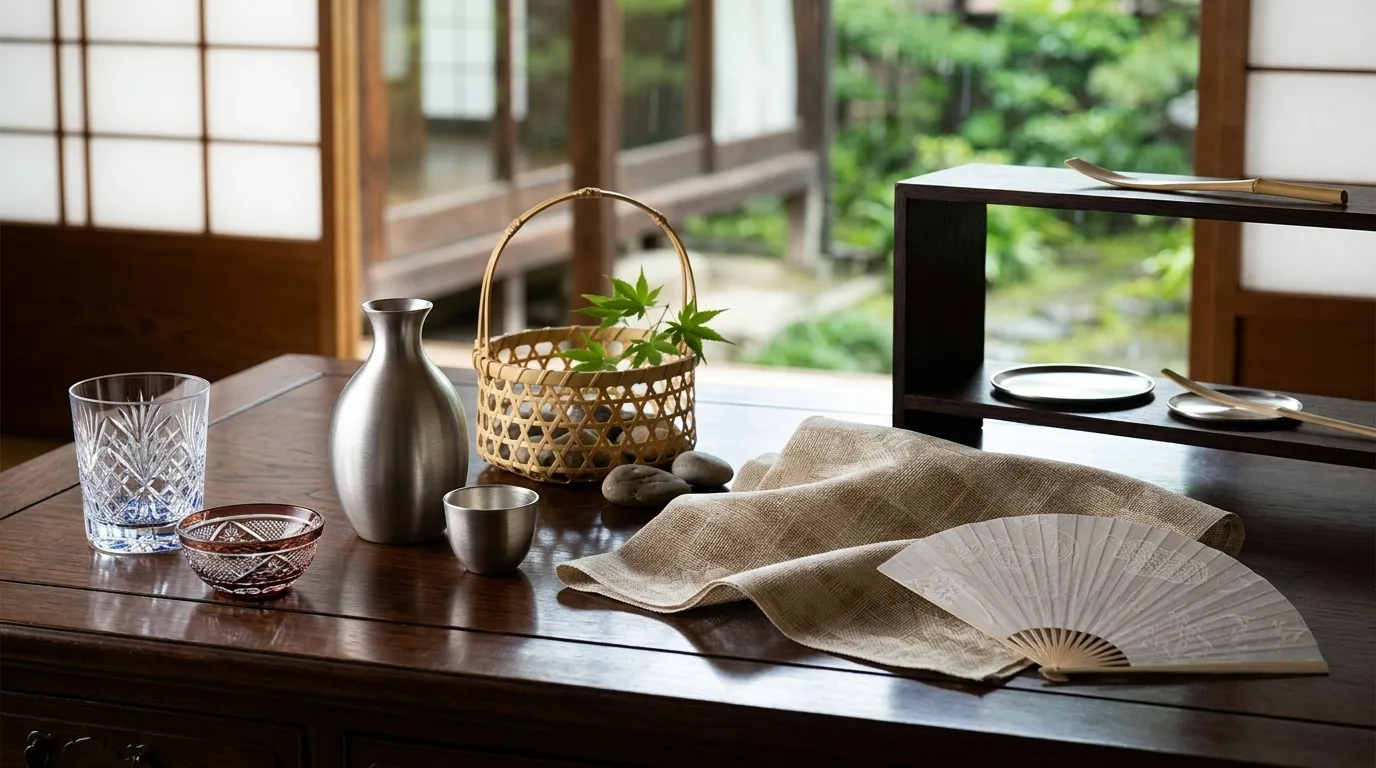
As summer approaches, more people begin looking for craft objects that carry a genuine sense of coolness. But faced with the range of options — glass, bamboo, tin, linen textiles, washi paper — it can be difficult to know where to begin.
Japanese summer craft objects are those in which the material itself — through its reflection of light, its permeability to air, its thermal conductivity, its translucency, or the play of shadow it casts — brings a sense of cool into the spaces and routines of summer living.
This article examines why each of these materials produces its particular cooling effect, how to bring them into daily life, and what to consider when introducing them into a hotel, restaurant, or commercial space — drawing throughout on the editorial perspective of Kogei Japonica.
Table of Contents
What Makes a Craft Object Feel Cool? The Different Logic Behind Each Material
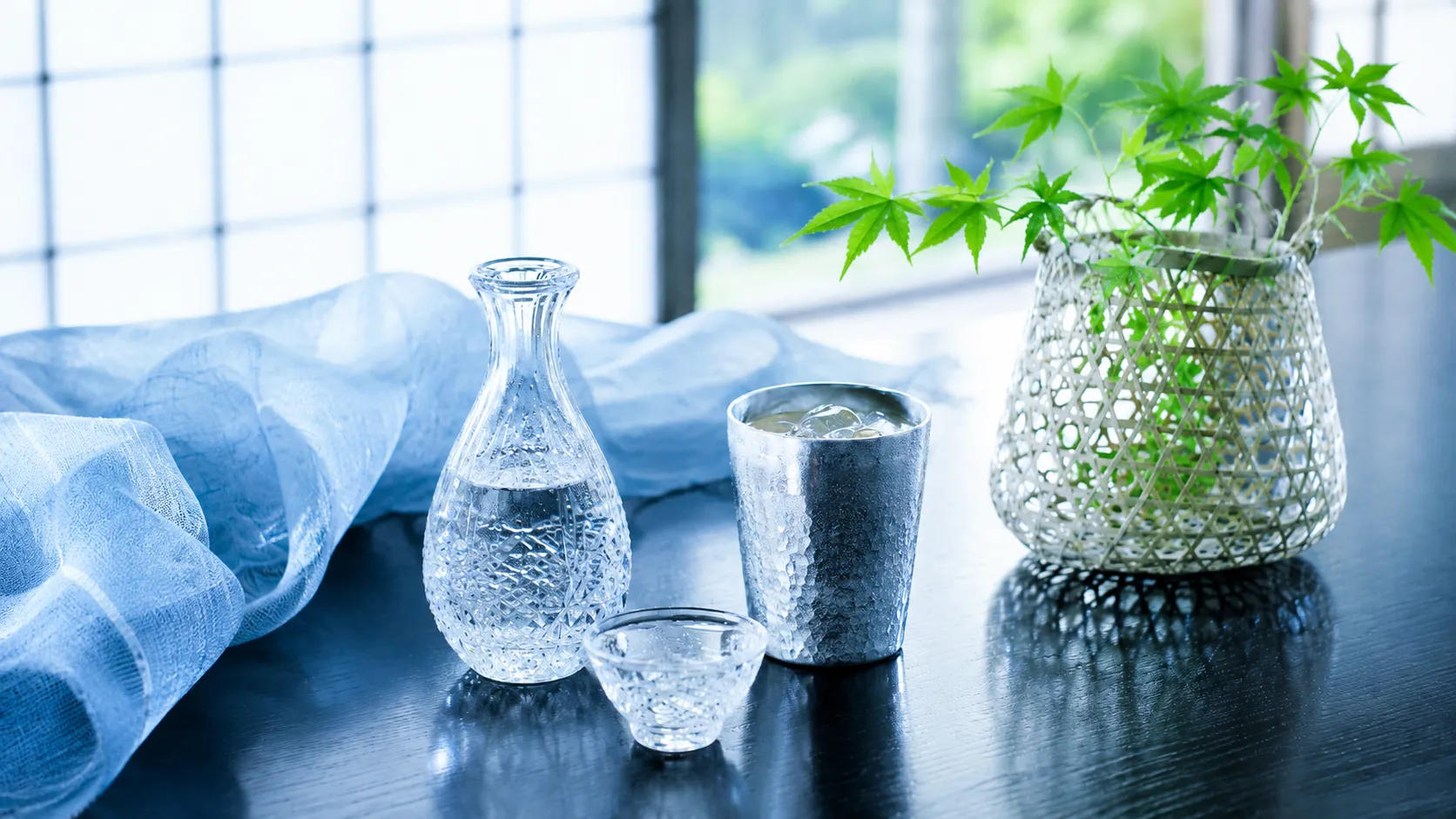
The cooling quality of these craft objects is not purely visual — each material produces its effect through its own physical properties. Glass refracts and reflects light to generate a visual sense of cool. Bamboo creates an impression of airflow and lightness through the open spaces in its weave. Tin vessels conduct cold readily: when filled with a chilled drink, the temperature reaches the surface of the vessel and passes directly to the hand.
Woven textiles and washi paper are not cool to the touch in any direct sense. Their contribution is different: the translucency of cloth or paper, the way they move, the shadow they cast, the way they diffuse light — these qualities work together to moderate the feel of an interior space.
In other words, what we often call “summer craft objects” actually includes several very different kinds of cooling effects. Knowing which kind you are actually looking for makes all the difference in choosing well.
The Difference Between Looking Cool and Functioning Cool
When choosing craft objects, “looking cool” and “actually being useful as a cooling object” are not the same thing. A glass piece with high visual transparency reads as refreshing — but glass that is not heat-resistant requires care around sudden temperature changes. Even for use with cold drinks, it is worth confirming the usage guidelines before purchasing.
Conversely, a tin vessel may look restrained and unassuming, but the cold from a chilled drink transfers quickly to the metal surface and from there to the hand — a strong and immediate physical sensation. Bamboo craft produces its cooling effect not through contact temperature but through lightness, the open structure of the weave, the movement of air it implies, and the quality of the shadows it casts.
Editor’s Note
Describing something as “cool because it’s transparent” or “Japanese because it’s bamboo” leaves the material and the maker’s time invisible. Understanding why a given material produces the sensation it does is the first step toward using craft objects well — and toward communicating their value accurately.
How Does Glass — Kiriko and Beyond — Create a Sense of Summer Cool?
Glass craft works through the transmission, reflection, and refraction of light, bringing visual coolness to a summer interior. Beyond its use as drinkware, sake vessels, dishes, and flower vases, glass has more recently been applied to lighting and interior decoration.
Among Japan’s glass craft traditions, the most recognized is kiriko — cut glass in which precise geometric patterns are ground into the surface. The two principal traditions are Edo Kiriko, from Tokyo, and Satsuma Kiriko, originating in what is now Kagoshima Prefecture in southern Japan.
Edo Kiriko produces sharp, clean reflections of light through fine surface cutting. According to the Edo Kiriko Cooperative, the tradition dates back to 1834, when a glass merchant named Kagaya Kyubei began engraving glass surfaces in Odenmacho, Edo, using a technique involving emery. Edo Kiriko was designated a Tokyo Metropolitan Traditional Craft in 1985 and a nationally designated traditional craft in 2002.


Satsuma Kiriko takes a different approach: a thick layer of colored glass is applied over clear glass, and cutting through that layer produces a gradation — color deepening toward the thickest areas and fading to near-transparency at the thinnest. According to Shimazu Satsuma Kiriko, the colored overlay glass is applied at a thickness of approximately 1 to 5 millimeters, and it is the variation in that thickness as the cut moves through the glass that generates the characteristic gradation.

Definition | Kiriko
Kiriko
Kiriko refers both to the technique of cutting patterns into glass using blades or abrasive tools, and to the glass objects produced by that technique. The principal traditions are Edo Kiriko and Satsuma Kiriko. Depending on the thickness of the glass, the presence or absence of a colored overlay, and the angle and depth of the cuts, the results range from sharp, sparkling clarity to soft color gradation.
Satsuma Kiriko Table Lamps
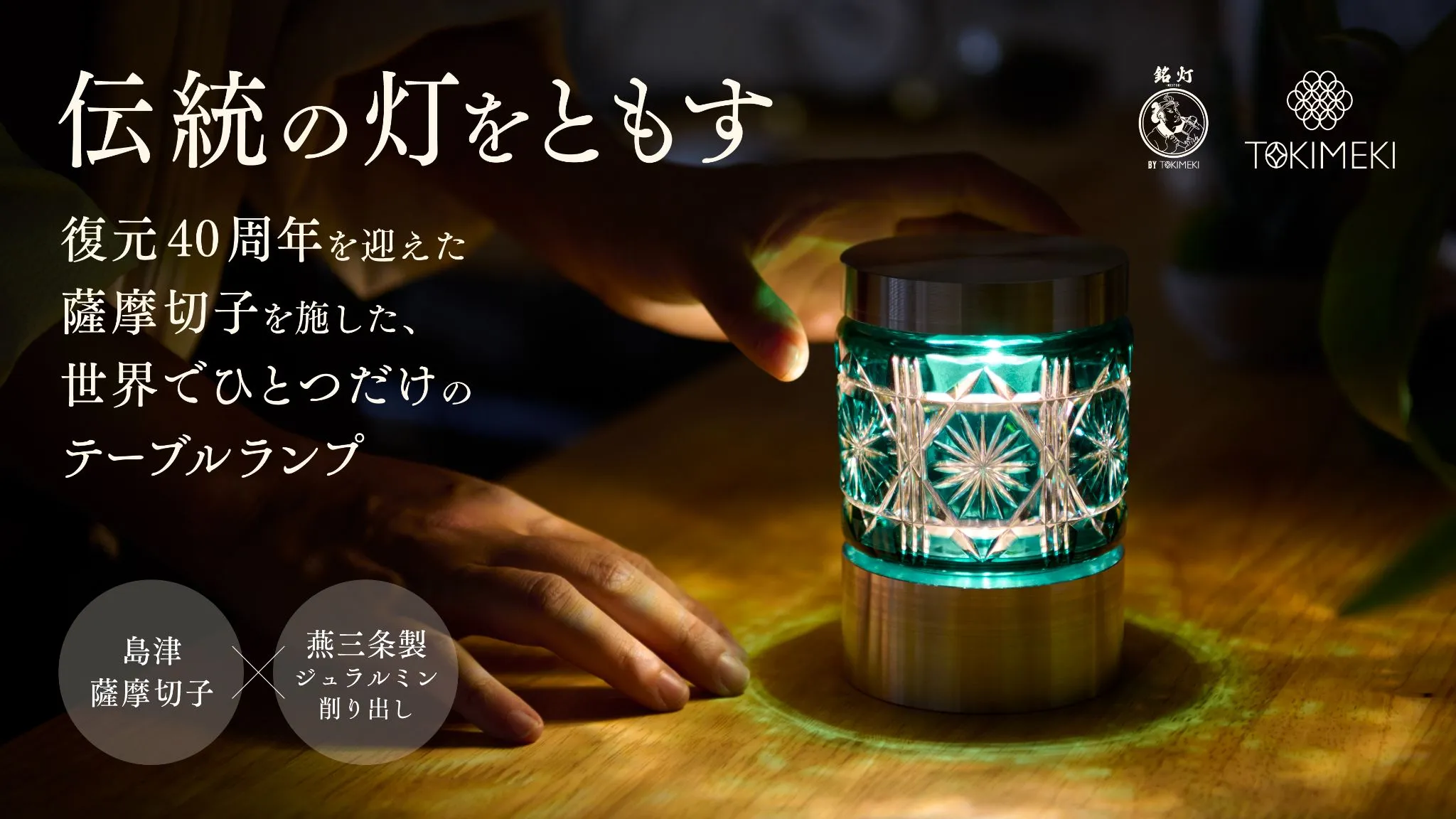
Color-overlay glass is not limited to drinkware. The quality of light passing through thick, graduated colored glass also lends itself to lighting applications. In the case of Satsuma Kiriko — with its characteristic color depth and gradation — combining the glass with a light source produces spatial effects quite different from those of an open vessel.
Kogei Japonica has covered examples of Satsuma Kiriko developed as table lamps. For those interested in using glass craft not only as tableware but as a material for interior atmosphere, the following piece is worth reading.
Why Does Bamboo Craft Suit Summer Living Spaces?
Bamboo craft brings a sense of airiness and lightness to summer interiors through its weight, its flexibility, and the open spaces in its woven structure. Bamboo itself is not cold to the touch; its cooling quality comes from a structure that does not fully block air or light, and from the way it distributes shadow.
The most significant center of bamboo craft production in Japan is Beppu, in Oita Prefecture. Beppu bamboo craft is known for the sophistication of its weaving technique. According to Beppu Bamboo Craft, the tradition recognizes eight base weave patterns, which can be combined to produce more than 200 distinct variants. The craft received its nationally designated traditional craft status in 1979, and its applications now range from everyday domestic objects to sculptural works and architectural elements including lighting and spatial installations.
What bamboo weaving does to a space is largely a matter of what it allows through rather than what it holds. A basket or flower container made from bamboo holds its contents while keeping the surrounding space unencumbered. Used as a lighting shade or a partition, bamboo does not fully block light or sightlines — it filters them, casting soft, patterned shadow.
For home use, bamboo baskets, flower baskets, trays, and small storage pieces are the most accessible entry points. In hotels and commercial spaces, bamboo is well suited to lobby displays, guest room accessories, restaurant settings, and seasonal decoration.
Definition | Kagome Weave
Kagome weave
Kagome weave is a bamboo strip weaving technique in which the strips are crossed to produce a continuous hexagonal lattice pattern. The regular spacing of the openings gives finished pieces a visual lightness and a sense of permeability. In formal craft descriptions, Beppu bamboo craft distinguishes multiple specific weave types — including mutsu-me (six-eye), yotsu-me (four-eye), and ajiro — so care should be taken to follow the terminology used by the individual workshop or production region when describing a specific piece.
What Kind of Experience Do Tin Vessels Offer?
Tin vessels are distinguished by their thermal conductivity: when filled with a cold drink, the chill transfers quickly to the surface of the vessel and from there to the hand — making them a natural choice for summer table settings, sake vessels, and corporate gifts. The cooling effect here is physical and immediate, not primarily visual.
Osaka Naniwa Suzuki — Japanese tinware produced primarily in Osaka — is a nationally designated traditional craft. According to Aoyama Square Traditional Crafts Center, its principal products include ritual and altar objects, sake vessels, tea vessels, confectionery dishes, and flower vases, with production centered in Osaka City, Matsubara City, Habikino City, and Higashiosaka City. It received its national designation on April 27, 1983.
The same source specifies that the tin purity in Osaka Naniwa Suzuki must be at least 97 percent. Tin is noted as a chemically stable metal with a history of use in sake vessels and tea caddies.
On the question of thermal conductivity, Osaka Suzuki’s own materials describe tin as a metal with high thermal conductivity — meaning that when a cold drink is poured in, the vessel cools quickly and the sensation of cold reaches the hand readily. The same property applies in reverse: hot contents will make the vessel hot. Usage accordingly requires attention to what is being served.
Tin vessels work well for chilled sake, cold tea, and beer served in summer. That said, tin is a relatively soft metal, and it is susceptible to deformation under impact or pressure. Before using any tin vessel, confirm with the maker or retailer whether it is dishwasher-safe, microwave-safe, what cleaning agents are appropriate, and how it should be stored.
Definition | Tin Vessels
Tin vessels
Japanese tinware — known as suzuki — refers to metalwork in which tin is the primary material. Objects include sake vessels, tea vessels, tumblers, dishes, and flower vases. The material’s thermal conductivity has made it a favored choice for serving cold drinks and food. Because tin is a soft metal, care in handling and maintenance is essential — always follow the guidance of the maker or retailer.
How Can Woven Textiles and Washi Paper Be Used in Summer Spaces?
Woven textiles and washi paper work through translucency, movement, permeability, and the diffusion of light — bringing a quiet, gradual quality of cool to a space rather than an immediate tactile sensation. Unlike glass or tin, they do not cool through contact; their contribution is to the overall character of a room’s light and air.
Among Japanese woven textiles suited to summer, Omi jofu stands out as a clear example — a linen cloth woven in the Koto region east of Lake Biwa in Shiga Prefecture. According to the Omi Jofu Traditional Industry Hall, Omi jofu was designated a nationally designated traditional craft by the Minister of Economy, Trade and Industry in 1977. Linen as a material is characterized by lightness, a tendency not to cling to the skin, and breathability. Beyond clothing, Omi jofu is used for noren (dividing curtains), table runners, wall hangings, and room dividers — softening the line of sight while lending a lightness to summer interiors.
For washi paper, Mino washi — produced in Gifu Prefecture — is a strong example. According to the Mino Handmade Washi Cooperative, Mino washi was designated a nationally designated traditional craft in 1985. Hon Mino-shi, the hand-laid paper variety within this tradition, was designated an Important Intangible Cultural Property in 1969, and in 2014 was inscribed as part of “Washi: Craftsmanship of Traditional Japanese Hand-made Paper” on the UNESCO Intangible Cultural Heritage list.
Washi does not transmit light in the clear, direct way glass does; it receives, softens, and diffuses it. Used in a light fitting, washi reduces harsh light to something quieter, introducing a calm shadow to a summer evening interior. It requires care around direct sunlight, high humidity, moisture, and open flame, but handled appropriately it translates readily to both residential and commercial spaces.
Kogei Japonica has also covered the character, history, and applications of Tosa washi from Kochi Prefecture — a useful reference for anyone considering washi in a living or commercial space.

Editor’s Note
The cooling quality of woven textiles and washi is not something you feel on first contact. It is something you become aware of after spending time in a room — when the light is not too sharp, when there is a sense of air moving, when the shadow of cloth or paper shifts quietly. Craft objects are not instruments for lowering temperature. They are one means of changing how time in summer feels.
Material Comparison: Glass, Bamboo, Tin, Textiles, and Washi
Each of these five materials produces its cooling effect in a different way. Comparing them across appearance, tactile quality, relationship to air and heat, care requirements, and primary uses makes selection considerably more straightforward.
| Material | Appearance / Light | Touch | Air / Thermal Properties | Care | Primary Uses |
|---|---|---|---|---|---|
| Glass craft (kiriko, etc.) | Reflections and refractions from cut surfaces; gradation from color overlay | Smooth and hard; some pieces have a cool surface feel | Requires care around sudden temperature changes | Avoid rapid heating or cooling; wash gently with mild detergent | Drinkware, tableware, flower vases, lighting |
| Bamboo craft | Woven pattern, natural material texture, shadow passing through the weave | Light and flexible | Visual sense of airflow and open space through the weave structure | Avoid excess humidity; also avoid excessively dry storage conditions | Baskets, flower containers, mats, lighting, display |
| Tin vessels | Quiet metallic sheen that deepens with use | Smooth; conducts cold and heat readily to the hand | High thermal conductivity; pairs well with cold drinks | Wipe dry with a soft cloth; handle carefully to avoid deformation | Sake vessels, tumblers, tea vessels, dishes, flower vases |
| Woven textiles (linen, etc.) | Natural weave texture, kasuri (ikat) patterning, translucency | Light; sits away from the skin | Creates a sense of airflow and visual lightness | Follow washing instructions specific to the material; dry in shade | Clothing, noren dividers, table runners, wall hangings |
| Washi paper | Fiber texture visible through the paper; soft shadow when light passes through | Thin and light | Diffuses light and moderates the brightness of a space | Avoid direct sunlight, high humidity, moisture, and open flame | Fans, lighting, art panels, interior decoration |
What this comparison makes clear is that there are at least two distinct directions to the cooling quality of these objects. One — represented by glass and tin — delivers a relatively immediate sensation through sight or touch. The other — represented by bamboo, woven textiles, and washi — works through the open structure, light, and air of a room, producing a quality of cool that accumulates over time rather than arriving at once.
Which of these matters more determines which material to choose. For cold drinks at the table, glass or tin. For making an entrance or guest room feel lighter, bamboo or textiles. For settling a summer evening interior, washi.
Home Use vs. Sourcing for Commercial Spaces: What Changes?
At home, ease of use and care requirements take precedence. In hotels and commercial spaces, durability, cleaning procedures, quantities, documentation, and end-of-season storage all need to be considered from the outset.
For home use, the approach is straightforward: choose a material that interests you, bring in one piece, and build from there. A glass bowl on the dining table, a bamboo basket holding a seasonal flower, a tin tumbler for cold tea, a washi lamp for a summer evening — these are natural points of entry.
In hotels, ryokan, restaurants, retail spaces, and offices, the context is different. Guests and customers will handle objects more frequently, and in more variable conditions. Choosing based on visual appeal alone tends to create operational complications around cleaning, breakage, storage, and reordering.
Kogei Japonica has covered the considerations involved in introducing craft objects into hospitality and commercial spaces in a separate article. Those evaluating spatial presentation or institutional sourcing will find it a useful reference.
Checklist for Home Use
- Identify which kind of cooling effect you are actually looking for — immediate tactile or visual cool, or ambient spatial cool — since this determines which material suits you.
- Confirm the care requirements for the material before purchasing: whether rapid temperature changes are permissible, which cleaning agents are appropriate, and what storage conditions are needed.
- Check whether the intended frequency of use matches the durability of the piece — everyday tableware and occasional seasonal objects call for different approaches.
- Plan where the piece will be stored after summer ends. Conditions free from direct sunlight, high humidity, and moisture are ideal for most of these materials.
- If placing objects in areas accessible to children or pets, assess the risk of breakage or tipping.
Checklist for Hotel and Commercial Sourcing
- Clarify whether the intended use involves direct guest contact, or display and decoration only.
- Establish repair and replacement routes before committing to a purchase, in case of breakage or deformation.
- Consider the practical workload for cleaning and maintenance staff.
- Plan for seasonal rotation in advance: determine where pieces will be stored off-season and who will manage them.
- Confirm quantities, lead times, reorder possibilities, explanatory signage, and whether Japanese and English labeling is available.
- Decide whether purchase, rental, temporary exhibition, or corporate gifting best suits the purpose.
Considering Japanese Crafts for a Commercial Space?
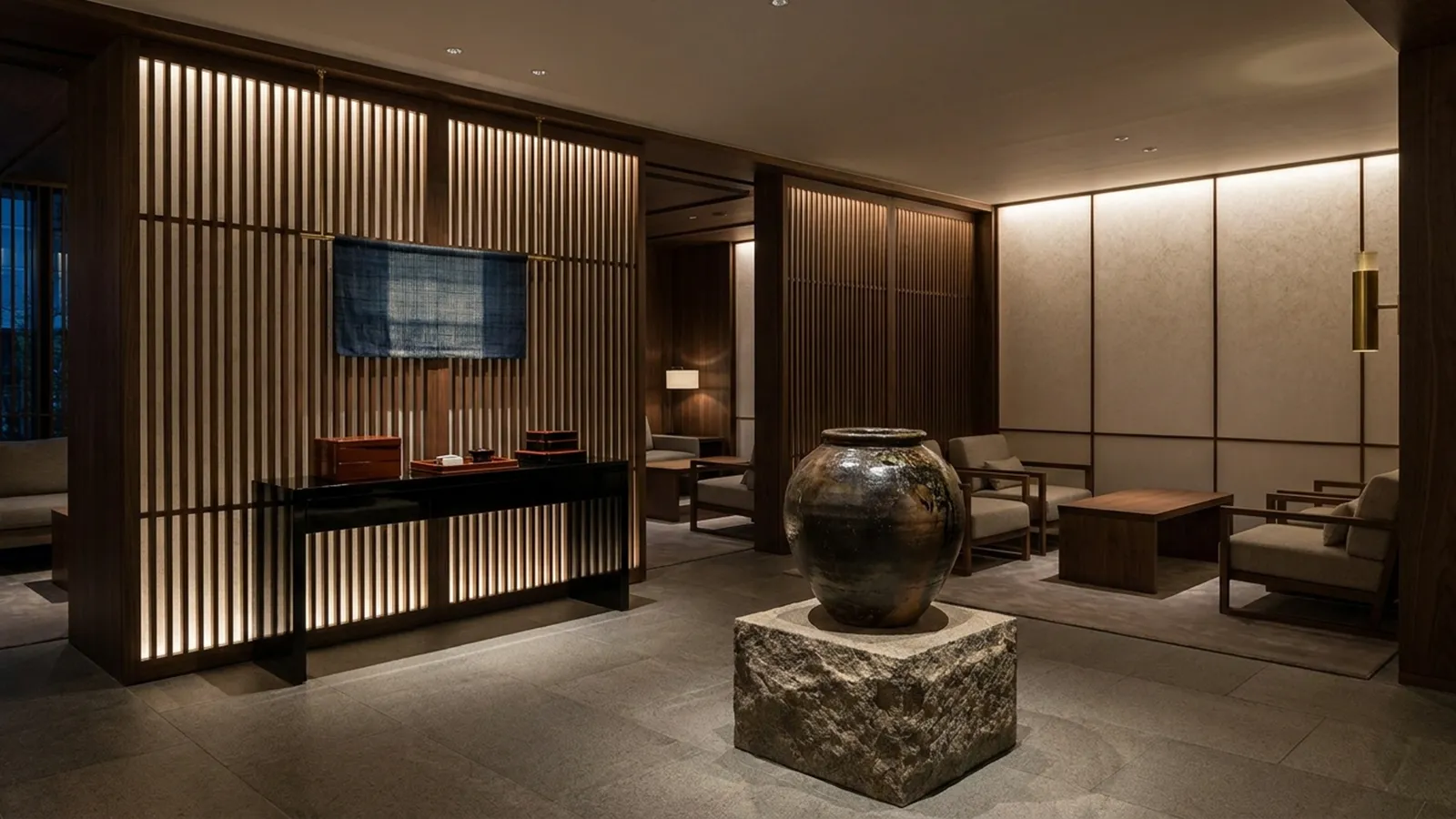
Kogei Japonica supports companies and organizations in product development, spatial presentation, branding, exhibition planning, and international communication drawing on artisan skills and regional craft heritage. Inquiries are welcome for those considering summer craft objects for a space — from material selection and coordination with makers and workshops, through to craft rental, corporate gifts, and commemorative commissions.
Craft rental also makes it possible to assess how a piece works in a specific space before committing to a purchase. The following article covers staged introduction of craft objects into hotel, office, event, and retail settings.
Frequently Asked Questions
When selecting Japanese summer craft objects, understanding the reasoning behind each material’s cooling effect, its care requirements, storage, sourcing for commercial spaces, and suitability as a gift will help narrow the choice considerably.
- Q1. Why do these craft objects feel cool?
- The reason differs by material. Glass works through the reflection and refraction of light. Bamboo works through the open structure of its weave and the visual lightness this creates. Tin vessels conduct cold from chilled contents to the surface and to the hand. Woven textiles and washi paper work through translucency, the diffusion of light, and the way they moderate the character of a space.
- Q2. What care does each material require?
- For glass: avoid rapid temperature changes and wash gently with mild detergent. For bamboo: keep away from excess humidity, and avoid excessively dry storage conditions. For tin: wipe dry with a soft cloth and handle carefully to avoid deformation. For woven textiles: follow the washing instructions for the specific material and dry in shade. For washi: avoid direct sunlight, high humidity, moisture, and open flame.
- Q3. How should summer craft objects be stored at the end of the season?
- The general principle is to avoid direct sunlight and high humidity and to store in a well-ventilated space. Bamboo and washi can be sensitive to humidity, so storage conditions matter. Glass and tin should be stored with protection from contact with other objects to prevent damage.
- Q4. Which craft objects are most manageable in a small or single-person home?
- A small glass vessel, a bamboo storage piece, a tin tumbler, or a small washi lamp or hand fan can each be introduced as a single piece without difficulty. Starting with something whose function is already clear — tableware, an item for the entrance, a bedside object — tends to be the most direct approach.
- Q5. Where should an organization go to source craft objects for a hotel or commercial space?
- It helps to clarify the purpose, location, quantities, lead times, budget, and maintenance capacity before beginning. From there, approaching individual makers, workshops, galleries, or organizations that support institutional craft sourcing is the most productive route. Kogei Japonica is available for consultation on spatial presentation and sourcing for commercial spaces.
- Q6. How should pricing be understood for these objects?
- Prices vary considerably depending on the maker, workshop, material, production process, scale of production, and distribution channel. This article does not provide specific pricing. For current pricing, consult workshops, regional craft associations, or authorized retailers directly.
- Q7. What should be considered when choosing craft objects as corporate gifts?
- It is worth thinking through the recipient’s circumstances — the practicality of care requirements and the durability of the object in a real use environment. Quantities, lead times, packaging, noshi gift wrapping, personalization, explanatory notes, and whether international shipping is available should all be confirmed in advance.
This article has examined five materials — glass, bamboo, tin, woven textiles, and washi paper — and the distinct reasoning behind the cooling quality of each.
What the editorial team at Kogei Japonica wants to emphasize is that choosing a summer craft object is not simply a matter of acquiring something that looks cool. It is a question of how to bring into a home or a working space something shaped by the climate of a particular place, the knowledge of particular makers, and the long use that has refined it. The thinking that goes into that choice — for a single piece on a dining table, or for the seasonal presentation of a hotel lobby — is ultimately the same.
The cooling quality of these objects is a way in. What it opens onto is a more considered relationship with the materials and the people who make them — which is the foundation of using craft objects well and keeping them for a long time.
Kogei Japonica will continue to organize the specific qualities of individual materials and the knowledge of their producing regions from primary sources, for readers who use and live with these objects and for the professionals and organizations who work with them.
