

Many people who come across the figure “the global bonsai market is worth ¥3 trillion” are struck by the scale. Interest in bonsai abroad is certainly growing, but if you intend to use a market-size figure in a business plan or a proposal, you need to check its scope and source carefully.
The short answer: “¥3 trillion” is not a current official market size. It is a yen conversion of a private research firm’s forecast for the early 2030s. Because each firm defines and estimates the market differently, the figure cannot be treated as a settled market size.
At the same time, bonsai is not a product that begins and ends with the tree. It is an ecosystem of time and craft, in which cultivation by a bonsai grower, the bonki (bonsai pot), the shoku (display stand), pruning and training tools, transport, display, and maintenance all work together.
This article verifies the figures behind the global bonsai market, then sets out the cultural foundation supporting overseas demand, the surrounding crafts starting with the bonsai pot, and how bonsai can be introduced into hotels, retail spaces, and private residences.
Table of Contents
Is the Global Bonsai Market Really Worth “¥3 Trillion”?
“¥3 trillion” is one example of a forecast, not an official statistic showing the current bonsai market. When citing it, you need to state the forecast year, the currency, and the scope of the market alongside it.
Where Does the “¥3 Trillion” Claim Come From?
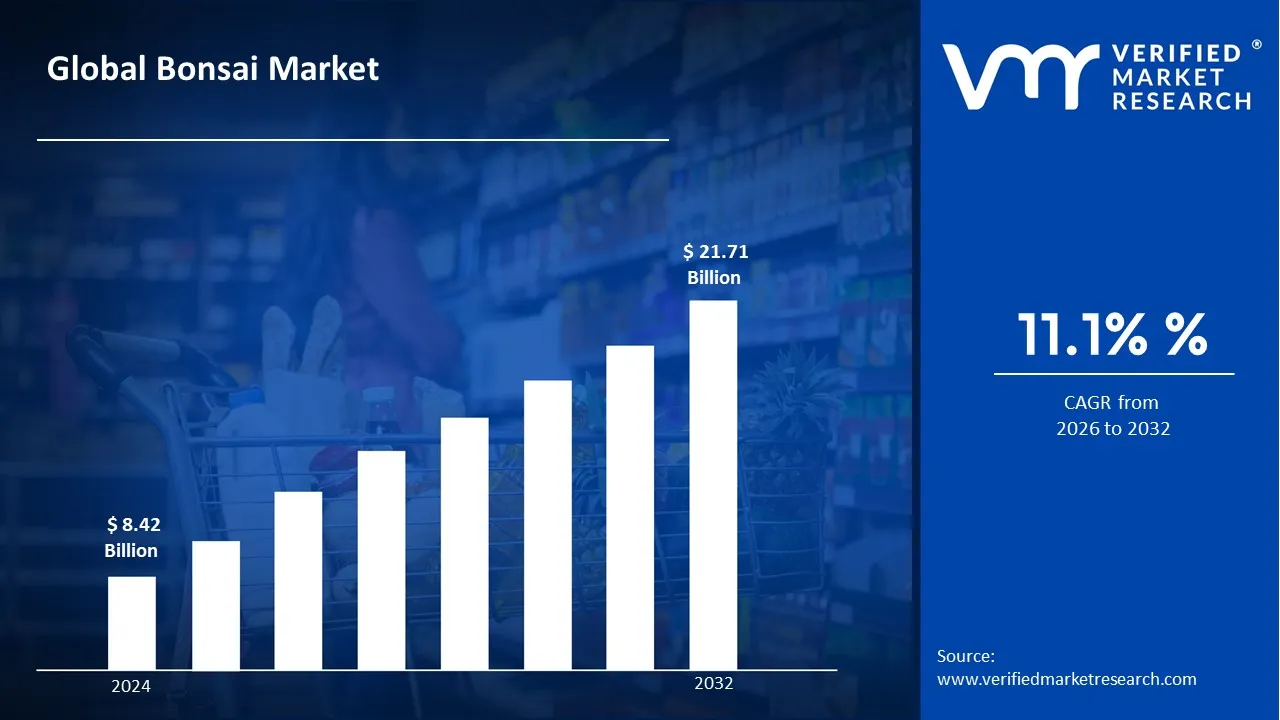
The explanation seen in Japan that “the bonsai market will grow to around ¥3 trillion” originates in articles that introduced overseas private market research converted into Japanese yen.
Verified Market Research publishes a forecast for the global bonsai market rising from $8.42 billion in 2024 to $21.71 billion in 2032, at a compound annual growth rate of 11.1%. The yen equivalent changes with the exchange rate, but this 2032 forecast is one of the bases for the “around ¥3 trillion” description.
(Source: Bonsai Market Size and Forecast — Verified Market Research)
In Japan it has also been presented as growth from around ¥1.3 trillion in 2023 to around ¥3 trillion in 2032. This, too, is a forecast based on a private report, not an actual figure compiled by a public institution.
(Source: The Global Bonsai Market Expands to ¥1.3 Trillion — @DIME)
Reading Market-Size Figures with Care
The phrase “¥3 trillion market” alone doesn’t tell you whether it is a current value or a forecast, or whether it counts only trees or also pots, tools, and services. In internal documents and proposals, it is important to present the research body, base year, forecast year, currency, and scope together as a single set.
Why the Figures Differ So Widely Between Research Firms
The main reason the figures differ between firms is that there is no standardized, official definition of the “bonsai market.” Estimates change depending on how far the count extends — beyond the bonsai itself to pots, tools, fertilizer, cultivation services, and distribution.
Moreover, the public pages of private reports alone may not let you confirm the survey scope, sample size, sales channels, or how regional data was compiled. When comparing forecasts against one another, you need to look at the transparency of the survey conditions rather than the size of the numbers.
Comparison Table ①: Bonsai Market-Size Forecasts by Major Research Firms
| Source | Base-year estimate | Forecast-year estimate | CAGR | Points to note |
|---|---|---|---|---|
| Verified Market Research | 2024 $8.42 billion |
2032 $21.71 billion |
11.1% | Close to the “around ¥3 trillion” claim. A private estimate; the yen equivalent fluctuates with exchange rates |
| KD Market Insights | 2023 $10.32 billion |
2032 $27.61 billion |
12.3% | A larger estimate than Verified Market Research. The methodology should be reviewed carefully |
| Business Research Insights | 2026 $14.27 billion |
2035 $36.8 billion |
11.1% | The base and forecast years change as the public page is updated, so the point of citation must be stated |
| MAFF, “The Current State of Floriculture” | 2024 Domestic bonsai output of ¥910 million |
No forecast | N/A | Official statistics on domestic production in Japan. Its scope differs from global market forecasts |
(Source: Bonsai Market Size and Forecast — Verified Market Research)
(Source: Bonsai Market Research — KD Market Insights)
(Source: Bonsai Market Size and Growth Forecast — Business Research Insights)
(Source: The Current State of Floriculture — Ministry of Agriculture, Forestry and Fisheries)
For reference, the combination previously cited for Business Research Insights — “$8.42 billion in 2023, $217.1 billion in 2032” — does not reconcile with a compound annual growth rate of 11.1%. Because it also differs from the current public page, this article does not adopt it.
How Does the Bonsai Market Look in Japan’s Official Statistics?
What Japan’s official statistics show is mainly domestic production and the practicalities of exporting bonsai as plants. Because their scope differs from global market forecasts, the two cannot be compared directly.
Actual Domestic Shipment and Export Figures
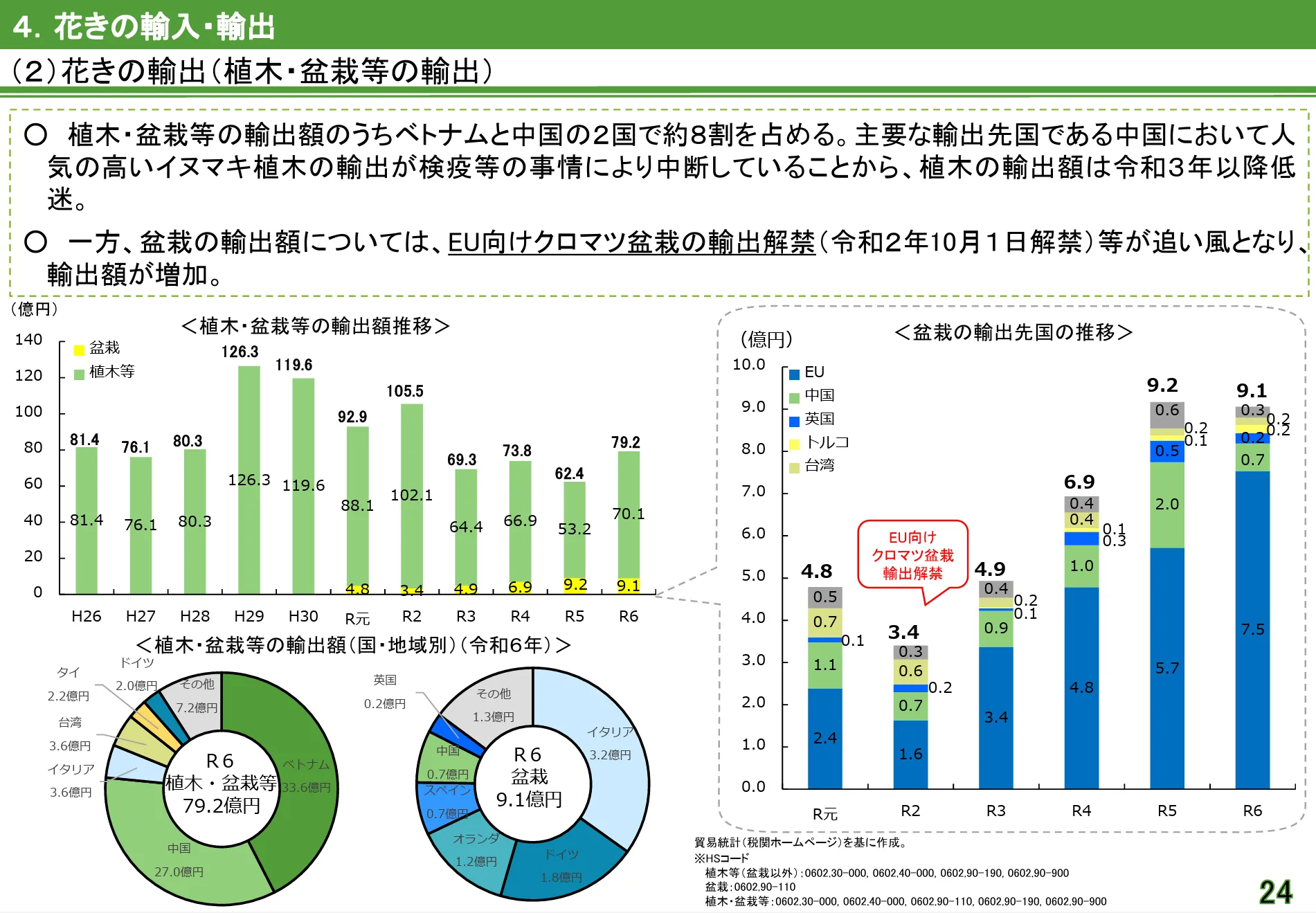
According to the Ministry of Agriculture, Forestry and Fisheries’ “The Current State of Floriculture,” the 2024 output for “potted plants (including bonsai)” was ¥7.92 billion, of which bonsai accounted for ¥910 million. This is a statistic on domestic production, and does not include bonsai pots, pruning tools, maintenance services, or bonsai produced and sold overseas.
(Source: The Current State of Floriculture — Ministry of Agriculture, Forestry and Fisheries)
A survey of bonsai nurseries that MAFF published in 2015 estimated domestic shipments at roughly 111,000 pots worth about ¥800 million, and overseas shipments at roughly 44,000 pots worth about ¥400 million.
That survey, however, covered 473 bonsai nurseries nationwide and estimated the total by simply doubling the results of a roughly 50% response rate. It is better read as a reference for understanding the distribution structure at the time, rather than as a statistic showing the current market size.
(Source: Survey Results on Bonsai Exports — Ministry of Agriculture, Forestry and Fisheries)
The ¥910 million domestic output figure and the multi-trillion-yen global market forecast are not contradictory; they count different things. The former is a domestic production statistic for Japan, the latter a private estimate that includes overseas activity.
The Practical Hurdles of Bonsai Export (Quarantine and Regulation)
Exporting a living bonsai overseas requires plant quarantine. Conditions differ by destination country or region, tree species, and cultivation method, and inspection at the growing site or an export inspection may be required.
The Plant Protection Station provides guidance on inspection conditions by tree species and application timing for exporting bonsai and garden trees to the EU, the UK, and elsewhere. Because conditions can change, the latest information must be checked case by case.
(Source: On Exporting Bonsai and Garden Trees — MAFF Plant Protection Station)
Entering an overseas market is not only a matter of shipping finished bonsai from Japan. Other approaches are possible: combining trees grown locally with Japanese bonsai pots, having a bonsai grower supervise on site, or providing display techniques and maintenance training.
The cross-border movement of plants carries quarantine constraints, but pots, stands, tools, cultivation knowledge, and display design operate under different conditions. It is important to see bonsai not as a single product, but as a value chain made up of several specialist fields.
What Crafts Actually Support Bonsai? (The Ecosystem of Pots, Stands, and Tools)
The value of bonsai emerges from the relationship between the tree, cultivation technique, the pot, the stand, the tools, and the display environment. It is a composite expression, updated over time, rather than a plant on its own.
The Bonki (Bonsai Pot) — Tokoname Ware as One Option
The bonki is a container that holds the tree, and at the same time a craft object that supports both its growing environment and the visual composition. Drainage, air permeability, the depth of the pot, its proportion to the tree’s form, and even the color of the clay surface and glaze all affect the tree’s condition and how it is seen.
Tokoname-yaki, made in and around the city of Tokoname in Aichi Prefecture, is a traditional craft designated by the Minister of Economy, Trade and Industry. It is a production area that has produced a wide range of goods in response to the demand of each era — large jars, teapots, clay pipes, architectural ceramics — and is also known for making planters and bonsai pots.
(Source: Tokoname Ware — Association for the Promotion of Traditional Craft Industries)
That said, asserting that a particular technique used in Tokoname ware is “unique to Tokoname” requires confirmation from the local cooperative or the makers. When introducing a bonsai pot, it is better to check not only the production area name but also the forming method — wheel-throwing, molding, hand-building — as well as firing, the presence of glaze, and the maker’s intent, each individually.
Bonsai pots include the work of contemporary makers, practical pieces produced in production areas, and antique bonki with a long history of circulation. Price and reputation cannot be set uniformly. The maker, the period of production, the state of preservation, the provenance, and the suitability for the tree all need to be assessed separately.


Bonsai Tools — The Connection to Blade-Making Regions
Maintaining and training bonsai calls for tools suited to specific tasks — pruning shears, branch cutters, wire cutters, and root cutters, among others. The shape of the blade and the cut surface affect not only ease of work but also the strain placed on the tree.
Banshu Miki uchihamono, forged blades centered on the city of Miki in Hyogo Prefecture, are a traditional craft designated by the Minister of Economy, Trade and Industry. The designated items, however, are saws, chisels, planes, trowels, and small knives, so describing bonsai shears themselves as a designated item would not be accurate.
(Source: Banshu Miki Uchihamono — Miki Hardware Cooperative Federation)
What matters here is not confusing a region’s reputation with the scope of what is officially designated. When choosing bonsai tools, don’t judge by the single phrase “it’s a traditional craft”; check the intended use, the steel, the blade adjustment, and whether repair and sharpening are supported.
Glossary Box: Bonki, Bonsai Stand, and Training
Bonki
The pot in which bonsai is planted. In English it is generally called a “bonsai pot.” Beyond its appeal to the eye, it has the function of supporting drainage, air permeability, and root growth.
Bonsai stand (bonsai-shoku)
A stand for displaying bonsai. Also called shoku, it is described in English as a “bonsai display stand.” It relates to techniques such as woodwork, sashimono (fitted joinery), and lacquer art.
Shitate (training)
The ongoing process of shaping a tree’s form while keeping it healthy, through pruning, bud-pinching, leaf-cutting, wiring, and repotting. It is a concept that the English word “pruning” alone cannot fully convey.
Baiyō (cultivation)
The overall care needed to grow bonsai in good health and maintain it as a work. It includes watering, fertilizing, light exposure, repotting, and pest and disease control.
How Realistic Is Bonsai Installation in Hotels, Retail Spaces, and Residences?
Installing bonsai in a space is possible, but it must not be kept there permanently in the way an indoor ornament is. Before considering how to buy, you need to plan for sunlight, watering, outdoor recovery, rotation, and emergency response.
A Case in Point: Using Bonsai Art in Hotels
Some individual cases involving hotels and commercial facilities are introduced only through press releases on ad-distribution services and cannot be confirmed on the facility’s own website. When publishing such cases as installation track records, confirmation from the facility, the maker, and the manager is essential.
For that reason, we avoid generalizing the effect or the work’s price at a specific hotel from public information alone. A living bonsai and a sculptural work reconstructed from materials such as deadwood should not be treated as the same thing either. The former is a plant requiring continuous cultivation; the latter is an art or decorative object whose care conditions vary with its materials and method of making.
A useful reference for management in public spaces is the practice of the Omiya Bonsai Art Museum, Saitama. The museum’s annual report notes that, in its collection gallery, bonsai are rotated and displayed weekly with cultivation in mind. Separating indoor display from outdoor cultivation is an important idea that can also be applied to hotels and shops.
(Source: Omiya Bonsai Art Museum Annual Report — Omiya Bonsai Art Museum, Saitama)
Editor’s Note
When bringing bonsai into a space, the first thing to choose is neither the species nor the pot.
What has to be decided first is who takes responsibility for keeping it alive. Bonsai is not a finished ornament but a living thing whose condition changes day by day. Only when the design extends to the operation that takes on that time does the relationship between a space and its bonsai actually hold together.
Checkpoints When Considering Installation
If you are handling bonsai in a hotel, shop, office, or residence, confirm at least the following before installation.
- Display period: permanent, or a short-term display during an event
- Sunlight conditions: whether direct light, window orientation, and the number of hours under artificial lighting alone can be confirmed
- Temperature, humidity, and air conditioning: whether drafts from heating and cooling and sudden drying can be avoided
- Watering: whether the person responsible, the frequency, the drainage method, and closed-day coverage are set
- Outdoor recovery: whether the tree can be returned to a suitable environment while not on display
- Rotation system: whether works can be swapped according to season and vigor
- Maintenance contract: whether the scope of periodic visits, pruning, repotting, and pest and disease response is clear
- Pot and stand: whether tree growth, safety, and harmony with the space have been considered together
- Delivery route: whether weight, stairs, elevators, protective covering, and the load capacity of the display stand have been checked
- Incident response: whether the division of responsibility is defined for tipping, broken branches, water leakage, theft, and loss of the tree
- Interpretive labeling: whether the species, maker, pot, and manager can be communicated appropriately
- Photography and publicity: whether the terms of use for the maker’s name and images of the work have been confirmed
Purchase, short-term rental, and periodic-rotation rental each carry a different cost structure and management responsibility. Choose according to the display period and operating setup.
| Method | Suited to | Main advantage | Points to check |
|---|---|---|---|
| Purchase | Residences, symbolic permanent spaces | Easier to build a long-term relationship | Annual maintenance, repotting, response if the tree is lost |
| Short-term display / event rental | Events, seasonal displays, photo shoots | Can be introduced for a limited period | Delivery in and out, insurance, care during display |
| Periodic-rotation rental | Hotels, shops, offices | Balances a sense of season with tree vigor | Rotation frequency, maintenance scope, emergency response |
| Local trees paired with maker’s pots | Overseas facilities, long-term projects | May reduce the burden of plant quarantine | Local growers, tree species, shipping conditions for the pots |
The Kokufu Bonsai Exhibition and Omiya Bonsai Village: Bonsai Culture Today
As international recognition rises, Japan faces the challenge of passing on both its practitioners and its growing environment. The 100th anniversary of the Omiya Bonsai Village in 2025 and the 100th Kokufu Bonsai Exhibition in 2026 became occasions to consider both sides.
The Milestone of the 100th Kokufu Bonsai Exhibition
The Kokufu Bonsai Exhibition is a long-running exhibition whose first edition was held in 1934. According to the Nippon Bonsai Association, which organizes it, the 100th edition was held in 2026 at the Tokyo Metropolitan Art Museum. The first period ran from February 8 to 11, and the second from February 14 to 18.
(Source: Kokufu Bonsai Exhibition Information — Nippon Bonsai Association)
The Nippon Bonsai Association was established in 1965 and works on promoting, surveying, and registering bonsai culture, including through the Kokufu Bonsai Exhibition.
(Source: About the Nippon Bonsai Association — Nippon Bonsai Association)
When describing a specific edition’s number of display spaces, the bonsai entered from the Imperial Household Agency collection, or the judging criteria, however, confirmation from that year’s official catalogue or entry guidelines is needed. Descriptions of past editions should not automatically be applied to the 100th exhibition.
What the Kokufu Bonsai Exhibition shows is that bonsai is not judged by the rarity of the tree alone. Long-term cultivation, tree form, season, the pot, the stand, the tenpai (accent display pieces), and the relationship with the display space are presented together as a single scene.
The Omiya Bonsai Village Centenary and the Challenge of Succession
The Omiya Bonsai Village was formed in 1925, in part when bonsai businesses from Tokyo relocated after the Great Kanto Earthquake. In 2025 it marked its 100th anniversary, and the City of Saitama held commemorative programs.
(Source: 100th Anniversary of the Omiya Bonsai Village — City of Saitama)
Information the City of Saitama published in 2024 explains that the bonsai nurseries, once more than 30, numbered six at the time of the announcement. The aging of nursery owners and the shortage of successors are problems to be faced separately from the growth of overseas demand. Because the number can change, it should be treated as information as of the 2024 announcement rather than fixed as “currently six nurseries.”
(Source: Efforts Toward Passing On Omiya Bonsai — City of Saitama)
The crowdfunding-style hometown-tax program announced at the same time was a limited-period initiative in 2024. It cannot be presented as though it is still accepting support. If you are considering support, check the latest information from the City of Saitama.
The Omiya Bonsai Art Museum, Saitama collects and displays not only bonsai but also pots, suiseki (viewing stones), ukiyo-e, and historical materials. It is a facility where bonsai can be studied not only as a plant but as a body of display culture and material culture.
(Source: Omiya Bonsai Art Museum, Saitama — Official Site)
Editor’s Note
The growth forecasts for the global market and the succession problem facing bonsai nurseries in Japan do not necessarily point in the same direction.
Even if demand rises, the cultural foundation will not grow stronger unless the profit returns to the land, time, and people that cultivation requires. To speak of bonsai as a global collectible culture, you have to look all the way to who grows it, who maintains it, and who passes the technique on to the next hands.
Frequently Asked Questions
Here are concise answers to the questions that commonly arise when searching for information on the bonsai market, spatial installation, and overseas export.
- Q. Is the global bonsai market really worth ¥3 trillion?
- A. It is not a current official market size. It is a private research firm’s forecast for the early 2030s converted into yen. Estimates and market definitions differ between firms.
- Q. Why do bonsai market forecasts differ between research firms?
- A. Because there is no consistent standard for whether the count includes only trees, or also pots, tools, fertilizer, distribution, and maintenance services. Differences in survey method and target regions also have an effect.
- Q. How large is the domestic bonsai market in Japan?
- A. In MAFF materials, 2024 bonsai output was ¥910 million. This is not a figure for the whole market including pots, tools, maintenance, and secondary distribution, however.
- Q. How should I choose a bonsai pot?
- A. Beyond how it looks with the tree’s form, check the tree species, the state of the roots, drainage, air permeability, the depth of the pot, and the installation environment. For maker’s works and antique bonki, evaluate the maker, provenance, and condition separately.
- Q. Can bonsai be kept permanently indoors in a hotel or shop?
- A. Not every bonsai is suited to permanent indoor display. You need to plan for sunlight, air conditioning, watering, and outdoor recovery, and put in place a specialist management system that includes periodic rotation.
- Q. Which is more suitable, purchase or rental?
- A. Purchase is a candidate if you can take on long-term ownership and annual maintenance; short-term or periodic-rotation rental is a candidate if you want seasonal display or to adjust the maintenance burden.
- Q. Can bonsai be exported overseas?
- A. It can be in some cases, but plant quarantine appropriate to the destination country, tree species, and cultivation situation is required. Confirm the latest conditions with the Plant Protection Station and the importing country’s authorities before any contract or shipment.
- Q. Is it safe to buy bonsai as an investment product?
- A. Future appreciation and liquidity are not guaranteed. It is more appropriate to check the state of cultivation, provenance, maintenance costs, and transport risk, and to decide with appreciation and stewardship as the main aim.
- Q. Are there ways for companies to support bonsai culture?
- A. Options include entrusting management to a bonsai nursery, adopting maker’s pots, supporting exhibitions, spatial display, training, and overseas outreach. Beyond one-off purchases, a design in which payment reaches cultivation and the passing-on of technique on a continuing basis is preferable.
Summary
The figure “the global bonsai market is ¥3 trillion” is not a settled current value but one of the forecasts made by a private research firm. When citing a forecast, you must state the research body, base year, forecast year, currency, and scope of the market.
Growing overseas interest in bonsai is also not the same thing as sustainable profit returning to Japan’s production areas and nurseries. Only when plant quarantine, long-term cultivation, maintenance, and the succession of practitioners are all included can market growth be connected to the durability of the culture.
Bonsai is neither a mere plant nor a symbol that adds a “Japanese” impression to a space. It is a craft ecosystem that holds together through the time a bonsai grower designs, the pot a ceramicist makes, the stand made by woodwork and lacquer art, the tools of metalwork and blade-making, and daily care.
At Kogei Japonica, rather than presenting large market forecasts as an attraction in themselves, we look at who is working with their hands inside those figures, and what techniques and relationships support the value. When considering installation in a hotel, shop, or residence too, the starting point is not only selecting the work, but building a structure in which respect for the bonsai grower and the makers shows in the operation and the payment.
For companies and design professionals considering spatial design with bonsai and crafts
When introducing bonsai into a hotel, ryokan, shop, office, or residence, the work itself is only one part of the design: the display period, maintenance, rotation, and the combination with pots and stands all need to be planned together. Kogei Japonica / ARTerrace welcomes inquiries on craft rental, spatial design, collaboration with makers and workshops, and overseas outreach. Even before the installation conditions are settled, please start by consulting us on organizing your goals and operational challenges.