

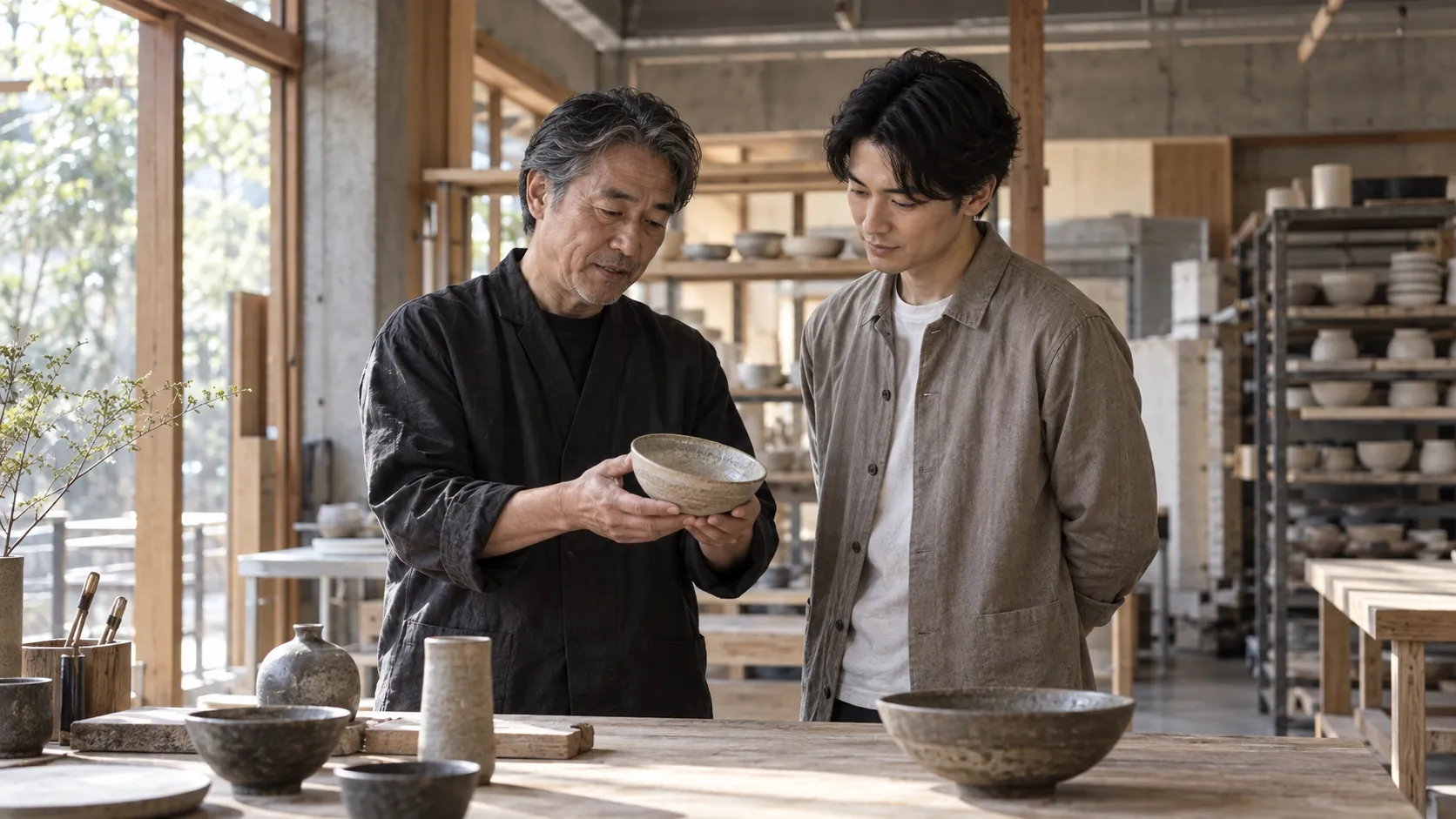
“I need to start thinking about what happens to this workshop after me.” Many workshop owners reach that thought and then stall, because it is not obvious what business succession actually covers, or where to begin.
What passes down in a craft workshop is not only technique. Equipment, material suppliers, clients and trading partners, production records, contracts and reputation — the resources that keep a workshop running as a business — all have to be considered.
This article sets out how skills transfer and business succession relate to one another, the four areas most often overlooked on the workshop floor, what can be prepared before a successor is decided, succession to a third party, and the public offices available for advice.
Table of Contents
What is craft business succession, and how does it differ from skills transfer?
Skills transfer is one essential component of business succession. But carrying a workshop into the next generation means handing over more than craft skills: the equipment, materials, people, clients, contracts and reputation that allow those skills to function as work.
Skills transfer (passing on the craft)
Skills transfer means passing on the technical ability and judgement required to make the work — handling the wheel, mixing glazes, carving, weaving, polishing, dyeing — to the next maker.
What is being passed on is not simply a set of steps to memorise. It includes tacit knowledge, which resists being written down: how to read the condition of a material, where the line falls between acceptable and rejected work, how to adjust a process for temperature and humidity.
The Association for the Promotion of Traditional Craft Industries runs training sessions for people working in production regions, including new entrants, as part of its successor development programme; participants learn from the techniques and working practices used in craft-producing regions other than their own. Delivery of the programme has been announced for the 2026 financial year, with opportunities to encounter methods and approaches across regional boundaries.
(Source: Public call for secretariat services: FY2026 successor development programme, regional workers’ training sessions | The Association for the Promotion of Traditional Craft Industries)
Training of this kind offers more than technical instruction. It also exposes participants to how other craft-producing regions work, and to how they think about sustaining their industry.
Editor’s Note
When a workshop documents its making, recording finished pieces and hand movements is not enough. What matters is whether the reasoning behind decisions survives: why the work stops at this point, why this material rather than another. The smaller the judgement, the more habitual it has become for the person making it — and the less visible it is to whoever comes next.
Business succession (passing on business assets)
Business succession covers not only craft skills but the resources that allow the business to keep operating.
The Small and Medium Enterprise Agency frames the resources transferred through succession in terms of people (management), assets, and intangible assets. For a craft workshop, that means technical know-how, relationships with trading partners, client information and reputation all form part of the value of the business, alongside equipment and capital.
(Source: Business succession support measures | Small and Medium Enterprise Agency)
A successor may be able to make the same work and still be unable to run the workshop in the same way — not knowing where the materials are bought, who can repair the kiln or the machinery, or what terms have been agreed with key wholesale clients.
If skills transfer enables someone to make the work, business succession must also ensure that the workshop itself can continue to operate.
What needs to be handed over? Four categories to review
The items requiring attention differ from workshop to workshop. This article concentrates on the four that most often depend on a single person in craft production: equipment, material suppliers, clients and trading partners, and production records.
| Category | Main items to check | Easily overlooked |
|---|---|---|
| Equipment | Kilns, machinery, tools, moulds, jigs, repairers | Modifications and habits of use |
| Material suppliers | Raw materials, suppliers, order quantities, quality standards | Why that supplier was chosen; whether alternatives exist |
| Clients and trading partners | Clients, wholesalers, galleries, department stores | How the relationship began, agreed terms, handling of personal data |
| Production records | Ratios, dimensions, drawings, processes, photographs, video | Judgement criteria, failures, seasonal adjustments |
Equipment
Kilns, wheels, looms, polishing machines, carving tools. Simply listing the equipment is not enough.
Equipment used over many years often carries adjustments or modifications made within the workshop itself. Purpose-built jigs, moulds and custom parts cannot always be reproduced by buying a replacement.
For the main items, it is worth recording not only manufacturer and model number but how the equipment is used, where it has been adjusted, why modifications were made, which parts are replaced, and who carries out repairs and maintenance.
Where technical refinements are built into the equipment itself, what needs to survive is not only the tool but the reasoning that brought it to its present form.
Succession may also require equipment to be valued, ownership to be transferred, or lease agreements to be amended. The procedure varies with the type of equipment and the form of succession, so it is sensible to work through it with a tax accountant, another professional, or a public advisory office.
Material suppliers
Craft production often depends on materials from particular regions, or specified to particular quality conditions. Some workshops have dealt with the same merchant, producer or wholesaler for decades.
Names and telephone numbers are therefore only the surface. Why a material is chosen, and what quality is being ordered against, matter just as much.
It is worth recording the material name, the region or manufacturer it comes from, the supplier, the order quantity, the standard used to judge quality, the storage conditions, and whether suitable alternatives exist.
Natural materials vary between batches. Rather than documenting only the ideal material, it helps to record the judgements around it — what condition makes a batch unusable, how the process changes when the material is slightly harder — so that a successor can apply the knowledge in actual production.
Sourcing materials is not simply purchasing; it is part of the technical foundation that makes the workshop’s quality possible.
Clients and trading partners
Relationships with individual clients, wholesalers, galleries, department stores and corporate customers are assets that the accounts alone do not show.
Who the workshop deals with, when and how each relationship began, and what products and specifications have been asked for. Over long relationships there is often information that appears in no contract: an order that arrives at the same point every year, a client for whom a particular dimension is always used.
Preparing for succession means setting down not only contact details for the main clients and partners but the history of the relationship, the terms, the individuals involved, past orders, and the approach taken to repairs and aftercare.
Where personal data for individual clients — names, addresses, telephone numbers, email addresses — is transferred, the Act on the Protection of Personal Information applies. Where personal data is acquired through a merger, corporate division, business transfer or other form of succession, it must in principle continue to be handled within the scope necessary to achieve the purpose of use that applied before the transfer.
(Source: Guidelines on the Act on the Protection of Personal Information (General Rules) | Personal Information Protection Commission)
Where possible, introducing the successor to long-standing wholesale partners before the handover — bringing them to meetings and negotiations — is one approach. Rather than simply passing across a client list, the aim is to hand over the reasons the relationship has lasted.
Production records and recipes
Glaze ratios, pattern dimensions, dye quantities, firing conditions, finishing sequences: a workshop holds a great deal of information that supports its production.
When that information exists only in the owner’s head, where nobody else can consult it, the workshop becomes dependent on one person.
Records need not be written. Movement suits video, equipment suits photographs and measurements, ratios suit figures, finish suits a physical reference sample. Matching the method to the content is more practical.
Failures deserve as much attention as successes. A note that a given temperature did not work, or that a particular material caused a particular problem, spares the successor from repeating the same trials.
Alongside what to do, it matters to record what is being looked at before moving to the next stage, and at what point a piece is judged defective.
A workshop’s technical knowledge accumulates not only from the methods that worked, but from the methods set aside and the failures absorbed over years of work.
A handover checklist for workshops
Start by checking how far each of the following is already documented in your own workshop.
- Equipment: is there a list of the main tools and machines, with their use and their repair and maintenance contacts?
- Material suppliers: beyond contact details, is the reasoning behind material choice and the quality standard recorded?
- Clients and trading partners: are the history and terms of the main clients, wholesalers and galleries written down?
- Production records: can ratios, patterns, dimensions, processes, judgement criteria and failures be consulted?
- Subcontractors and specialist processes: is it clear which stage goes to whom, and in what condition the work changes hands?
- Workshop name, trademarks and digital assets: are the workshop name, trademarks, domains and social accounts settled in terms of ownership and rights?
- Contracts: is it known where the trading agreements, leases, rental contracts and insurance documents are held?
- Digital information: are the storage locations and access methods for client data, production files and accounting records shared with anyone else?
Nothing has to be complete. Simply identifying what only you know is already the beginning of succession planning.
When should succession planning start, and how?
Succession planning does not begin when a successor is found. Taking stock of equipment, materials, production conditions and trading partners can proceed while the question of who takes over is still open.
The general sequence
Circumstances differ between workshops, but the following order makes the work easier to approach.
- Take stock of the assets of the business
Make visible what exists and where, across craft skills, equipment, materials, trading partners, production records and contracts. - Separate what is being handed on from what is being wound up
Not everything needs to pass to the next generation. Divide it into what stays, what changes and what ends. - Consult public offices and professionals
Identify the items requiring specialist judgement: tax, legal matters, assets, succession to a third party. - Draw up a handover plan with the successor
Once the successor is settled — family member, employee or third party — run the learning of the craft and the transfer of business assets in parallel.
How long the preparation takes varies widely from one workshop to another. Size, equipment, employees, relationships, the structure of the assets and the successor’s experience all affect it.
Taking stock, however, can begin now.
Editor’s Note
Treating business succession as a set of procedures for the point of retirement makes it harder to start. Yet making visible the skills, equipment, materials and relationships a workshop holds is also a way of examining the business as it stands today. Even without a fixed timetable for handing over, reducing the number of things only one person knows has a value in current management.
Routes into craft work, and the ways successors enter through apprenticeship, employment or regional training programmes, are set out in the following article.


What options exist when there is no successor?
An absence of successors does not mean closure is the only course. A business can be passed to an employee, or to a third party outside the family.
Business Succession Support Centres handle enquiries according to the circumstances of the business, covering succession within the family, succession to employees and succession to third parties. They are public advisory offices established in all 47 prefectures, where succession and M&A can in principle be discussed free of charge.
(Source: Business succession support measures | Small and Medium Enterprise Agency)
The centres also run schemes connecting owners without successors to people who want to take on an existing business and run it themselves.
An important distinction applies here: a scheme for finding someone who wants to learn a craft and a scheme for finding someone who wants to take over a business are not necessarily the same thing.
In craft, receiving the assets of a business does not by itself confer the ability to make the work. Succession to a third party may therefore require the transfer of the business and the acquisition of the necessary craft skills to be planned separately.
Separating the question of who receives the business from the question of how that person learns to make the work is particularly important in craft succession.
Rather than treating family inheritance or long apprenticeship as the only routes, establishing early which forms of succession are actually available widens the options.
For a successor to continue in craft as an occupation, income and routes to market matter alongside making skills. The following article looks at how craft makers’ work and earnings are structured.

Where can workshops go for public advice on succession?
Succession touches management, tax, law, assets and personnel at once. Rather than deciding everything inside the workshop, it is worth using public advisory offices and professionals according to the subject.
SME Support, JAPAN acts as the national headquarters supporting the Business Succession Support Centres established across all 47 prefectures, providing help with implementation structures, practical advice and training, publicity and promotion of use.
(Source: National Headquarters for Business Succession and Transfer Support | SME Support, JAPAN)
The Business Succession Support Centres are public advisory offices for succession, covering transfer to family members, to employees and to third parties. The scope of what each centre handles can differ by region, so check the current information published by the centre covering your area.
The succession portal operated by SME Support, JAPAN sets out the basics and lists advisory offices nationwide.
(Source: Business Succession and Transfer Portal | SME Support, JAPAN)
Workshops in a designated traditional craft production region, or sanchi, should also look at the training and technical transmission programmes run by their regional association, the Association for the Promotion of Traditional Craft Industries and local government. These do not, however, perform the same function as the Business Succession Support Centres.
Deciding first whether the question concerns learning the craft and developing people, or succession as a matter of assets and contracts, makes it easier to choose the right office.
What Kogei Japonica can do
Succession involves more than legal and tax procedure. It also means putting the workshop in a position to explain to people outside it what it makes and what it has built.
This matters particularly for succession to a third party, for opening new accounts and for recruitment. Unless the workshop’s history, methods, materials, equipment, work and track record are organised, people outside it will struggle to understand the value of the business.
Kogei Japonica works with workshops, craft makers, manufacturers and craft-producing regions on coverage, business profiles and communication in Japan and abroad.
It is not a service that handles the practical side of succession — tax, legal matters or M&A. Those belong with public advisory offices, tax accountants and lawyers. What it offers is a way to organise a workshop’s methods and activities into information that can be passed on.

Frequently asked questions
- Q. What is the difference between business succession and skills transfer?
- Skills transfer means passing on both the practical craft skills and the judgement involved in making the work. Business succession adds to that the resources needed to keep operating: equipment, suppliers, clients, contracts and reputation. Skills transfer is one essential component of business succession.
- Q. When should succession planning start?
- It can start before a successor is decided. Begin by taking stock of equipment, suppliers, production records and client information, and reducing the number of things only you know.
- Q. If there is no successor, is closure the only option?
- No. Succession to an employee or to a third party can be considered. Business Succession Support Centres across Japan can advise on which options suit a particular business.
- Q. How should equipment and tools be handed over?
- Start by listing the main equipment and tools, recording model numbers, how they are used, how they have been adjusted, who repairs them, and which parts were made or modified in the workshop. Where valuation, transfer of ownership or amendment of contracts is required, check with a tax accountant or another professional.
- Q. How should client and trading partner information be organised?
- Alongside contact details, record how each relationship began, what has been ordered, the terms, the individuals involved and how past issues were handled. Where personal data for individual clients is transferred, the purpose of use and other requirements under the Act on the Protection of Personal Information need attention.
- Q. How should making knowledge be recorded?
- Combine written notes with photographs, video, drawings, figures, material samples, finished reference pieces and rejected pieces. Alongside what to do, record what is being looked at when a judgement is made.
- Q. Are there public offices that advise on succession?
- Yes. The Business Succession Support Centres established in all 47 prefectures are the principal public advisory offices. What each centre handles can differ by region, so check the current information for the centre covering your area.
- Q. Can a workshop be passed to someone outside the family?
- Yes. Succession to an employee or to a third party is possible. In craft, however, taking over the business and learning to make the work can be separate challenges, so both need to be planned for.
Faced with the word succession, most people think first about who will take on the making. But keeping a workshop running involves equipment, materials, suppliers, clients, production records, contracts and reputation — the many elements that make the daily work possible.
Attending only to craft skills is how the conditions for continuing get missed: nobody knows where the materials were bought, who can repair a particular machine, or what was agreed with a key client.
At the same time, succession is not a matter of preserving the present workshop unchanged and for ever.
What matters is sorting out what stays, what changes and what ends, so that the next person understands the background they have received and can carry it into the work of their own time.
Begin by writing down what only you know.
Where the materials are ordered, the dimensions of a tool you made yourself, the firing conditions that failed. Looking across both craft skills and business assets, and establishing what is documented and what rests on one person’s memory: that is the first concrete step in thinking about craft business succession.
From the Kogei Japonica editorial team
What a workshop most needs to pass on is not only its best-known methods or its finished work. The criteria for choosing a material, the reason a tool was modified, the relationships built with particular people over many years, and the accumulated failures behind every method the workshop decided against — together these make up the knowledge of a single workshop. Turning that everyday information into a form the next person can understand is not about fixing the past in place. It is preparation for allowing the craft to move forward in the hands of the next generation.
