




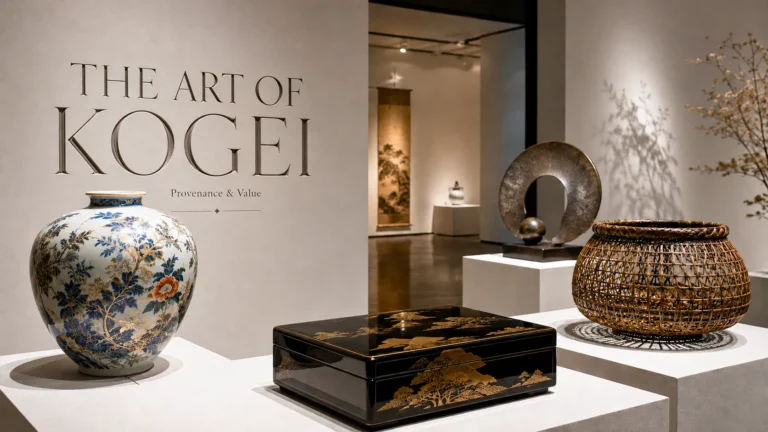
Japanese kogei can be evaluated as a serious collectible on the international market when provenance, technique, artistic identity, and condition can be verified. That said, the evaluative framework does not map neatly onto the provenance model used in Western art markets. Hakogaki (box inscriptions), tomobako (the artist’s original box), exhibition history, purchase lineage, and the regional and master-student context in which a work was made — understanding these kogei-specific structures is the starting point for anyone approaching this market.
Collectors, gallery professionals, and institutional buyers sometimes ask: is Japanese kogei evaluated as art? Or should it be understood through the lens of mingei folk craft, functional ware, tourist souvenir, craft commodity, or contemporary art? These are questions Kogei Japonica receives regularly.
The answer is not straightforward. In market terms, kogei operates according to its own evaluative logic — and attempting to measure it solely through the framework of the fine art market has real limits.
This article draws on The Japanese Art Market 2025 (produced in connection with an Agency for Cultural Affairs initiative), the The Art Basel and UBS Global Art Market Report 2026, and official information from the Japan Kogei Association to organize the provenance structures, market characteristics, and pre-purchase considerations relevant to Japanese kogei. The aim is not to encourage acquisition or suggest investment. It is to give collectors, galleries, and institutional buyers the framework to understand, select, and seek advice about kogei works accurately.
Table of Contents
Can Japanese kogei be treated as a serious collectible?

Japanese kogei can be evaluated as a serious collectible on the international market when provenance, technique, artistic identity, and condition can be verified. That evaluation, however, functions according to different criteria than those of the fine art market.
The direct answer is yes — kogei can fully qualify as a collectible, given the right conditions. But the conditions matter. When a work’s provenance, the rarity of its technique, the artist’s identity, its condition, its connection to a production region, and its institutional context can all be confirmed, the work can become a credible acquisition for international collectors and galleries alike.
What matters is recognizing that the question itself — “does it qualify?” — contains an implied perspective: that of someone evaluating kogei from the outside. Kogei is not made solely for the purpose of collection. It involves sustained engagement with materials, the accumulation of technique, and the overlap between use and contemplation. Value emerges from that layered relationship. The market may later assess that value, but it does not create it.
With that premise established, the sections below set out the relevant evaluative frameworks in detail.
Kogei cannot be reduced to “art vs. craft”
The tendency to treat craft as subordinate to fine art is connected to historical distinctions within Western art markets. But those distinctions do not adequately describe what Japanese kogei actually is.
In Japan, the fields of lacquer art (shitsugei), textiles, ceramics, metalwork, bamboo and woodwork, and doll-making are not simply techniques for producing functional objects. They are creative domains that simultaneously involve material understanding, the inheritance of technique, individual artistic expression, and a productive tension with use. The fact that something can be used does not disqualify it from being art. In Japanese kogei, function and beauty are not separable — that inseparability is one of the field’s defining characteristics.
Internationally, kogei is increasingly discussed through the frameworks of Contemporary Craft, Collectible Craft, and Material Culture. Situating Japanese kogei within these terms avoids both excessive mystification and the flattening of the field into a generic ethnic category — and allows its actual richness to be communicated more precisely.
What is kogei (Kōgei)?
Kogei is a creative domain encompassing material knowledge, technique, function, artistic identity, and the transmission of practice. In Japan, its major fields include ceramics, lacquer art, textiles, metalwork, bamboo and woodwork, and doll-making. Works carry a dual character as objects both for use and for contemplation. While distinctions between kogei and fine art exist, they do not imply a hierarchy of value.
How to explain “Kogei” in English
When introducing Japanese kogei to overseas collectors and galleries, “Japanese craft” is a useful shorthand — but it does not always communicate the full context of the field.
In English, the following framings can be used depending on the situation.
- Kogei: Using the Japanese term directly avoids the misreadings and reductions that translations can introduce.
- Contemporary Craft / Collectible Craft: Frameworks that are legible to Western collectors and position works as serious acquisition objects.
- Material Culture: An academic and curatorial framing that encompasses material, technique, and cultural context. Appropriate for museum and gallery settings.
- Applied Art: Useful when explaining kogei through the integration of function and aesthetic.
In all cases, grounding the description in specific artists, techniques, and production regions — rather than reaching for stereotypes like “Exotic Japanese Aesthetic” or invoking wabi-sabi as a catch-all — is what allows kogei’s actual character to come through.


What does provenance mean for kogei?
Provenance in kogei — raireki — is established not only through ownership history but through hakogaki, tomobako, exhibition records, and purchase lineage. The artist’s certification history, regional lineage, and master-student relationships provide additional context for understanding a work.
What is provenance — raireki?
In Western art markets, provenance refers to the documented record of when a work was made, by whom, who has owned it, and where it has been exhibited and sold. A verifiable provenance history increases credibility in auction and gallery transactions and directly influences price formation.
Provenance is equally important in Japanese kogei, but its constituent elements differ somewhat from those of the contemporary art or painting markets. Rather than auction records and the ownership histories of notable collections, the primary evidence for kogei provenance includes hakogaki (inscriptions on the work’s storage box), tomobako (the artist’s original box), exhibition records, purchase source, and the buyer’s direct relationship with the artist or workshop.
Additionally, the lineage of master-student relationships within a production region, the artist’s certification history, organizational affiliations, and exhibition record function not so much as provenance itself but as essential contextual material that strengthens the understanding of a work. It would be a mistake to read this structure as a lesser version of Western provenance. It is a distinct evaluative framework that needs to be understood on its own terms.
Raireki / Provenance
Raireki refers to the total record of a work’s creation, ownership, exhibition, sale, and documentation. In kogei, hakogaki, tomobako, exhibition records, and purchase lineage are the primary tools for confirming provenance. The artist’s certification history, regional lineage, and master-student relationships serve as contextual material that deepens understanding of the work.
What do hakogaki and tomobako tell us?
Japanese craft objects and tea utensils are commonly stored in wooden boxes on which the artist, an appraiser, or another associated figure has written a signature, seal, and title. The information recorded on the box is collectively called hakogaki (box inscription); a box bearing the artist’s own signature and details is generally referred to as a tomobako (the artist’s original box).
Hakogaki and tomobako are important evidence when considering the authenticity of a work. That said, the presence of a box inscription alone does not guarantee either the value or the authenticity of a piece. Whether the box and work are an original pair, whether the inscriptions are internally consistent, and whether the information recorded can be corroborated through other documentation, the vendor, or a specialist — all of these need to be assessed together.
When explaining hakogaki to overseas collectors, it helps to note that while it shares some functions with a Certificate of Authenticity, it is a distinct form of information — one rooted in Japanese conventions of storage, appreciation, and circulation. The simplification “tomobako means it’s authentic” should be avoided.


The Living National Treasure designation is an institutional context, not a price guarantee
Living National Treasure is the informal title for holders of an Important Intangible Cultural Property (Jūyō Mukei Bunkazai Hojisha). In the kogei field, holders are recognized across ceramics, lacquer art, textiles, metalwork, bamboo and woodwork, and doll-making.
The Japan Kogei Association lists approximately fifty active Living National Treasures affiliated with the Association across these craft fields.
(参照:Living National Treasures | Japan Kogei Association)
The Living National Treasure designation is an institutional recognition made from a cultural standpoint — specifically, the preservation and transmission of technique. It can provide a context in which a given artist’s work receives a degree of market recognition, but it does not guarantee a market price.
Prices vary substantially depending on the artist, the specific work, technique, size, condition, and distribution channel. The simplification “Living National Treasure therefore high-value” risks producing misjudgments in purchasing and acquisition decisions.
Living National Treasure (Ningen Kokuhō)
Living National Treasure is the informal designation for individual holders of an Important Intangible Cultural Property. The state designates the most significant intangible cultural properties as Important Intangible Cultural Properties, and recognizes individuals or groups who embody those skills at the highest level as holders or holding organizations — thereby supporting the continuation of traditional techniques. Individual holders, informally known as Living National Treasures, receive a special government subsidy for the preservation of their designated skill, as well as support for training successors and public presentation activities. The Living National Treasure designation is appropriately understood not as a guarantee of market value but as an institutional recognition by the state of cultural and technical significance, in support of preservation and transmission.
Why does sanchi keifu — regional lineage — matter?
Japanese kogei has deep traditions of technique rooted in specific production regions. Wajima-nuri lacquerware, Kyoto lacquerware, Bizen ware, Arita ware, and Nishijin textiles are place names, but they are also terms that designate accumulated systems of technique, aesthetic convention, and material philosophy built up over long periods of time.
Sanchi keifu (regional lineage) provides a thread to follow when understanding a work — the master-student relationships the artist belongs to, the stylistic context of the production region, and the relationship between the work and the materials it uses. Two works using the same technique name can occupy quite different positions depending on which lineage the artist belongs to and in which region they have inherited that technique.
Understanding regional lineage is essential to reading the provenance of a kogei work. At the same time, there are cases where regional lineages have been interrupted or have transformed over time. Rather than treating such changes as straightforward evidence of diminished value, understanding the context of that transformation leads to more accurate assessment.
Editor’s note
The fact that a price attaches to a work in the market is one important point of contact through which the value of kogei reaches society. Market criteria — price, rarity, artistic identity, and distribution history — all carry real meaning.
At the same time, kogei works carry backgrounds that price alone cannot make visible. Which production region shaped the technique? What materials were used? Through whose hands was the skill passed down, and to whom? Knowing that context makes a work three-dimensional in a way that market data alone does not.
Collecting kogei is not only a matter of assessing value. It is also the gradual act of understanding the circumstances from which a work came. Having both a market-based evaluation and a grounded understanding of provenance and technique — that combination, I think, is the threshold for a more serious engagement with the field.
How does the art market differ from the kogei market?
In kogei, market judgment is influenced not only by artist name and sales record but by material, technique, conservation qualities, and the work’s relationship to use. Comparing contemporary art, modern Japanese painting, and Japanese kogei clarifies how the evaluative frameworks diverge.
The short answer to “can kogei be evaluated with the same logic as the art market?” is: the evaluative axes are different. Even when objects circulate through the same marketplace, the foundations of their value differ — and so the judgment framework must differ too.
The comparison table below organizes the primary evaluative criteria for three categories: contemporary art, modern and contemporary Japanese painting, and Japanese kogei.
| Criterion | Contemporary Art | Modern and Contemporary Japanese Painting | Japanese Kogei |
|---|---|---|---|
| Primary value judgment | Artistic identity, critical reception, exhibition history, market standing | Artist, period, authentication, condition | Technique, material, artistic identity, provenance, condition |
| Key provenance elements | Gallery history, exhibition record, ownership history | Authentication certificate, previous collection, exhibition history | Hakogaki, tomobako, exhibition record, purchase lineage, artist and regional context |
| Authenticity verification | Certificate, catalogue, artist foundation | Authentication body, literature, specialists | Hakogaki and signature, workshop and artist confirmation, technical consistency |
| Conservation considerations | Varies by material | Condition management of paper, silk, and pigment | Varies substantially by material — lacquer, ceramics, textiles, metalwork each differ |
| Secondary market maturity | Relatively established | Established in some areas | Significant variation by field; contextual explanation is important |
| International positioning | Terminology and context well established in international markets | Connects readily to the Japanese art market | Challenges in terminology and contextualization remain — and represent an opportunity |
The table reflects general tendencies across each category. Evaluative criteria vary substantially depending on the individual work, artist, and distribution channel.
Kogei is difficult to compare through price alone
No simple price guide exists for kogei works. This does not mean pricing is opaque — it means the elements that constitute price are layered in ways that resist reduction.
An artist’s certification and recognition history, the rarity of the technique, the provenance and quality of materials used, the scale and production time of the work, its condition, the presence or absence of hakogaki, exhibition history, and distribution channel all factor into price formation.
The generalization “works of this technique cost roughly this much” has almost no practical meaning in kogei. Rather than attempting to fix prices, the basic approach is to verify individual works through the vendor or appropriate specialists before making any decision.
A note on pricing
The price of a kogei work varies substantially depending on the artist, the specific piece, technique, material, condition, and distribution channel.
Any purchase or acquisition decision should be preceded by direct verification with the vendor, the artist, or a specialist institution.
What to take from The Japanese Art Market 2025 and the Art Basel & UBS report
Market reports are a valuable entry point for understanding the Japanese art market, but they require careful handling when used to assess the value of kogei works specifically. The numbers need to be read alongside their context.
Key findings: The Japanese Art Market 2025

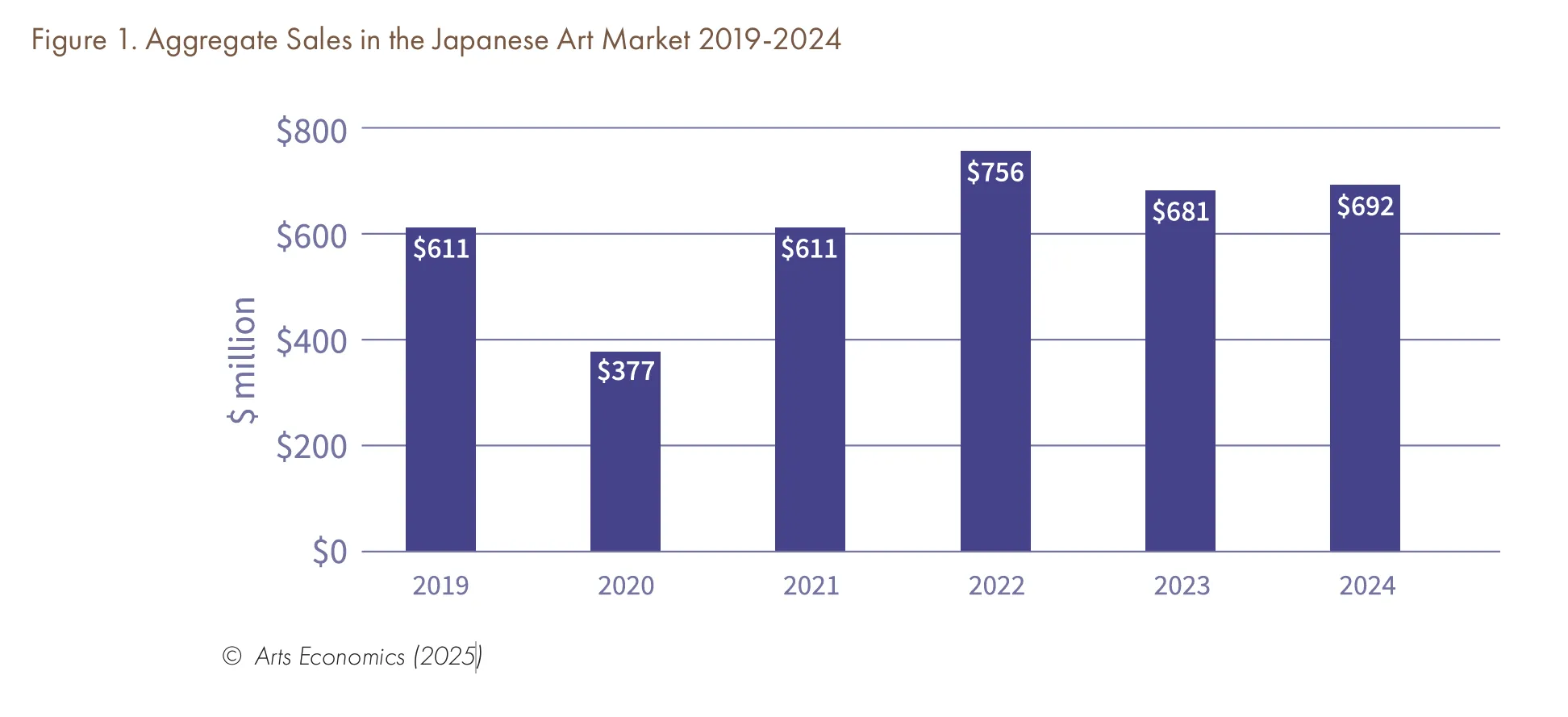
The Japanese Art Market 2025 was produced in connection with the Agency for Cultural Affairs’ art ecosystem initiative, in collaboration with Dr. Clare McAndrew of Arts Economics. It integrates data from the dealer/gallery sector and the auction sector to estimate the scale and structure of Japan’s art market.
Key findings are as follows.
- Japan’s art market sales in 2024 were estimated at USD 692 million.
- An increase of approximately 2% on the previous year. While the global art market declined by 12% in 2024, Japan’s market sustained modest growth.
- The dealer/gallery sector accounted for 71% of total market value — USD 494 million.
- Art-related services expenditure in 2024 was at least USD 138 million.
- 80% of dealers surveyed expected stable or increased sales in 2025.
(参照:The Japanese Art Market 2025 | Agency for Cultural Affairs)
Important note
This report is an estimate of Japan’s art market as a whole. It does not measure the kogei market as a separate category. Assessing the value of kogei works requires a distinct set of criteria — provenance, technique, artistic identity, and condition among them.
Key findings: The Art Basel and UBS Global Art Market Report 2026

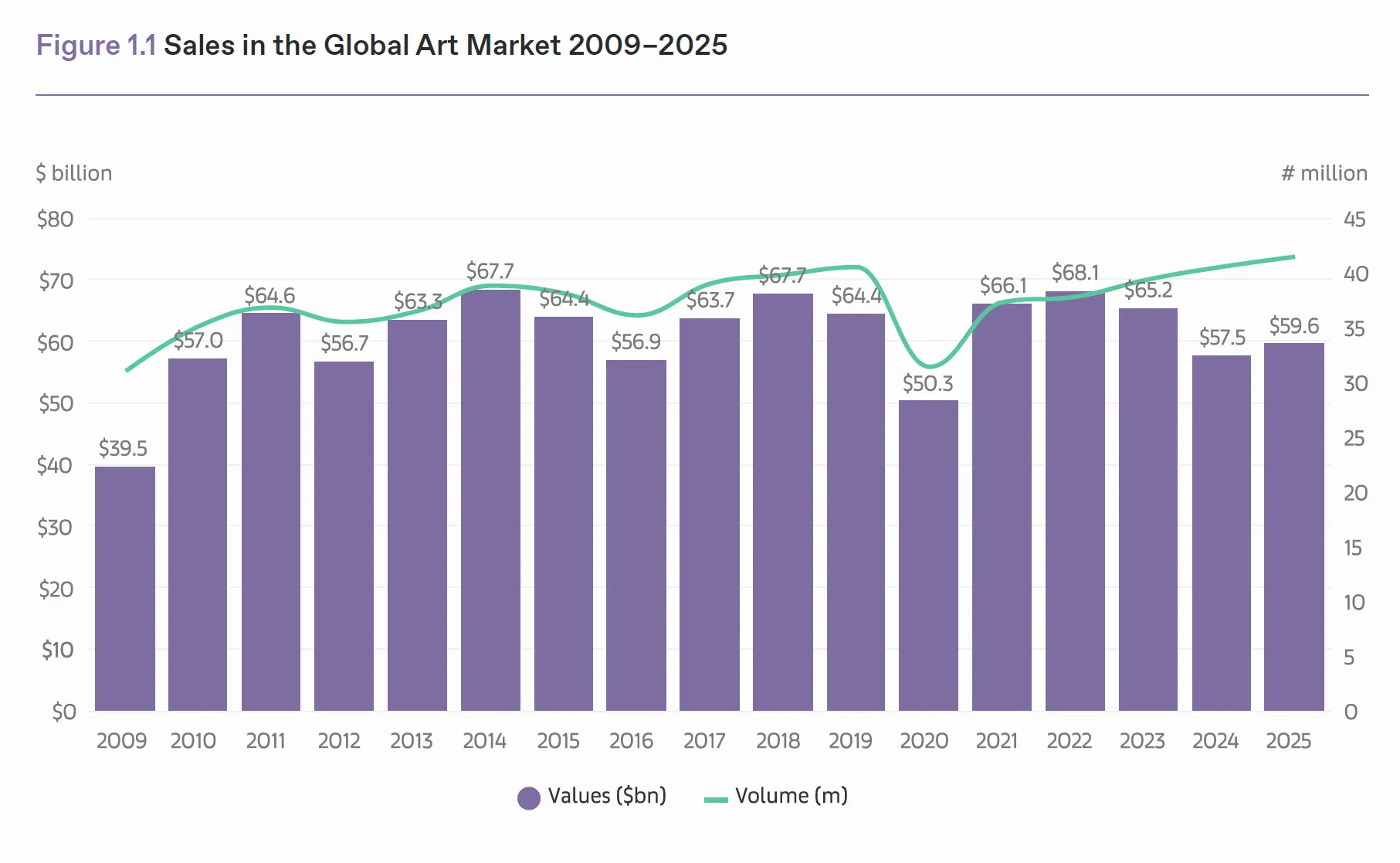
The Art Basel and UBS Global Art Market Report is a key source for tracking global art market trends. The 2026 edition reports on 2025 market conditions as follows.
- The global art market in 2025 is estimated at USD 59.6 billion, up 4% on the previous year.
- The dealer sector grew 2%, reaching USD 34.8 billion.
- Public auction sales grew 9%, reaching USD 20.7 billion.
- Total transactions globally in 2025 are estimated at 41.5 million.
- The United States, United Kingdom, and China together accounted for 76% of global art market value.
(参照:The Art Basel and UBS Global Art Market Report 2026 | UBS Art Market Research)
The kogei market cannot be read from this data alone
Both reports are valuable as panoramic views of the Japanese art market and the global art market respectively.
When thinking about the value of Japanese kogei specifically, however, it is important to treat these figures as background context rather than direct measurement tools.
The fact that the global art market showed signs of recovery in 2025 does not translate directly into changes in the valuation of individual kogei works.
In kogei, the central determinants of value are material, technique, provenance, condition, the relationship between buyer and artist or workshop, and regional context — axes that operate independently of overall market sales volume.
Editor’s note
What The Japanese Art Market 2025 reveals most clearly is that Japan’s art market held up relatively well during a period of global softening, and that dealers and galleries remain at the center of that market. At the same time, transactions are concentrated in lower price brackets — this is not a market defined entirely by high-value works or investment-driven activity.
That has real implications for kogei. What matters for craft works is not simply whether they can be sold at high prices, but whether the provenance, technique, material, and background of the artist can be communicated carefully — through galleries, specialist shops, fairs, exhibition spaces, and online channels. For overseas collectors and institutional buyers in particular, the ability to explain why a technique matters, and what regional and artistic context a work carries, is what builds trust.
The Art Basel & UBS report similarly shows a global market recovering unevenly, with significant variation by region, price bracket, and sales channel. This is precisely why Japanese kogei cannot rely on the assumption that “the market is growing, so recognition will follow.” It requires editorial care in how works are presented, clear documentation of provenance, physical access to the work, and the ability to explain it in English. What the market data points toward is not the dilution of kogei’s criteria to fit market logic, but the importance of organizing kogei’s own context into a form that markets can actually understand.
What should overseas collectors and galleries verify before purchasing?
Before purchasing, it is essential to confirm work details, provenance, hakogaki, condition, shipping conditions, and the reliability of the vendor. Organizing a verification checklist in advance makes subsequent decisions substantially cleaner.
When considering the purchase, acquisition, or institutional installation of kogei works, organizing the information to verify in advance reduces the risk of later disputes or misaligned expectations. Use the checklist below as a reference before purchasing or opening a consultation.
Kogei Collection Checklist: what to verify before buying
KOGEI COLLECTION CHECKLIST
- Artist name and/or workshop name
- Work title and series
- Year of production (including estimated date where applicable)
- Technique (technique name and outline of process)
- Materials (including provenance and variety of materials used)
- Dimensions and weight
- Hakogaki and tomobako: presence and condition
- Exhibition history and records of inclusion in shows
- Purchase source (whether primary source information can be confirmed)
- Condition (presence of damage or restoration history)
- Details of any restoration work (if applicable)
- Shipping and packaging conditions
- Insurance: availability and applicable terms
- Notes for overseas display (humidity, temperature, light environment, etc.)
Get the Free Checklist Here


Verification criteria differ by technique — lacquer, ceramics, textiles, metalwork
Conservation, transportation, and display considerations for kogei works vary substantially depending on technique and material.
For lacquer art (shitsugei), changes in temperature, humidity, and light environment can affect the surface over time.
For overseas transport and display, confirm packaging, temperature and humidity control, direct light exposure, and insurance conditions with the vendor, a restoration specialist, and a conservation professional before proceeding. For ceramics (tōgei), breakage risk and packaging method are essential considerations. For textiles (senshoku), the duration of light exposure and whether folding is permissible are key concerns. For metalwork (kinkō), storage environment review from an oxidation and corrosion prevention standpoint may be necessary.
For detailed guidance on conservation and transport by technique, refer to the individual technique articles on this site or contact your vendor or a relevant specialist.
For hotel, gallery, and corporate installations — design the explanatory context
When introducing kogei works into hotels, galleries, offices, or commercial spaces, the design of the exhibition context matters as much as the selection of the works themselves. How to present artist information, technique description, material notes, provenance, and regional context — in both Japanese and English — is essential to communicating the value of a work accurately.
For spaces that receive substantial numbers of overseas visitors, we recommend developing an “explanatory package” alongside the works: English-language descriptive text, romanized proper nouns, and cultural background notes. Kogei Japonica accepts consultations on this kind of installation design and international communications work.
For those considering kogei acquisition, institutional installation, or international communications
We accept professional inquiries on kogei work selection, provenance documentation, and the preparation of explanatory materials for overseas clients — for galleries, hotels, and corporate contexts. From designing the contextual framework that allows a work’s value to be understood accurately, through to English-language communications, please feel free to get in touch.


A glossary of market terms for kogei collectors
Accurate understanding of the institutional, conventional, and technical terminology specific to Japanese kogei is essential for collectors. The following reference table presents key terms in Japanese-English parallel.
When purchasing, exhibiting, or introducing kogei works to international audiences, terminology specific to Japanese can become a barrier to understanding. The glossary below compiles the vocabulary that collectors, galleries, and institutional buyers will most need, presented in Japanese-English parallel.
| Japanese | Romanization | English | Notes |
|---|---|---|---|
| 工芸 | Kōgei / Kogei | Japanese craft | A creative domain encompassing material, technique, artistic identity, and the transmission of practice. Discussed internationally as contemporary craft, collectible craft, or material culture depending on context. |
| 来歴 | Raireki | Provenance | The complete record of a work’s creation, ownership, exhibition, and sale history. |
| 箱書 | Hakogaki | Box inscription | Signatures, seals, titles, and related information recorded on the work’s storage box by the artist, an appraiser, or associated figures. |
| 共箱 | Tomobako | Artist’s original box | A work’s storage box bearing the artist’s own signature and details. One of the important tools for confirming provenance. |
| 人間国宝 | Ningen Kokuhō | Living National Treasure | The informal designation for holders of an Important Intangible Cultural Property. Understood as an institutional recognition related to the transmission of technique — not a guarantee of market price. |
| 漆芸 | Shitsugei | Lacquer art | The domain of craft and art using urushi lacquer. Encompasses techniques including maki-e, chinkin, and raden (mother-of-pearl inlay). |
| 産地系譜 | Sanchi keifu | Regional lineage | The lineage of technique, aesthetic convention, and master-student transmission within a specific production region. Functions as context for understanding individual works. |
| 真正性 | Shinseisei | Authenticity | The judgment of whether a work corresponds to its attributed maker and production context. Assessed through a combination of provenance, technical consistency, hakogaki, and other evidence. |
On not measuring Japanese kogei by market value alone
Market value is one means through which kogei reaches a wider audience, but the substance of kogei lies in the totality of technique, material, transmission, and artistic identity. Speaking the language of markets and honoring the context of kogei are not in conflict.
What it means to discuss market value — and its risks
The formation of market value around kogei works carries genuine meaning for the field’s continuity and reach. When prices become visible, people who had not previously engaged with kogei may find a reason to consider collecting. And the development of distribution structures that sustain artists and workshops economically is indispensable for cultural transmission.
At the same time, when price becomes the dominant frame, the actual evaluative criteria tend to recede.
Market value is one of the axes on which kogei can be assessed — it is not the only one.
How to retain respect for artists, workshops, and production regions
When writing about kogei, I sometimes find it uncomfortable when the background of a work’s production — the time the artist spends with materials, the relationship between a region’s climate and landscape and its techniques, the gestures passed between master and student — is treated as “added value.”
These are not added value. They are part of the work itself. Treating the region where materials originate, the methods of sourcing those materials, the years required to acquire a technique, and the structure of the production process as narrative content to be consumed, rather than as the core through which a work is understood — that, to my mind, is where the engagement with kogei becomes less than honest.
To collectors, galleries, and institutional buyers working with kogei: the most important thing this article can offer is the argument for knowing a work before buying it. Understanding provenance, technique, and regional context is an act of respect toward kogei — and it also raises the quality of what gets collected.
FAQ: frequently asked questions about the Japanese kogei market
Practical questions on provenance, authenticity, hakogaki, conservation, and overseas purchase and display.
- Is Japanese kogei evaluated as art?
- It can be. But rather than the question of whether it counts as “art,” kogei is assessed through its own evaluative criteria: provenance, technique, artistic identity, and condition. Internationally, it is increasingly discussed in the frameworks of Kogei, Contemporary Craft, Collectible Craft, and Material Culture.
- Do works by Living National Treasures always command high prices?
- The Living National Treasure designation — holder of an Important Intangible Cultural Property — is an institutional recognition related to the preservation and transmission of technique. It does not guarantee a market price. Prices vary substantially depending on the specific work, technique, size, condition, and distribution channel. Any price assessment should involve direct verification with a vendor or specialist rather than relying on the designation alone.
- Does the absence of hakogaki or tomobako reduce a work’s value?
- Hakogaki and tomobako are important tools for confirming provenance, but their absence does not automatically indicate diminished value. Depending on the work, authenticity may be confirmable through exhibition records, direct verification with the artist or workshop, or technical consistency. A comprehensive judgment is required.
- What is the difference between provenance and authenticity?
- Provenance (raireki) refers to the documented record of a work’s creation, ownership, exhibition, and sale. Authenticity (shinseisei) is the judgment of whether a work corresponds to its attributed maker and production context. Provenance is one of the elements that supports authenticity, but the existence of a provenance record does not automatically guarantee authenticity.
- What should I be aware of when exhibiting or storing lacquer art overseas?
- Lacquer art can be affected by changes in temperature, humidity, and light environment over time. For overseas transport and display, confirm packaging, temperature and humidity control, direct light exposure, and insurance conditions with the vendor, a restoration specialist, and a conservation professional before proceeding.
- What should I verify when purchasing Japanese kogei from outside Japan?
- Verify work details, artist and workshop information, technique, material, year of production, provenance, hakogaki and tomobako, exhibition history, reliability of the vendor, condition, shipping and packaging conditions, and insurance.
For works that may constitute antiques or that may be designated cultural properties or recognized important art objects, confirm the relevant requirements — including the Agency for Cultural Affairs’ antique export inspection certificate — before taking works out of Japan.Works designated as National Treasures or Important Cultural Properties, and works recognized as Important Art Objects, are in principle prohibited from export (removal from Japan) under the Law for the Protection of Cultural Properties and related legislation. To prevent the inadvertent outflow of cultural properties that form part of the national heritage, customs authorities may require confirmation that items being exported are neither designated National Treasures or Important Cultural Properties nor recognized Important Art Objects.
(参照:Antique Export Inspection Certificate | Agency for Cultural Affairs) - Where should galleries and hotels go for advice on introducing kogei works?
- The starting point is direct consultation with specialist kogei galleries, regional craft associations, craft-related organizations, or the artists and workshops themselves.
Kogei Japonica also accepts inquiries on collection consultation, installation design, and the preparation of explanatory materials for international audiences — including work selection, provenance documentation, and context design.
Summary: knowing a work is where collecting begins
Whether Japanese kogei qualifies as a collectible is not determined solely by whether it can attract a price — it depends on where the basis for that valuation is grounded.
Hakogaki and tomobako, the institutional context of the Living National Treasure designation, regional lineage, exhibition history, condition. These do not constitute the same structure as the provenance model assumed by Western art markets — but each has its own distinct system of verification.
Reading the difference as inferiority rather than difference is where the engagement with kogei starts to go wrong.
The market figures in The Japanese Art Market 2025 are useful for understanding the current state of Japanese art distribution.
But the value of kogei moves within those figures at a finer grain.
An artist engages with materials, receives the memory of a production region, renews a technique through the act of making. The market’s assessment rests on top of that accumulation.
Knowing a work before buying it. That is what this article has tried to make possible.
This article does not make specific claims about individual prices, market rates, artist biographies, or award histories. For any purchase, acquisition, overseas transport, or exhibition, please verify directly with the vendor, the artist or workshop, specialists, and relevant primary sources.


