

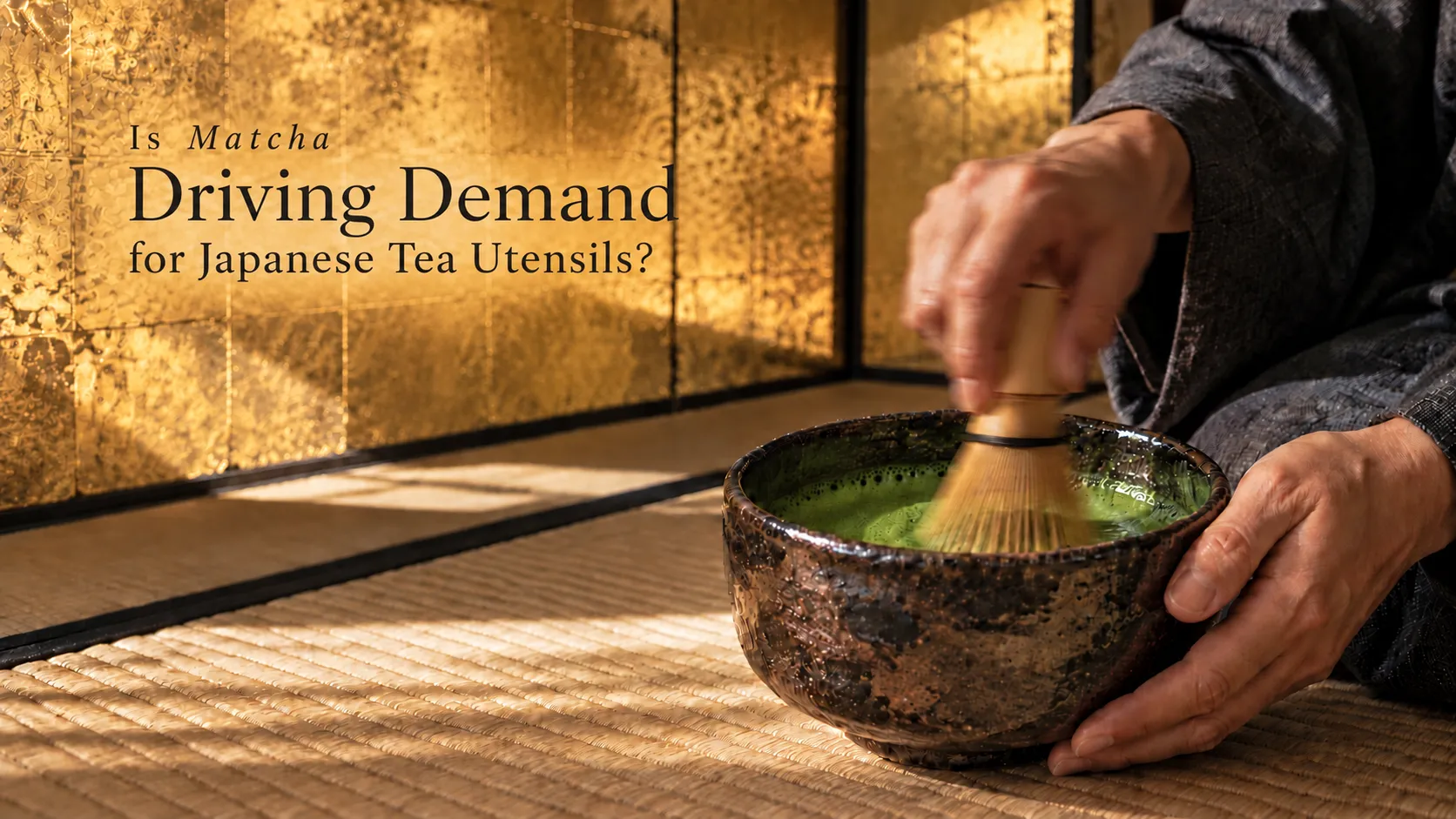
The value of tea utensils traded on at least one cross-border wholesale platform has risen amid growing interest in matcha. That evidence alone, however, does not establish a market-wide increase in demand for Japanese-made tea bowls and bamboo whisks.
“If matcha is selling overseas, is there an opportunity in tea bowls (chawan) and bamboo tea whisks (chasen) too?” It is a natural question for anyone weighing up purchasing or product development. Yet between rising interest in matcha and your own utensils actually being chosen lie real differences in use, price, sales channel and supply conditions.
This article compares tea export statistics, cross-border e-commerce transaction data and official announcements from production areas and workshops to establish how far demand can actually be confirmed. It is written for craft businesses, galleries, retailers, restaurants and cafés deciding whether to stock tea utensils or sell them outside Japan.
Table of Contents
Is Matcha’s Popularity Driving Demand for Japanese Tea Utensils?
On one wholesale platform, the value of tea utensils traded has grown. Tea export statistics, however, cannot tell you directly how tea bowls and chasen are selling.
According to the Ministry of Agriculture, Forestry and Fisheries (MAFF), Japan’s green tea exports in 2025 were worth approximately ¥72.1 billion. From January to August 2026 they reached around ¥67.4 billion, running ahead of the same period the previous year. These figures, however, cover green tea as a whole. They are neither the export value of matcha alone nor the size of a market that includes tea utensils.
(Source: The Situation Surrounding Tea: Export Data | Ministry of Agriculture, Forestry and Fisheries (in Japanese))
For tea utensils, data from private companies offers more concrete clues. In October 2025, Raccoon Holdings announced that the value of tea utensils traded on SD export, its cross-border wholesale e-commerce service, from May 2024 to April 2025 was 2.2 times the value recorded in the preceding 12 months. This is one example of growth in the tea utensil trade, but it shows neither sales volumes to end consumers nor growth in Japanese-made products alone.
(Source: B2B Sales Trends: Demand for Matcha and Tea Utensils | Raccoon Holdings / PR TIMES (in Japanese))
| Subject | What can be confirmed | What that information alone cannot tell you |
|---|---|---|
| Powdered green tea | Export value and volume can be tracked by statistical code | The split between matcha and other powdered tea; purchases of tea utensils |
| Matcha bowls | Categories such as ceramic tableware can be identified | The export value and volume of matcha bowls alone within those categories |
| Chasen | Production areas and workshops publish information on methods and order status | In the sources reviewed here, a nationwide export trend for chasen alone |
| Tea utensils in wholesale distribution | An increase in transaction value has been announced for a specific cross-border e-commerce platform | Growth of the market as a whole; detailed breakdowns by use or country of manufacture |
How “Demand” Is Defined Here
Here, demand for tea utensils means not just interest or enquiries but evidence of actual purchasing and use. That evidence falls broadly into three kinds.
- Trade statistics: data on cross-border trade, aggregated by item, period, partner country and so on.
- Wholesale and distribution data: figures published by wholesale sites, trading companies and others, drawn from their own transactions.
- Makers’ and retailers’ announcements: information on orders, sales, lead times and how products are used, item by item.
These differ in what they cover and what they measure. Official statistics allow broad, continuous comparison but cannot reveal individual uses. A workshop’s announcements are specific, but findings from one business cannot be generalised to the entire market.
Orders, shipments and final sales should also be kept apart. An overseas retailer buying its first stock and the same retailer reordering after items have sold mean different things when judging whether demand will last.
How Far Can Matcha Exports Be Traced in the Statistics?
What export statistics can track is “powdered green tea”, a category that includes matcha. Bearing in mind that this is not a figure for matcha alone, value, volume and average unit price should each be read separately.
According to Osaka Customs, a powdered category was added within green tea in the January 2019 revision of Japan’s Export Statistical Schedule. This made it possible to analyse export trends in finer detail than green tea as a whole. The new code, however, was not created for matcha specifically.
(Source: Green Tea Exports: December 2025 Feature | Osaka Customs (in Japanese))
What Does “Powdered Green Tea” Include?
MAFF explains that powdered green tea includes both matcha and other powdered tea. A rise in exports of powdered green tea should therefore not be read simply as a rise in exports of matcha alone.
Terms explained: matcha, tencha and powdered green tea
- Tencha: tea leaves grown under shade and dried without rolling, in a tencha drier or similar. It is the raw material for matcha.
- Matcha: tencha ground into a fine powder using a stone mill or similar.
- Powdered tea: described in MAFF material as tea ground into powder with a grinder or similar.
- Powdered green tea in the statistics: covers both matcha and powdered tea, which are not counted separately within this category.
The “powdered” classification used in the data and “matcha” as a product name cover different ranges of goods.
(Source: Tea Exports by Form | Ministry of Agriculture, Forestry and Fisheries (in Japanese))
The statistical codes for powdered green tea are 0902.10-100 for products in immediate packings with a net weight of 3 kg or less, and 0902.20-100 for all others. Looking at the category as a whole means including both. The packing-weight distinction alone cannot tell you whether a product is intended for household or commercial use.
(Source: Export Statistical Schedule, Chapter 9 (January 2026 edition) | Japan Customs (in Japanese))
Export Value and Unit Price Since 2019
Osaka Customs data shows Japan’s total exports of powdered green tea rising from ¥8.89 billion in 2019 to ¥27.2 billion in 2024. Volume grew over the same period from 2,200 tonnes to 5,092 tonnes.
| Year | Export volume (tonnes) | Export value (¥ million) |
|---|---|---|
| 2019 | 2,200 | 8,893 |
| 2021 | 3,024 | 13,338 |
| 2023 | 4,290 | 21,606 |
| 2024 | 5,092 | 27,197 |
| 2025 | 8,718 | 60,384 |
The figures cover Japan’s exports of powdered green tea to all destinations. Data for 2019–2024 comes from Osaka Customs and data for 2025 from MAFF. Both draw on the Ministry of Finance’s Trade Statistics of Japan, so they are not two independent surveys.
(Source: Green Tea Exports: Data Tables | Osaka Customs (in Japanese))
(Source: Tea Exports by Form | Ministry of Agriculture, Forestry and Fisheries (in Japanese))
In 2025, exports were worth approximately ¥60.4 billion, at an average export unit price of ¥6,927/kg. The average unit price here is export value divided by export volume. It moves not only when the same products rise in price but also when the mix shifts towards products in different price ranges.
(Source: Export Unit Price by Form (2025) | Ministry of Agriculture, Forestry and Fisheries (in Japanese))
Growth in export value is not the same as growth in the amount of tea drunk, or in the number of people buying utensils. To understand demand for tea utensils, you need to look separately at the shops and households using the tea, how it is prepared, and whether utensils are being added to or replaced.
Three Checks Before Comparing Export Figures
First, FOB prices: do not confuse export value with retail sales abroad. Export statistics are in principle based on FOB (free on board) prices, the value of goods at the port of export. They differ from shelf prices, which include international freight and insurance to the importing country as well as local duties and retail costs.
(Source: Frequently Asked Questions | Trade Statistics of Japan, Ministry of Finance (in Japanese))
Second, revision status. Trade statistics are released as preliminary, provisional, second provisional and final figures, and quantities and values may change as they are revised. When comparing figures, keep a record of the source document and period, and compare year-to-date totals with the same period of the previous year.
(Source: Notes on Use | Trade Statistics of Japan, Ministry of Finance (in Japanese))
Third, the mix of matcha and powdered tea. Keeping the category name “powdered green tea” in charts and headings reduces the risk of misunderstanding when the numbers are quoted on their own.
Why Is It Difficult to Track Tea Bowl and Chasen Exports Separately?
Matcha bowls cannot be isolated within the ceramic tableware categories reviewed. For chasen, too, no standalone export trend could be confirmed in this research.
This does not mean there is no demand. The problem is a mismatch between the range of products you want to know about and the range the statistics aggregate. When a broad category is used, it is necessary to state what the figure includes.
| Subject | Statistical code or category reviewed | Limits on interpretation |
|---|---|---|
| Powdered green tea | 0902.10-100 / 0902.20-100 | Matcha and other powdered tea are combined |
| Porcelain tableware and kitchenware | 6911.10-000 | Includes tableware other than matcha bowls; quantities are recorded in KG |
| Ceramic household articles other than porcelain, etc. | 6912.00-000 | Includes items other than matcha bowls; quantities are recorded in KG |
| Chasen | No standalone statistical series confirmed here | No export value is calculated from an assumed category |
The classification of individual products needs to be checked against their material, specifications and other factors.
(Source: Export Statistical Schedule, Chapter 9 (January 2026 edition) | Japan Customs (in Japanese))
(Source: Export Statistical Schedule, Chapter 69 (January 2026 edition) | Japan Customs (in Japanese))
Where Tea Bowls Sit in the Ceramics Classification
Categories such as porcelain tableware and kitchenware, and ceramic household articles other than porcelain, have no subdivision that identifies matcha bowls. Even if exports in those categories rise, the contribution of matcha bowls cannot be known.
In addition, quantities are recorded by weight, so they cannot be converted directly into numbers of items sold. With tableware of varying sizes and weights mixed together, estimating a count by assuming an average weight per bowl produces large errors.
When planning a tea bowl product, it makes sense to treat these statistics as a reference for tableware trends overall, and to rely on order and sales records for the specific products to understand actual volumes and uses.
Which Category Do Chasen Fall Under?
The focus here is the bamboo chasen. However, the sources reviewed for this article could not establish a statistical code from which the export value or volume of chasen alone can be extracted.
We have avoided guessing a category simply because the material is bamboo, and treating a figure that includes other bamboo products as the export value of chasen. The classification actually used for export needs to be confirmed with customs or the relevant authorities, on the basis of the product’s specifications.
When you come across a figure said to show demand for chasen, check whether it comes from national statistics, one company’s orders or a survey of the production area. Data with a clearly defined scope is useful, but it cannot support conclusions beyond that scope.
Purchases That Do Not Appear in Export Statistics
The Ministry of Finance’s notes on trade statistics state that small consignments of ¥200,000 or less, and goods cleared as passengers’ baggage, are not counted. As a result, some transactions, such as items bought by visitors to Japan and taken home with them, do not appear in the trade statistics.
(Source: Notes on Use | Trade Statistics of Japan, Ministry of Finance (in Japanese))
The sources here do not, however, show what share of demand from outside Japan these purchases represent. It is not possible to infer their scale, for instance by claiming that “a large part does not appear in the statistics”.
Equally, products purchased through wholesalers or other intermediaries in Japan are included in the statistics if their subsequent export is counted. Rather than judging by the name of the purchasing channel, check which stage of the transaction you are looking at.
What Can Wholesale Data and Makers’ Announcements Tell Us?
Wholesale data confirms growth in the value of tea utensils traded, and official accounts of Takayama chasen production show that bamboo preparation can take years. Combining sales trends with supply conditions reveals both the opportunity and the constraints.
Even where statistics cannot separate products in detail, there are clues to how they are used. A company’s announcement, however, contains both the transaction results it reports directly and its own interpretation of the market, and the two need to be read separately.
What the Wholesale Report Says About Spouted Matcha Bowls
In its announcement of 3 October 2025, Raccoon Holdings stated that the value of tea utensils traded on SD export from May 2024 to April 2025 was 2.2 times that of the preceding 12 months. It also reported that the value of tea utensil orders by country reached 2.48 times the previous level in the United States and 2.88 times in Australia. These are measures of transaction value, not numbers of units sold.
(Source: B2B Sales Trends: Demand for Matcha and Tea Utensils | Raccoon Holdings / PR TIMES (in Japanese))
A katakuchi is a bowl or vessel with a pouring spout. The announcement attributes the popularity of the katakuchi matcha bowl to how easily whisked matcha can be poured from it into a glass of milk when making a latte. Its linking of a vessel’s shape to the task of making a drink is a useful point of reference.
However, the attention to katakuchi bowls here reflects the use and featured products the company chose to highlight. Neither the share of katakuchi bowls nor their contribution to the overall rise in tea utensils is given. It cannot be concluded that vessels for lattes are driving growth across the market.
What makers and sellers can take from this is not just the multiples but the question of why that shape became necessary. Understanding what the user does with a vessel makes it possible to define what to test: ease of pouring, ease of holding, capacity and so on.
What Is Happening in Takayama, the Chasen Production Area
Takayama, in Ikoma City, Nara Prefecture, is a production area for chasen. Volume 8 of “Densan Danshi, Densan Joshi”, a series by the Kinki Bureau of Economy, Trade and Industry profiling young makers in traditional industries, describes the Takayama chasen process: bamboo cut in winter is dried, has its oils removed and is left to rest for two to three years before it is worked.
(Source: Densan Danshi, Densan Joshi Vol. 8: Takayama Chasen | Kinki Bureau of Economy, Trade and Industry (in Japanese))
This method shows that the time spent finishing a whisk does not by itself explain supply conditions. Production has to be planned with the preparation of bamboo included. The source does not, however, allow any judgement about individual workshops’ bamboo stocks or spare capacity.
The official website of Suikaen, a chasen workshop in Takayama, still carries a notice explaining that it temporarily suspended orders through its web shop because of a large number of orders and a backlog of deliveries, with reopening announced for March 2025. This is a past example of a workshop having to adjust how it handled orders. It does not show the share or growth of orders from outside Japan, or current lead times.
(Source: Temporary Suspension of Web Shop Orders | Suikaen)
Read together, the time needed to prepare bamboo and an actual notice adjusting orders make clear that more orders do not necessarily mean output can be increased straight away. Before ordering, it is essential to confirm current supply conditions directly.
How to Read Makers’ Announcements
Stock-outs and longer lead times are important clues to demand. On their own, though, they cannot distinguish an increase in orders from a fall in supply. Even if orders stay the same, items run short when production or deliveries fall.
Points worth checking include:
- The period and products the notice covers
- Changes in orders, and changes in production and deliveries
- Where the products are going: domestic or overseas, wholesale or retail
- Whether it is a temporary surge or ongoing demand with reorders
That something appears on an official website does not mean it is still the case. Past notices should not be presented as the current sales situation.
Editor’s Note: Don’t describe a market only through the products that have numbers
Growth in a product that is visible in the statistics tends to be used to explain the movement of tools whose numbers are hard to extract. But tea exports and tea bowl purchases are not the same phenomenon. Tea is consumed; a tea bowl is used again and again. Chasen, too, are replaced depending on how they are used and cared for.
In my view, we need to check whether the number of people and businesses using these utensils has grown, and whether pieces are being added or replaced. Rather than simply presenting long lead times as proof of popularity, we should look at the conditions under which makers can accept those orders. Only when that is included does an analysis of demand become useful to a business.
What Do You See When You Break Down “Selling Well”?
Use, place of manufacture and production method are factors that should be assessed separately. The difference between chanoyu and café use alone cannot tell you whether a piece is studio work or mass-produced, or whether output can be increased.
When considering purchasing, first clarify where the item will be used, then check material, maker, place of manufacture, quantity, price and so on. The table below is not a bestseller ranking but a set of points for evaluating products.
| Use | Specifications and qualities to check | What to confirm before trading |
|---|---|---|
| Chanoyu (the Japanese practice of preparing and serving matcha), lessons and tea gatherings | Fit with the purpose and teaching approach, ease of handling, how it combines with other utensils | Required specifications, quantity, lead time, information on the maker and the work |
| Preparing matcha at home or in cafés | Ease of whisking and pouring, capacity, ease of washing and drying | Fit with how it will be used, restocking, care instructions |
| Gifts and souvenirs | Clarity of use, packaging, portability, the context behind its making | Contents of sets, protection against breakage, labelling of place of manufacture |
| Appreciation and collecting | Form, material, the maker’s artistic approach, the context behind its making | Information on the work, condition, terms of sale, handling |
For every use, products across a range of methods and price levels are possible. Even when investigating demand by use, comparisons need to keep differences in product mix visible.
Demand for Chanoyu Versus Demand for Matcha Lattes
When choosing utensils for chanoyu, you check the purpose of the lesson or gathering, any requirements set by the teacher, and how the piece combines with other utensils. For a vessel used to prepare lattes, on the other hand, one reason for choosing it is how well it suits transferring whisked matcha into a separate glass.
Even within “for matcha”, the shape and number of vessels needed differ between a bowl for drinking from and one for preparing in. More matcha on café menus does not necessarily mean as many matcha bowls as customers.
Interest in lattes may lead to interest in chanoyu or in makers’ work, but that transition has not been confirmed by the sources used here. The connection between uses is best held as a possibility, while actual purchasing behaviour is looked at separately.
How Should Buyers Assess Tea Utensils Made Outside Japan?
The Raccoon Holdings announcement also includes the example of an exhibitor that turned to products made in China in response to stock-outs. It is, however, an anonymous individual case and does not show market share by country of manufacture for tea utensils as a whole.
(Source: Company Responses to Rising Demand for Matcha and Tea Utensils | Raccoon Holdings / PR TIMES (in Japanese))
Equating Japanese-made products with superior quality and those made outside Japan with inferior quality is not appropriate. What needs checking is material, method, fitness for use, place of manufacture and terms of trade. Only by explaining the differences between individual products does information help users choose.
Conveying a maker’s skill and background does not require disparaging other products. Showing why a particular material is used, and what task a shape was designed around, explains more concretely why a piece is chosen.
What Should You Check When Buying or Developing Tea Utensils?
Define your target customers and use, then check sales records, reorders and supply conditions. Start with a small trial, and feed what you learn from actual use back into the next round of purchasing and making.
Buzz can prompt research, but it is not enough to set order quantities. Separate products to sell in your shop, tools to use on your premises and products to develop jointly, and set out what you need to confirm before making the next decision.
Ten Checks to Confirm Demand for Tea Utensils
- You know whether the evidence for “selling well” comes from statistics, wholesale, retail or social media
- You have checked the period, region, unit and product category behind the figures
- You are not treating tea export value as a sales record for tea utensils
- You have defined your target customers and the settings of use
- You have checked the required shape, capacity and ease of use
- You have confirmed the place of manufacture, maker and material from the product information
- You have discussed lead times, desired quantities and capacity for repeat orders
- You can record first orders separately from restocks and reorders
- For sales outside Japan, you will check import conditions for the destination country and product
- You have set criteria for evaluating a trial and a date for the next decision
What Galleries and Retailers Should Check
Retailers should record not only sales value but also units sold, quantities received, how long items took to sell and why customers bought them. Distinguish whether sales grew because you added new products or because the same products sold more.
Because tea bowls are used repeatedly, there is no need to expect repeat purchases at the rate of a consumable. Look at indicators that suit the nature of the product: whether it is reaching new customers, whether customers are adding other bowls, and whether wholesale accounts keep restocking.
When handling makers’ work, align sales plans with the pace of production. Consider both holding the stock you need and communicating the next delivery date accurately, and build a trading relationship that does not overstretch anyone.
Choosing Bowls for a Matcha Menu in Restaurants and Cafés
Restaurants and cafés should choose vessels to suit how they prepare and serve matcha. Will it be whisked at the table and drunk from the bowl, or prepared in the kitchen and transferred to a glass? Deciding the setting of use first makes it easier to consider shape and quantity.
Katakuchi bowls are worth considering where matcha is poured into another vessel, but ease of pouring and holding must be tested product by product. Check that they fit daily work, including washing, drying, storage and replacement after breakage.
The basic points for choosing a matcha bowl, such as the shape of the mikomi (the inner well of the bowl) and how it sits in the hand, are set out in the following Japanese-language article.


During a trial, record both why staff found a vessel easy to use and the moments when it was awkward. Sharing that with the maker makes it possible to discuss specifications and usage guidance in concrete terms.
What Should Businesses Check Before Exporting Tea Utensils from Japan?
When selling from Japan to other markets, first define the target market and the product specifications. Then check the conditions that apply, such as product classification, duties, requirements for items that come into contact with food, and labelling. Export conditions for tea cannot simply be applied to ceramics or bamboo products.
On terms of trade, set out quantities, lead times, additional production, acceptable variation between pieces, handling of breakage and changes to specifications. Agreement should come only after confirming what the maker can manage, rather than promising what the buyer wants first.
If you are considering product development or new sales channels, set out your intended use, quantities, lead times and target country, then take a look at Kogei Japonica’s business support page (in Japanese). Enquiries can be directed according to purpose, from collaboration with makers and workshops to communicating the value of products.

Frequently Asked Questions (FAQ)
The basic principle is to separate what the statistics cover from how individual products are selling. In purchasing decisions, checking use and supply conditions is also essential.
- Q1. How much have matcha exports grown?
- The figures to check are for powdered green tea, which includes matcha, rather than for matcha alone. According to official sources, exports rose from ¥27.2 billion in 2024 to ¥60.4 billion in 2025.
(Source: Green Tea Exports: Data Tables | Osaka Customs (in Japanese))
(Source: Tea Exports by Form | Ministry of Agriculture, Forestry and Fisheries (in Japanese)) - Q2. Are tea utensils included in matcha export statistics?
- No. Tea and tea utensils are classified as separate items, so sales of tea bowls and chasen cannot be read from tea export values.
- Q3. Where can I check whether tea bowl exports are rising?
- Matcha bowls cannot be isolated from the ceramic tableware categories reviewed here. The gap has to be filled with wholesale and retail sales records for the products concerned, or with workshops’ order data.
- Q4. Are the tea utensils selling outside Japan mainly for chanoyu or for matcha lattes?
- A cross-border wholesale company’s announcement points to interest in katakuchi matcha bowls, which are convenient for preparing lattes. However, no breakdown of the market by use is available, so it is not possible to say which is driving the whole.
- Q5. Why can it take time to increase chasen production?
- In the Takayama production process described by the source, bamboo preparation can take years. The cause of any particular shortage, however, can only be known by checking order volumes, material stocks and production and delivery status.
- Q6. Are more chasen and tea bowls made outside Japan appearing on the market?
- A wholesaler’s announcement includes a case of a business handling products made in China to cover stock-outs. An individual case, however, cannot show the market-wide share or growth rate by country of manufacture.
- Q7. What should a restaurant or café check when choosing bowls for a matcha menu?
- Decide whether the bowl is for preparing or for serving, then check ease of whisking and pouring, washing, drying and storage, and how easily breakages can be replaced. Testing it in actual service before introducing it is effective.
Conclusion
The value of tea utensils traded on at least one cross-border wholesale platform has risen amid growing interest in matcha. How far demand for Japanese-made tea bowls and chasen as a whole has grown, however, cannot be judged from these sources alone.
Tea export statistics are a starting point for understanding trade beyond Japan. Adding sales by product, use, reorders and makers’ supply conditions brings the demand that matters to your own business into focus.
For Kogei Japonica, the useful question is not simply whether more tea utensils are selling, but why buyers choose them, and whether makers can fulfil subsequent orders sustainably. What task did the vessel’s shape make easier? What did users need to know that the product information did not explain? On what terms can the next order be accepted? Sharing those answers between makers and users is what turns a single sale into a lasting relationship.
To connect interest in matcha with craft work, start by testing one product, one use and one sales channel. Building on that, step by step, leads to demand that makers can meet sustainably and products that users value.
This article is based on publicly available sources checked as of 27 October 2026. Export figures are taken from official publications, and no independent estimate of market size has been made. No direct interviews with workshops or collection of sales records were carried out. Company announcements are referenced only within the scope of the services and cases concerned, and past notices are not treated as current stock levels or lead times.
