

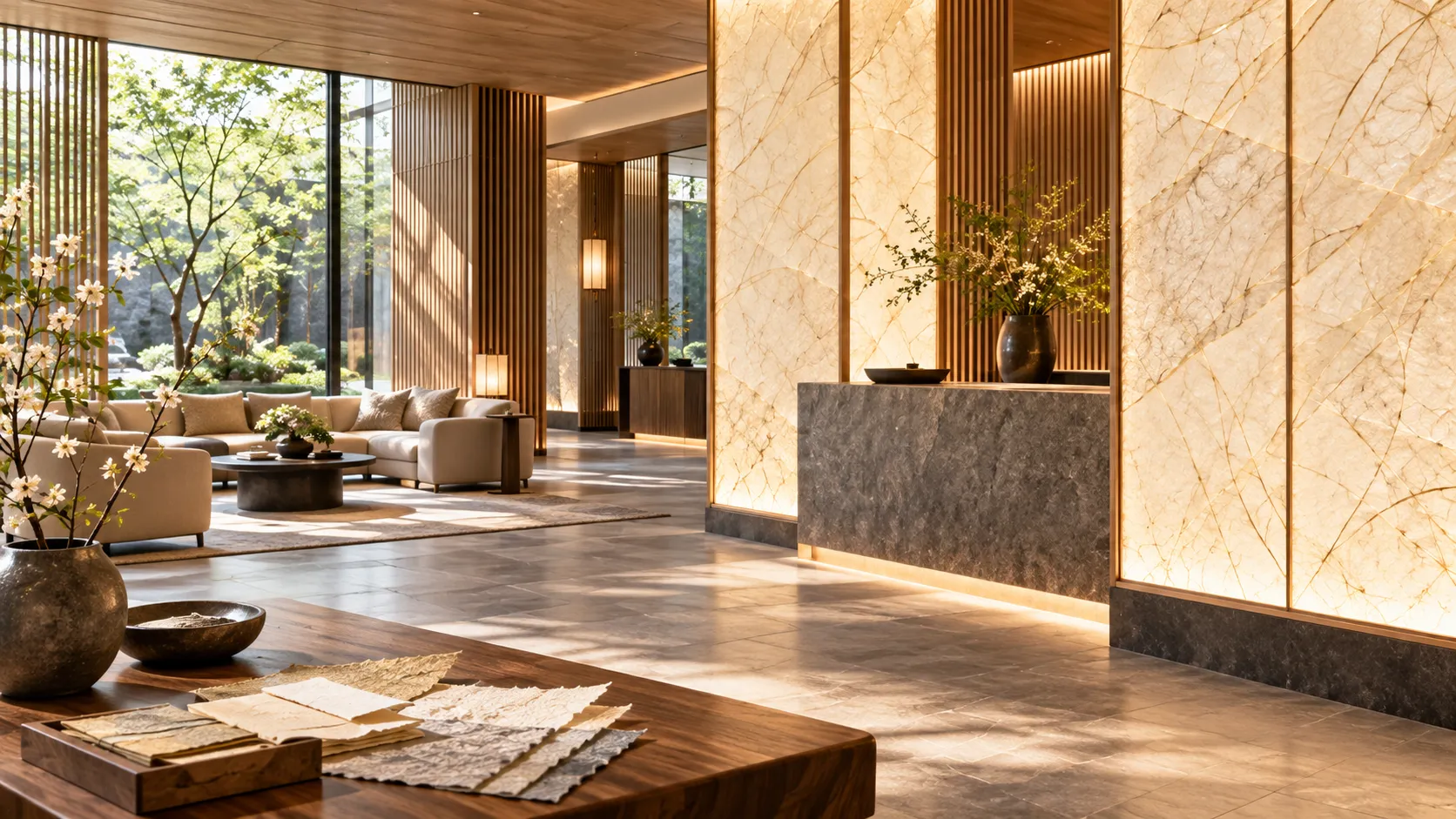
If you have worked on a hotel or retail interior, you may have considered washi for a wall surface. The appeal is obvious enough from photographs of completed projects. The questions start when you try to place an order: can it meet the fire requirements, how do you obtain samples, how large can it actually be made, and who is responsible for what.
Washi can be used on walls in hotels and retail spaces, but where interior-finish restrictions apply, the substrate and installation method specified must meet the required fire performance.
With custom washi, the paper maker, the fire-treatment company and the installer may all be different parties, so sampling, dimensions, fire performance and the division of responsibility are best settled before you order.
This article sets out what to check when specifying washi for walls in hotels, ryokan, restaurants and retail spaces, drawing on documented projects and primary sources.

Table of Contents
Can washi be used on walls in hotels and retail spaces?
The short answer is yes: washi can be used on walls in hotels and retail spaces.
Depending on the building’s use, scale, number of storeys and the particular area involved, interior-finish restrictions under Japan’s Building Standards Act may apply, in which case the installation must meet the fire performance required there.
What matters here is that neither “a hotel always requires non-combustible materials” nor “washi is paper, so it cannot be used” holds as a general rule. The scope of the restrictions and the performance demanded vary with the building and the area in question.
Interior-finish restrictions, or naisō seigen, are set principally under the Building Standards Act and prescribe the fire performance required of interior wall and ceiling finishes in buildings of certain uses, sizes and structures. Hotels and ryokan, restaurants and retail premises all fall within scope under certain conditions.
(Reference: Interior finish restrictions|Wall Covering Association of Japan)
Separately, Japan’s Fire Service Act sets its own flame-retardancy requirements: curtains, carpets, fabric blinds and display plywood used in designated premises such as ryokan and restaurants must meet specified standards. The interior-finish restrictions under the Building Standards Act and the flame-retardancy rules under the Fire Service Act are distinct, and need to be checked separately.
(Reference: Flame-retardant products|Fire and Disaster Management Agency)
When planning a washi wall, then, the question is not simply whether the material is washi. It is which area it will occupy, and with what substrate and installation method — the specification as a whole.
What the interior finish restrictions cover
The technical requirements sit across several provisions of the Building Standards Act and its Enforcement Order.
The Wall Covering Association of Japan publishes a summary table setting out the finish performance required of walls and ceilings, broken down by category: special-use buildings, building scale, rooms where fire is used, underground shopping areas and so on.
(Reference: Interior finish restrictions|Wall Covering Association of Japan)
There are also provisions that exempt an area where certain fire-protection or smoke-extraction systems are installed, though the presence of such equipment does not lift the restrictions across the board.
Which provisions apply to a given project is best confirmed through the designer and contractor, and with the relevant building authority where necessary.
Terms
- Non-combustible material (funen zairyō): a material that, when subjected to the heat of an ordinary fire for 20 minutes, does not burn, suffers no damage compromising fire safety, and emits no smoke or gas that would impede escape.
- Quasi-non-combustible material (jun-funen zairyō): a material meeting the same performance for 10 minutes.
- Flame-retardant material (nannen zairyō): a material meeting the same performance for 5 minutes.
- Interior-finish restrictions (naisō seigen): rules under the Building Standards Act requiring fire performance of wall and ceiling finishes in specified buildings and areas.
- Handmade washi (tesuki washi): washi made sheet by sheet by hand, traditionally using a vat known as a sukibune together with a mould-and-screen tool called a sugeta.
The Ministry of Land, Infrastructure, Transport and Tourism publishes the underlying framework for the non-combustible, quasi-non-combustible and flame-retardant classifications.
(Reference: Non-combustible, quasi-non-combustible and flame-retardant materials|MLIT)

How do you confirm the fire performance of washi wallcovering?
Fire performance for washi wallcovering cannot be read off the surface material alone: it has to be confirmed as a combination of certified substrate and installation specification.
The Wall Covering Association of Japan explains that for thin finishing materials such as wallcoverings, fire performance is certified as a combination of substrate and installation method.
In other words, a wallcovering described as compatible with a non-combustible assembly does not necessarily carry that certification once it departs from the substrate or the conditions under which the certification was granted.
(Reference: Fire performance of wallcoverings|Wall Covering Association of Japan)
This is easy to miss if material selection proceeds from samples alone. When ordering, confirm not only the certification number but which substrate and installation conditions that certification assumes.
The Wall Covering Association of Japan also operates a searchable register of wallcovering product information. Final judgements on compliance, however, should not rest on a search result alone: pair it with the manufacturer’s certification documents and specifications, and with confirmation from the designer and contractor.
(Reference: Wallcovering quality information search system|Wall Covering Association of Japan)
Which washi can be treated for non-combustibility, and which cannot
The assumption that washi, being paper, cannot serve as a non-combustible material is not accurate either. Post-treatment allows some companies to produce washi wallcoverings that comply with specific certifications.
Asano Funen Co., Ltd. offers a process that applies non-combustible treatment to washi supplied to it, and its Selfnen non-combustible washi is covered by MLIT non-combustible-material certification NM-0996 for an applied washi wallcovering.
The certified specification calls for a statutory non-combustible substrate, excluding metal sheet.
(Reference: Selfnen non-combustible washi|Asano Funen Co., Ltd.)
The company also treats thicker papers and client-supplied washi, though not every paper is suitable for the process.
Thickness, surface treatment and water repellency all affect whether treatment is possible, so once a candidate paper has been chosen, it needs to be checked individually.
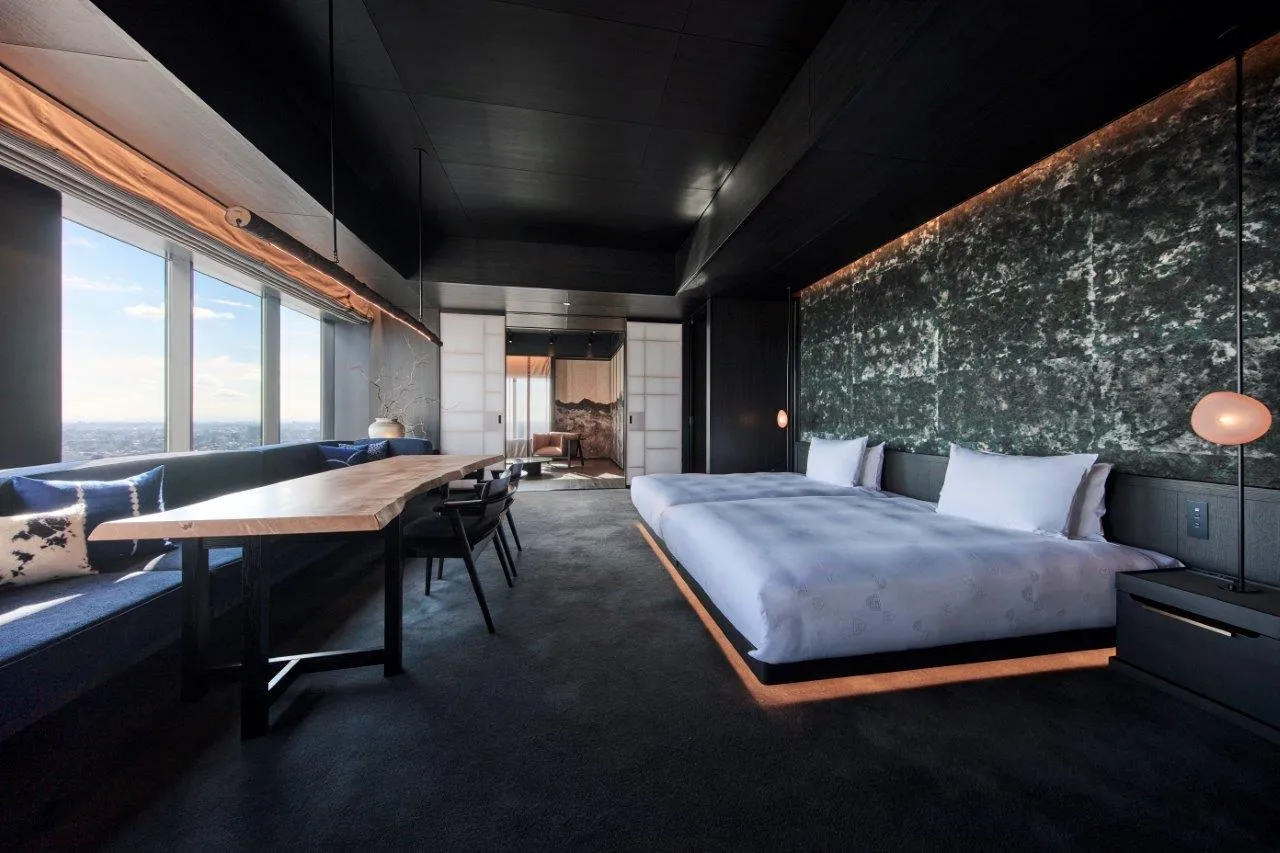
A concrete example: at The Royal Park Hotel Iconic Nagoya, washi made by Senda Takanori, a papermaker in Mino, Gifu Prefecture, was treated for non-combustibility and installed across large wall surfaces in guest rooms.
An interview with Takenaka Corporation and Asano Funen describes the use of Senda’s Mino washi as an interior material in the premium rooms, treated to meet non-combustible requirements while preserving its texture and colour.
(Reference: Mino washi made non-combustible with its character intact: the washi wallcovering used at The Royal Park Hotel Iconic Nagoya|Kenzai Navi SumaiRing)
Editor’s note
What this project makes visible is that making washi and preparing it for use in a building are two separate bodies of expertise.
There is no need to regard fire treatment as something that dilutes the value of the craft. Seen as the technique that allows a maker’s material to work within present-day building conditions, it brings the terms of collaboration between craft and architecture into sharper focus.
How should you request samples?
Requesting samples is not the end of material selection but the point of entry into working out a specification the space can actually take. Once colour and pattern are settled, the substrate, location, dimensions and fire performance follow.
Look at more than colour in a sample: the character of the fibre, the surface relief, the sheen, the translucency and the thickness.
Washi reads differently depending on the direction and level of the light, so for hotel and retail use it is worth viewing samples under conditions close to the installed lighting where possible.
Kami Asakura (Asakura Shigyo Co., Ltd.) describes a made-to-order process that works from photographs and floor plans of the intended space, together with material and colour samples.
Samples are generally chargeable, with free samples available for some plain white washi.
(Reference: Q&A|Kami Asakura)
The company also publishes its production sequence: enquiry, consultation, design proposal, order, production, delivery and after-sales support.
On hotel and retail projects, the dimensional checks and the decisions on substrate and installation conditions from the architectural side are layered onto that sequence.
(Reference: Production process|Kami Asakura)
Kami Asakura publishes work for accommodation projects, including washi made for the wall surfaces of the hotel GRAND BASE KANAZAWAEKI.
Projects of this kind show that beyond selecting from existing ranges, there are workshops and manufacturers who will take on the planning and production of a paper to suit a given use and dimension.
(Reference: Washi created for hotel wall surfaces|Kami Asakura)
Pre-order checklist (extract)
- Have you examined a physical sample?
- Have you told the maker the location and use?
- Have you shared the intended substrate specification?
- Have you confirmed the required fire performance and the certified specification?
- Have you confirmed the dimensions that can be produced?
- Have you discussed seam placement and pattern alignment?
- Have you agreed who carries out site measurement?
- Have you agreed who carries out the installation?
- Have you confirmed the method of repair and replacement?
The list can be used as it stands, in internal meetings or in a first conversation with a workshop.
How far can custom sizes, curved surfaces and column wraps go?
Whether a given dimension, curve or column wrap is feasible depends on the paper, the method of forming, the treatment and the installation conditions, so it is a matter for case-by-case discussion.
With handmade washi, the dimensions that can be produced are governed by the tools — the sukibune vat and the sugeta used to form each sheet — as well as by the drying and finishing equipment.
Rather than specifying a single continuous sheet on the basis of the wall dimension alone, it is better to establish first what the workshop can make and how it will be installed.
Awagami Factory notes that among its large-format washi, the largest sizes have for the most part been produced as custom orders.
Some are now available as part of its standard product range, but this reflects that company’s production and sales, not a standard shared across washi workshops.
(Reference: Large-format washi|Awagami Factory)
The Fukui Prefecture Washi Industry Cooperative publishes the traditional standard dimensions for Echizen handmade washi, including the shi-roku, go-shichi and roku-hachi formats.
Those standards are a useful way into understanding paper types, but a standard dimension and the maximum size a particular workshop can produce are two different things. On a custom project, confirm with the maker.
(Reference: Echizen handmade washi standard dimensions|Fukui Prefecture Washi Industry Cooperative)
Where a wall is meant to read as a single expanse, making the largest possible sheet is not the only answer.
Aligning the divisions with column centres, joinery, fixtures or a change in the wall composition allows the seams themselves to be handled as part of the spatial arrangement.
What to confirm about seams and pattern alignment
Large wall surfaces often use several sheets of washi. Where they do, seam placement and the continuity of pattern and colour are worth settling before installation.
Alongside methods for making seams less visible, there are approaches that treat them as part of the design from the outset: aligning them with corners or architectural lines, introducing a trim, or dividing the surface into panels deliberately.
With hand-dyed or handmade washi, no two sheets are entirely identical.
Rather than forcing uniformity at the installation stage, agreeing with the maker how much variation is acceptable and in what order adjacent sheets will be placed will reduce any gap between expectation and result.
Curved surfaces and column wraps likewise vary in workability according to the thickness of the paper, the shape of the substrate, the adhesive and the treatment applied. Rather than settling feasibility in conversation alone, consider a trial installation using the actual material and substrate.
| Stage | Client responsibilities | Washi maker’s principal role | Designer and contractor’s principal role |
|---|---|---|---|
| Sample review | Space, use and desired treatment | Supplying samples, proposing material, colour and pattern | Setting out substrate and installation conditions |
| Dimensions | Drawings and photographs of the area | Advising on producible dimensions and division | Site measurement, fixing installed dimensions |
| Fire performance | Sharing building use and the area concerned | Supplying details of the washi and treatment | Confirming required performance, substrate and certified specification |
| Production | Approving final design and dimensions | Forming, dyeing, decoration and any treatment | Preparing substrate and installation sequence |
| Installation | Final inspection where required | Supplying installation notes and material information | Delivery, application, fixing and finishing |
| Repair and replacement | Reporting condition and location | Confirming whether remaking or replacement is possible | On-site repair and reinstallation |
Who handles production, fire treatment and installation?
Washi production, fire-performance treatment and on-site installation may each be handled by a different company. Before placing a firm order, the client needs a clear picture of who is responsible for which stage.
In the case of The Royal Park Hotel Iconic Nagoya described above, the original Mino washi was made by Senda Takanori, with Asano Funen involved in the non-combustible treatment.
The architectural design and construction side, the papermaker and the treatment company worked together to integrate a craft material into an architectural interior.
(Reference: Mino washi made non-combustible with its character intact: the washi wallcovering used at The Royal Park Hotel Iconic Nagoya|Kenzai Navi SumaiRing)
Kami Asakura, by contrast, states in its published Q&A that it does not carry out site measurement or installation. Being able to commission made-to-order washi and being able to commission the installation are not the same thing.
(Reference: Q&A|Kami Asakura)
Left unclear, this is where mismatched assumptions arise: that the workshop would handle measurement, that the contractor would decide the divisions, that someone had checked the dimensions after treatment.
Before ordering, it is worth putting at least the following in writing.
- Who carries out site measurement
- Who approves the final production dimensions
- Who produces the washi
- Who arranges fire treatment, where it is required
- Who designs and builds the substrate
- Who arranges delivery
- Who carries out application and fixing on site
- Who is the point of contact for repairs after installation
Editor’s note
When craft enters architecture, handing a maker a set of finished dimensions and asking them to produce exactly that will often fall short of what the material can do.
The size that can be formed, the size that can be dyed, the conditions for drying and finishing: these are not simply manufacturing constraints but the design parameters of the material itself.
Bring the maker into the conversation early and those parameters need not be concealed — the seams and divisions can become part of the spatial expression.
Collaboration between craft and architecture works best not as a one-way process in which the maker simply carries out the designer’s brief, but when both sides translate the conditions of material, technique, regulation and construction for each other.
Kogei Japonica can also advise on introducing craft works and craft materials into hotels, ryokan, retail spaces and offices, and on working with makers and workshops suited to a particular use.

How do you deal with soiling, fading and replacement after installation?
Repair and replacement methods depend on the washi, its surface treatment and how it was installed, so they are best confirmed at the time of the first order.
The colour and surface of washi may change with the raw material, the dyeing and decoration, the surface treatment, ultraviolet light, temperature and humidity, and the conditions of use.
In hotels and retail spaces there is also soiling and damage from people and luggage to plan for.
Alongside how the surface will look on completion, then, the following are worth confirming at the point of order.
- What method of routine cleaning is suitable
- Whether damp cloths or cleaning agents can be used
- Whether a single section can be repaired or replaced
- Whether the same material can be remade in future
- Whether spare material should be held
- Who to contact when repair is needed
For its own art panels, Kami Asakura offers a chargeable service that replaces the washi while reusing the existing panel base.
Not every washi wall can be handled this way, but designing so that only the surface material needs renewing is a useful principle when considering the upkeep of a commercial interior.
(Reference: Q&A|Kami Asakura)
Composing a large wall from multiple panels is likewise an option where future partial replacement is a consideration. Designing for renewal some years on, rather than only for the coherence of the finished surface, makes a craft material easier to live with over time.
Frequently asked questions
- Q1. Can washi wallcovering be used in hotel guest rooms?
- Yes.
Where interior-finish restrictions apply, however, you need to confirm a substrate and installation specification that meets the fire performance required there. Handmade washi has been used on guest room walls in completed hotel projects. - Q2. How do I request samples?
- Practice varies by workshop and manufacturer. Kami Asakura, for instance, offers material and colour samples.
Telling the maker the location, use, dimensions and intended substrate when you request samples will make the subsequent discussion easier. - Q3. Can custom sizes, curved surfaces and column wraps be accommodated?
- It depends on the paper, the method of forming, the thickness, the substrate and the installation method. For large formats and curved installations, confirm the producible dimensions and the seam placement together, case by case.
- Q4. Where can I check the fire certification number?
- Start with the certification documents and specifications issued by the manufacturer or treatment company.
The Wall Covering Association of Japan’s wallcovering quality information search system is a useful reference, but check the certified substrate and installation conditions as well. - Q5. Should I approach the washi maker or the contractor first?
- Either will do, but it is better to establish the scope of both from the early planning stage.
In particular, settle early who is responsible for site measurement, substrate, fire performance, division of the surface and installation. - Q6. Who do I contact about soiling or discoloration after installation?
- Speak first to the original maker or the contractor.
Whether the material can be remade, or a section replaced, depends on the material, the treatment and the installation method, so it is worth confirming the approach to repair when you first place the order. - Q7. How long does it take from quotation to installation?
- Custom dimensions, design, fire treatment, sample approval and the extent of the installation all affect the timeline, so no single figure applies.
Where the work has to fit a construction programme, share your target installation date at the first conversation with the workshop.
In closing
Specifying washi for a wall in a hotel or retail space involves more than deciding which paper is the most beautiful.
The fire performance required in the area concerned, the certified substrate and installation specification, the producible dimensions, the seams, the site measurement, who installs and how it will be repaired in future: these are best considered as a single continuous piece of design.
With custom washi in particular, the person making the paper, the company applying fire treatment, the designer and the contractor may each hold a different part of the work.
Simply establishing who confirms what before the order goes in will remove a good deal of rework later.
At the same time, the value of bringing craft into architecture does not lie in demanding the uniformity of an industrial product.
Understanding the conditions particular to the material — the size that can be made, the variation between one sheet and the next — and designing the jointing and division from those conditions can produce something that belongs to that space alone.
A completed photograph shows only the final state. Behind it sit a great many decisions connecting material, technique, regulation and construction.
Designing that process with care is what allows washi to work as a craft material within a contemporary interior, rather than as decoration in a Japanese idiom.
If you are considering washi or other craft works for a hotel, ryokan, retail space or office, we can advise on working with makers and workshops suited to the use and the installation conditions.
