




HandMade In Japan Fes’ 2026 takes place on Saturday, July 11, and Sunday, July 12, 2026, at Tokyo Big Sight. Alongside a marketplace of makers from across Japan, the event brings together roughly 70 workshops, special exhibits, music, live painting, and food, all in one place.
This guide is for anyone looking for a hands-on experience to share with their children, gathering ideas for a summer school project or craft activity, or hoping to buy work directly from the people who made it. We’ll cover the dates, admission, workshops, and what to know if you’re bringing children along.
What stands out to us is not simply the number of works on display. It’s the chance to ask makers directly about their materials and processes, and a new program, “HMJ Re:Edit,” that looks at wild animals and human life through the lens of materials.
(Source: HandMade In Japan Fes’ 2026 Official Site — HandMade In Japan Fes’)
Table of Contents
When and Where Is HandMade In Japan Fes’ 2026?

The event runs July 11–12, 2026, from 11:00 to 19:00 on both days, at Tokyo Big Sight’s West Halls 1 and 2.
HandMade In Japan Fes’, known as HMJ, is organized by Creema Co., Ltd., which runs the handmade marketplace Creema. It began at Tokyo Big Sight in 2013 and has been held twice a year, in summer and winter, since 2019. This summer’s event marks the 19th edition.
The organizers’ figure of “3,000 creators from across the country” is the combined total across both days — the number of exhibitors on Saturday plus the number on Sunday — not 3,000 makers present at the venue simultaneously. It’s worth keeping that distinction in mind as you read on.
(Source: About HMJ / Event Overview — HandMade In Japan Fes’)
Event Overview (Dates, Venue, Admission)
| Item | Details |
|---|---|
| Name | HandMade In Japan Fes’ 2026 |
| Dates | Saturday, July 11 – Sunday, July 12, 2026 |
| Hours | 11:00–19:00 |
| Venue | Tokyo Big Sight, West Halls 1 & 2 |
| Advance one-day ticket | ¥1,300 |
| Advance two-day ticket | ¥2,000 |
| On-the-day one-day ticket | ¥1,500 |
| On-the-day two-day ticket | ¥2,500 |
| Children’s admission | Free for elementary school students and younger |
| Childcare | Paid childcare facility available |
| Organizer | Creema Co., Ltd. |
| Supported by | J-WAVE, TOKYO FM |
All prices include tax. Workshop fees, food and drink, and childcare costs are not included in admission. On-the-day tickets are available, but check the official ticket page for where they’re sold and current availability.
The same applies to the paid childcare facility. Childcare is available, but walk-in use is not guaranteed. Check the age requirements, fees, hours, reservation process, and availability on the day in advance.
(Source: Ticket Information — HandMade In Japan Fes’)
(Source: FAQ — HandMade In Japan Fes’)
What Can You Try Across the Roughly 70 Workshops?
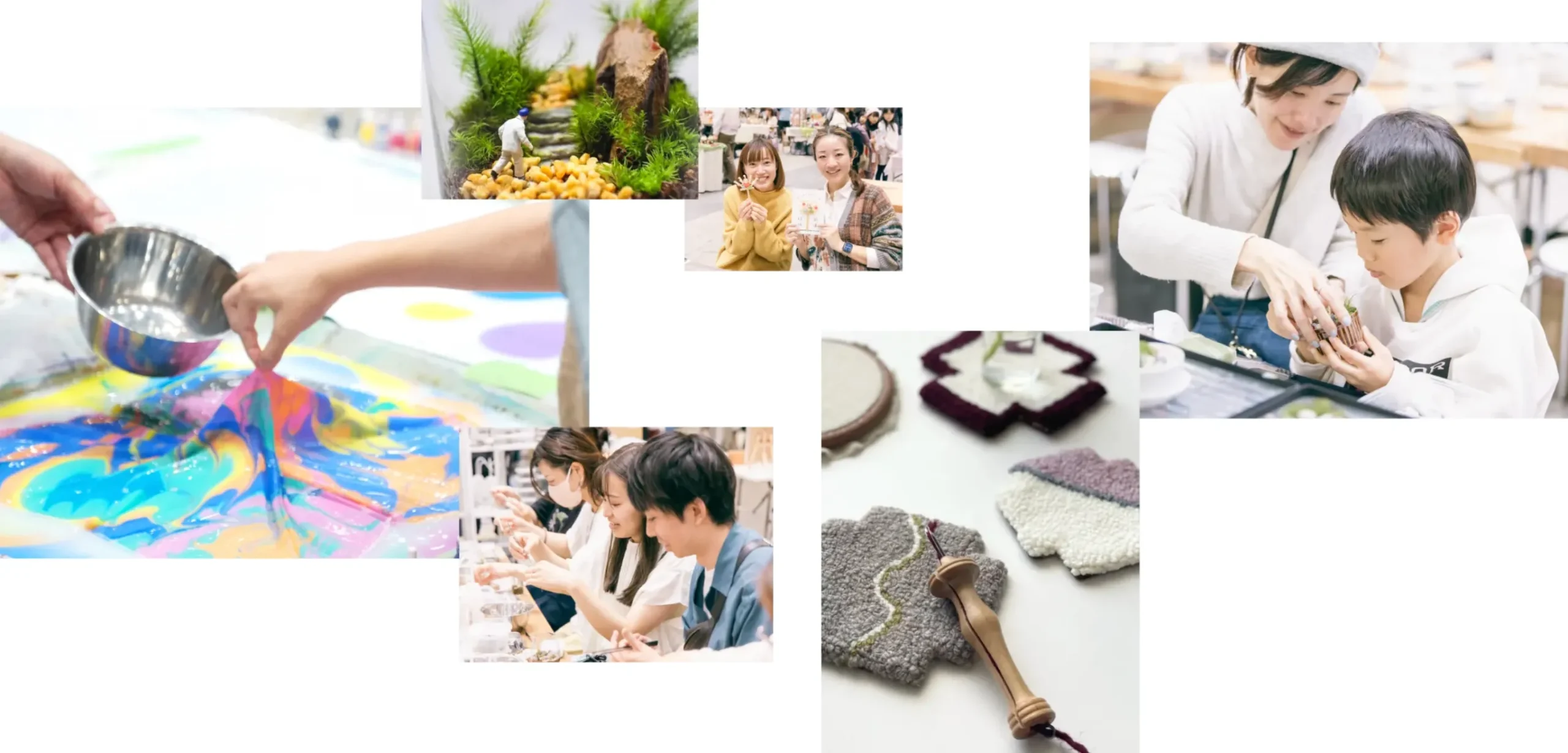

This edition of HMJ features roughly 70 workshops led by both certified traditional craft artisans and popular independent creators, with some accepting advance reservations.
The organizers describe these as workshops led by certified traditional craft artisans and popular creators, covering a range of backgrounds — glass engraving, metalwork, dyeing, leatherwork, embroidery, plant-based crafts, and simplified kintsugi, among others.
Dentō Kōgeishi is a title awarded by the Association for the Promotion of Traditional Craft Industries to artisans holding the traditional techniques of a craft designated by Japan’s Minister of Economy, Trade and Industry. Certification requires at least 12 years of hands-on production experience in the craft’s home region, plus passing practical, written, and interview examinations.
(Source: What Is a Dentō Kōgeishi — Japan Traditional Craftsman Navi)
The official exhibitor list lets you search by material, exhibition day, booth number, and tags such as “family/child-friendly,” “live demonstrations,” and “uses traditional techniques.” Some makers exhibit only on Saturday or only on Sunday, so check the exhibition day if there’s a specific experience you’re after.
Listed experiences include glass engraving with a rotary tool, rings hammered from silver, charms made with Nanbu hishizashi, a diamond-stitch embroidery from northern Japan, and simplified kintsugi accessories. Age requirements, fees, duration, tools used, and same-day availability vary by workshop.
(Source: Exhibiting Creators List — HandMade In Japan Fes’)
(Source: Workshop Information — HandMade In Japan Fes’)
If you’re choosing a kintsugi experience, check whether it uses natural urushi lacquer or a simplified method based on adhesives or synthetic resin. Working time, safety precautions, and whether the finished piece can be used as tableware all differ between the two.


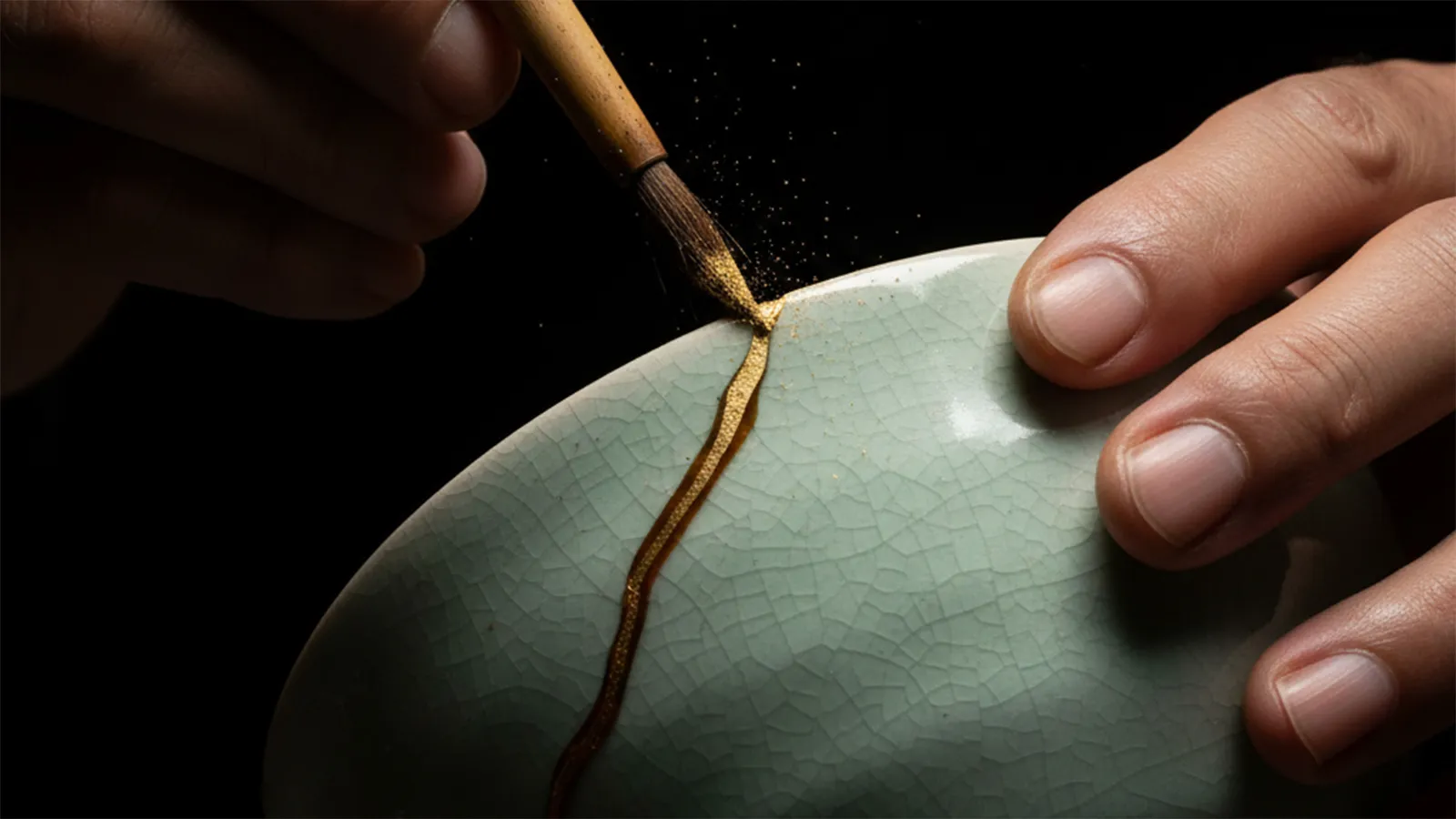
Knowing a few craft technique names ahead of time makes it easier to ask makers questions at the venue.


Editor’s Note
The value of a workshop isn’t only the finished piece you take home. Handling the material, moving the tools yourself, and working through steps that don’t go the way you intended changes how you see the price and the skill behind a finished object.
When visiting with children, it helps if the adults resist over-correcting the result and, once safety is covered, leave room for the child’s own hands to do the work. That’s a first step toward understanding what making something actually involves.
Why Does HMJ Re:Edit Matter to Kogei Japonica?
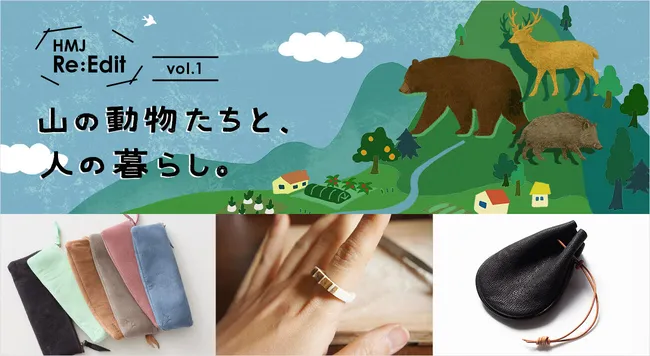

“HMJ Re:Edit” is a new hands-on program debuting this edition, with its first theme, “Mountain Animals and Human Life.”
In the venue’s H area, the program brings together panel displays on the current situation of wildlife, a market of makers working with deer hide, boar hide, and deer antler, workshops using animal-derived materials, and a food truck serving game meat, known in Japan by the French term gibier.
Admission to this program area is free, though general HMJ admission is still required. Ren Ayuzawa, representative of the Japan Game Meat Certification Association, is credited as the panel exhibit’s supervisor and information source.
HMJ Re:Edit does not set out to advocate a particular position on measures to address crop damage caused by wildlife, or on the consumption of game meat. Its stated aim is to let visitors see the realities shaping the relationship between wildlife and human communities — including the use of animals as food and as material — and come away with their own questions.
(Source: Special Content: HMJ Re:Edit — HandMade In Japan Fes’)
According to Japan’s Ministry of Agriculture, Forestry and Fisheries, crop damage from wildlife nationwide totaled ¥18.8 billion in fiscal 2024, an increase of ¥2.4 billion from the previous year. The Ministry of the Environment also updates preliminary figures on bear sightings, human injuries, and captures on an ongoing basis, noting that these numbers may change after posting.
(Source: Nationwide Crop Damage from Wildlife — Ministry of Agriculture, Forestry and Fisheries)
(Source: Information and Initiatives on Bears — Ministry of the Environment)
In craft, a material is never merely raw matter waiting to be worked. Its value is shaped by where it came from, the path it has taken, and the judgment of whoever turned it into a finished piece.
Rather than summing up deer or boar hide in a single word such as “eco” or “sustainable,” it’s worth asking about the circumstances in which the animal was captured, the relationship to meat consumption, the tanning and refining process, the distribution route, and how the piece can be repaired.
Featured Creators
Organizer materials introduce the following makers and brands taking part in the HMJ Re:Edit market.
- ENISICA: Makes bags from the hides of deer culled as a measure against crop damage and used as food afterward. Organizer materials describe the brand as treating each wild deer’s scars and uneven coloring as part of the material’s history, making each piece individually.
- yoki: Works with cow and horse hide as well as deer and bear hide, introduced as a maker engaged in regional collaboration and local revitalization through craft.
- Gibier skincare: A brand that refines otherwise-discarded boar fat for use in skincare products.
- A・I・C: A business working with deer, boar, and bear hides, with a stated focus on production methods that consider environmental impact.
These descriptions come from the organizer and the brands themselves. Rather than this publication asserting across the board that such materials are “low-impact” or “sustainable,” it’s worth checking sourcing, processing, and product lifespan for each one individually.
Workshop fees announced so far include ¥1,000 for “Make a Boar Hide Keychain” and ¥3,500 for the “Deer Antler Ring-Making Workshop.” Fees, availability, and participation conditions may change by the time you visit.
(Source: Make a Boar Hide Keychain — HandMade In Japan Fes’)
(Source: Deer Antler Ring-Making Workshop — HandMade In Japan Fes’)
What Else Is There to Experience? (Market & HASHTAG GALLERY)

The venue combines a market for buying finished work, hands-on workshops, special exhibits, live painting, music, comedy, street wrestling, and food.
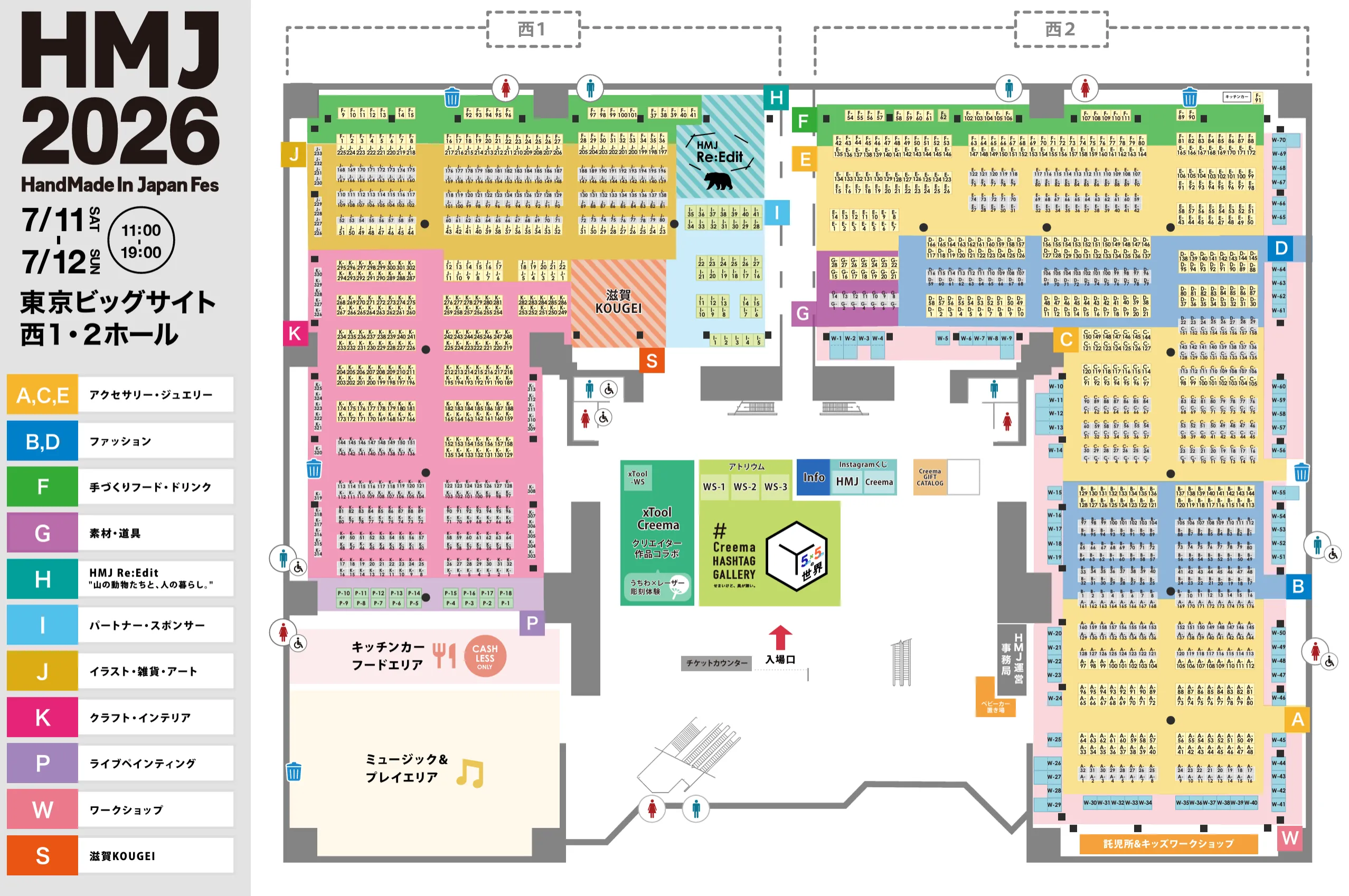
The official venue map lays out zones for accessories and jewelry, fashion, handmade food and drink, materials and tools, illustration, goods and art, craft and interior items, live painting, and workshops.
Beyond these, the map also lists the H area’s “HMJ Re:Edit,” the S area’s “Shiga KOUGEI,” a music and play area, and food trucks. Rather than thinking of the venue as five simple zones, it’s more practical to check the map ahead of time based on what you actually want to see.
(Source: HandMade In Japan Fes’ 2026 Venue Map — HandMade In Japan Fes’)
Creema HASHTAG GALLERY: “A World of 5cm × 5cm”
At the atrium near the entrance, Creema HASHTAG GALLERY runs on the idea that a small format can hold surprising depth.
This edition’s theme is “A World of 5cm × 5cm.” One hundred creators compose, display, and sell work within a space just five centimeters square. Small-format work isn’t only about being endearing — it’s a format where a maker’s editorial judgment, what to keep and what to leave out, and their finishing skill are easier to see up close.
| Related Workshop | Fee (as announced) |
|---|---|
| Ishikihana Original Bonsai-Making | ¥5,500 |
| Small Plate and Glass Painting Experience | ¥3,500 |
| Natural Wood Papercraft | ¥1,000 |
A giant capsule-toy machine filled with small works by five popular creators is set at ¥3,000 per try, limited to 50 capsules per day and 100 across the two days. Check availability at the venue.
(Source: Creema HASHTAG GALLERY Special Content — HandMade In Japan Fes’)
Music & Play
Scheduled acts for the music stage include sarasa (Duo Set), Gingersamm, D.W. Nichols (D.W.ニコルズ), Haruto Yamamoto (やまもとはると), Erino Yumiki (弓木英梨乃), and YONA YONA WEEKENDERS.
Alongside street wrestling from DDT Pro-Wrestling, a Yoshimoto comedy show featuring Ultra Boogies (うるとらブギーズ), Barikata Yujoumeshi (バリカタ友情飯), and Ichigo (イチゴ) is scheduled for 11:50–12:40 on Sunday, July 12. Check the official timetable on the day for exact times and lineup.
(Source: Music & Play Timetable — HandMade In Japan Fes’)
Food Area
The food area brings together 90 vendors selling baked goods, bread, coffee, tea, seasonings, and craft alcoholic drinks.
Food offers the same opportunity as the craft work itself: you can ask producers directly about ingredients, origin, preparation, and storage. If you’re planning to stay for a while, keep the midday rush in mind and set a break time that doesn’t overlap with the workshops or stage program you want to catch.
(Source: HandMade In Japan Fes’ 2026 Official Site — HandMade In Japan Fes’)
Visiting with Children: What to Check Before You Go

Admission is free for elementary school students and younger, but if you’re visiting as a family, check each workshop’s age requirements, reservation time, rest areas, and childcare conditions ahead of time.
Not every one of the roughly 70 workshops is suitable for young children on their own. Some use blades, needles, files, power tools, adhesives, or paint, so check individually whether an accompanying adult is required and what the safety conditions are.
When choosing an experience for a child, it helps to look past how the finished piece looks and check the following:
- Age requirements and whether an accompanying adult is needed
- Duration and start time
- Whether advance reservation is required, and same-day availability
- Whether it involves blades, needles, power tools, or heat
- Whether paint or adhesive could get on clothing
- Whether the finished piece can be taken home the same day
- Whether drying or firing means the piece is shipped later
- Whether materials are included in the fee
The official exhibitor list lets you search by the “family/child-friendly” tag. Combining it with a material or motif your child is interested in narrows things down further.
(Source: Exhibiting Creators List — HandMade In Japan Fes’)
Family Visit Checklist
- Confirmed ticket type and purchase
- Checked the exhibition day for the workshops you want
- Saved reservation times and booth numbers
- Checked age requirements and reservation conditions for paid childcare
- Prepared clothing that can get dirty
- Brought a bag for finished pieces
- Set break and meal times
- Decided on a meeting point in case you get separated
Trying to cover the entire venue tends to wear out adults as much as children. Narrowing it down to two areas you’ll definitely visit, and two more if time allows, makes it easier to engage with the work and the experiences rather than rushing through.
The nearest stations to Tokyo Big Sight are Tokyo Big Sight Station on the Yurikamome line and Kokusai-Tenjijo Station on the Rinkai line. Roads and parking around the venue can get congested, so public transit is generally the easier way to plan around.
(Source: Access — Tokyo Big Sight)
Frequently Asked Questions
Here’s a quick reference for the dates, fees, workshops, and children’s admission you’ll want to know before visiting.
- Q1. When and where is HandMade In Japan Fes’ 2026?
- A. It runs July 11–12, 2026 (Sat–Sun), 11:00–19:00, at Tokyo Big Sight, West Halls 1 & 2.
(Source: Event Overview — HandMade In Japan Fes’) - Q2. How much are tickets?
- A. Advance tickets are ¥1,300 for one day and ¥2,000 for both days. On-the-day tickets are ¥1,500 for one day and ¥2,500 for both days. All prices include tax.
(Source: Ticket Information — HandMade In Japan Fes’) - Q3. Is admission free for elementary school students and younger?
- A. Yes. Workshop fees, food and drink, and childcare are charged separately.
- Q4. Are all the workshops led by certified traditional craft artisans?
- A. No. The organizers describe the roughly 70 workshops as being led by certified traditional craft artisans and popular creators, which includes contemporary craft artists and creators from various fields, not only certified artisans.
- Q5. Do workshops require a reservation?
- A. Some accept advance reservations. Whether a reservation is required and whether walk-ins are accepted varies by workshop, so check the official page and each exhibitor’s own information.
(Source: Workshop Information — HandMade In Japan Fes’) - Q6. Is paid childcare available?
- A. The organizers have announced a paid childcare facility. Check the official FAQ for age requirements, fees, hours, reservation process, and availability.
(Source: FAQ — HandMade In Japan Fes’) - Q7. Do exhibitors differ between Saturday and Sunday?
- A. Yes. Alongside makers exhibiting both days, some appear only on Saturday or only on Sunday. You can search the official exhibitor list by exhibition day.
(Source: Exhibiting Creators List — HandMade In Japan Fes’) - Q8. What is HMJ Re:Edit?
- A. A hands-on program themed around “Mountain Animals and Human Life,” exploring the relationship between wildlife and human communities through panel exhibits, animal-derived materials, workshops, and game meat. The program area itself is free, but general HMJ admission is still required.
- Q9. Can I buy work directly at the event?
- A. Most booths sell work directly. Payment methods vary by exhibitor, so check each booth for cash and cashless payment options.
- Q10. Is the event held outside Tokyo too?
-
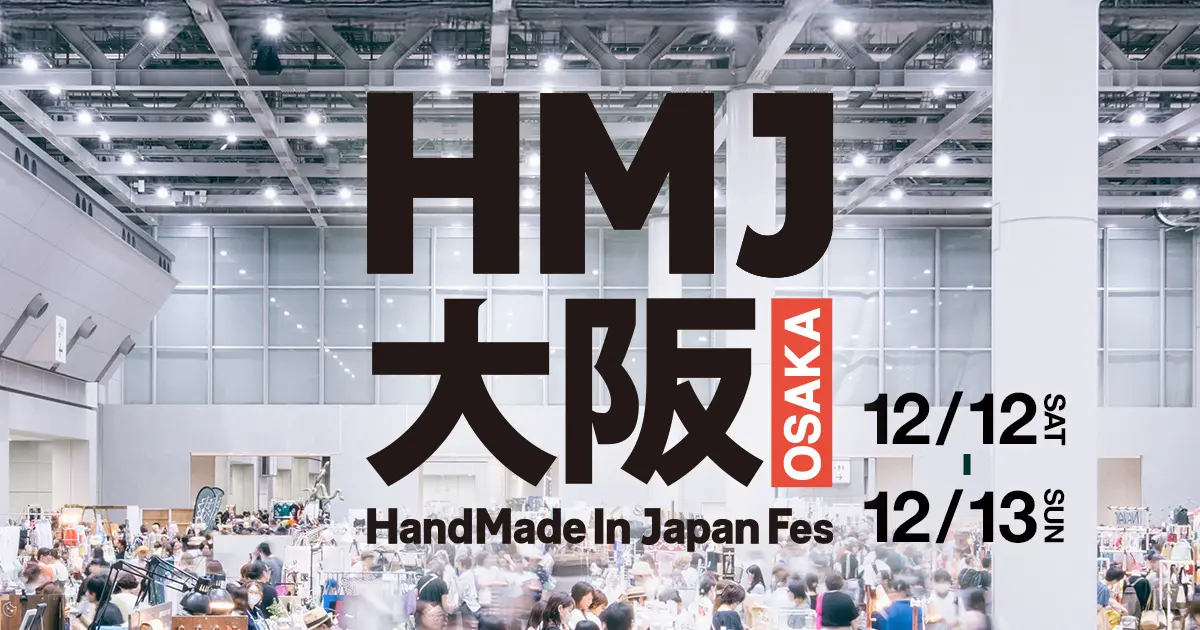
A. “HandMade In Japan Fes’ Osaka” is set to debut on December 12–13, 2026, at INTEX Osaka Hall 2. Check the official site for the latest details.
(Source: HandMade In Japan Fes’ Official Site — HandMade In Japan Fes’)

Summary
HandMade In Japan Fes’ 2026 is a craft event held July 11–12 at Tokyo Big Sight, where visitors can meet makers directly.
Across both days, 3,000 creators from around the country take part in total, with sales, roughly 70 workshops, Creema HASHTAG GALLERY, HMJ Re:Edit, music, live painting, and food all running alongside each other.
That said, the event’s value doesn’t come down to scale — “lots of exhibitors” or “plenty to buy.”
Where did a material come from? Which steps did the maker do by hand? Can the piece be repaired after years of use? For animal-derived materials, what path did it take before becoming a finished piece? Being able to ask makers these questions directly is what an in-person event makes possible.
Editor’s Note
Understanding craft doesn’t start and end with looking at a finished piece. When you touch the material, hear directly from the maker, and work with your own hands, processes and decisions that would otherwise remain invisible begin to emerge.
Rather than trying to see everything at HMJ, pick a few materials or makers that catch your interest and ask one question in depth about how a piece came to be. That conversation is what turns something you bought into something you want to keep using.
Tickets, workshop availability, exhibitors, and the timetable are all subject to change. Check the official site for the latest information before visiting.
(Source: HandMade In Japan Fes’ 2026 Official Site — HandMade In Japan Fes’)


