

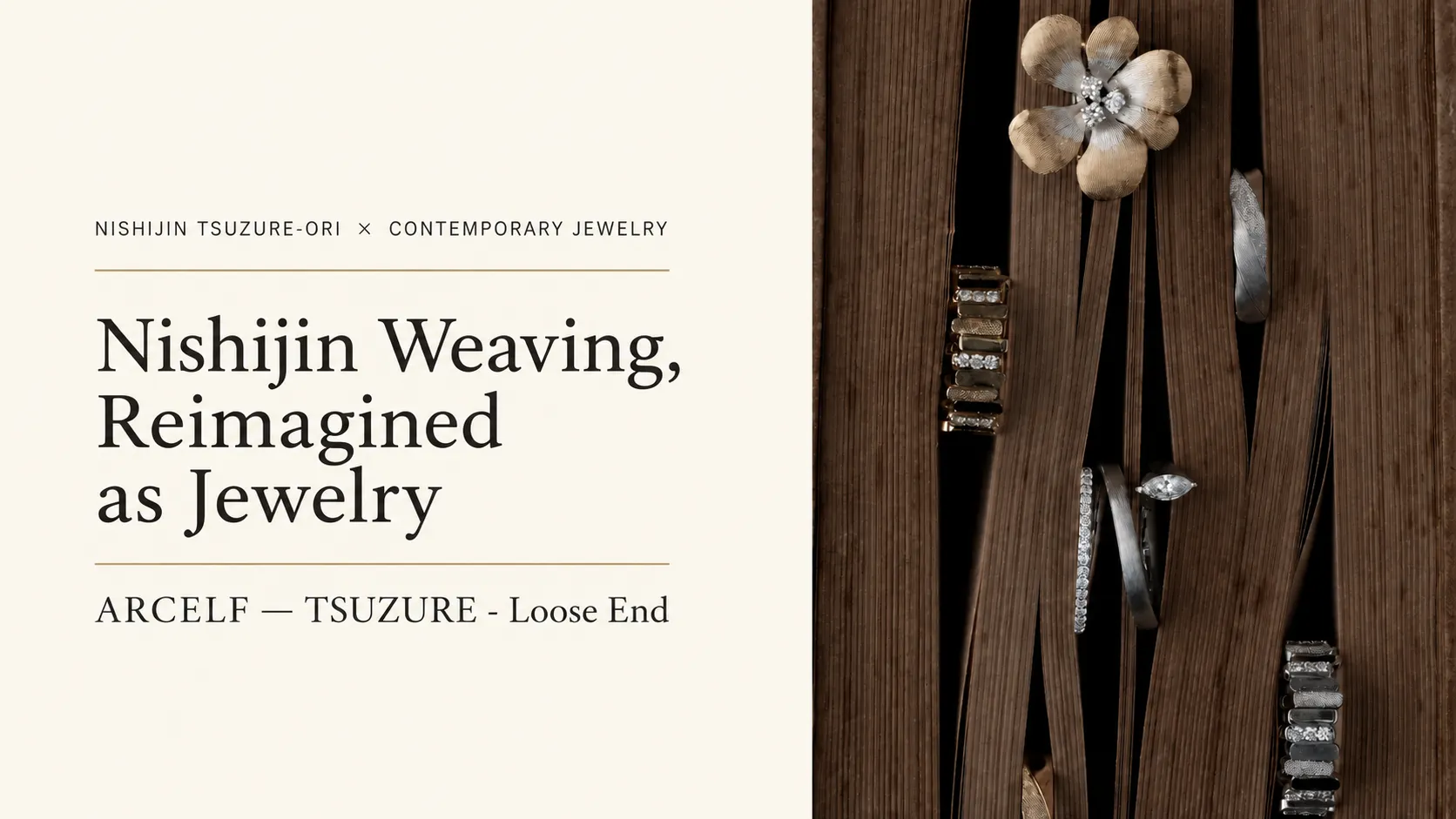
ARCELF, a Japanese jewelry brand that made its Paris debut in September 2026, finds contemporary forms in the structures and everyday scenes of Kyoto’s Nishijin weaving workshops.
Jewelry rooted in craft invites us to look beyond the finished piece. Its appeal also lies in the traditions that inspired it and the relationships behind its making. Understanding those connections can change how we see and wear it.
For its first collection, TSUZURE – Loose End, ARCELF draws on the workshop rather than incorporating Nishijin fabric as decoration. Taut warp threads, unevenly arranged bobbins, the light created by interwoven yarn, and the movement of artisans’ hands become starting points for jewelry design.
Here, we explore Nishijin tsumekaki hon-tsuzure-ori, the handwoven tapestry technique behind the collection; the jewelry it inspired; and the workshop and artisans involved. We also consider ARCELF’s ambition to connect the purchase of a piece with new value and opportunities for craft makers.
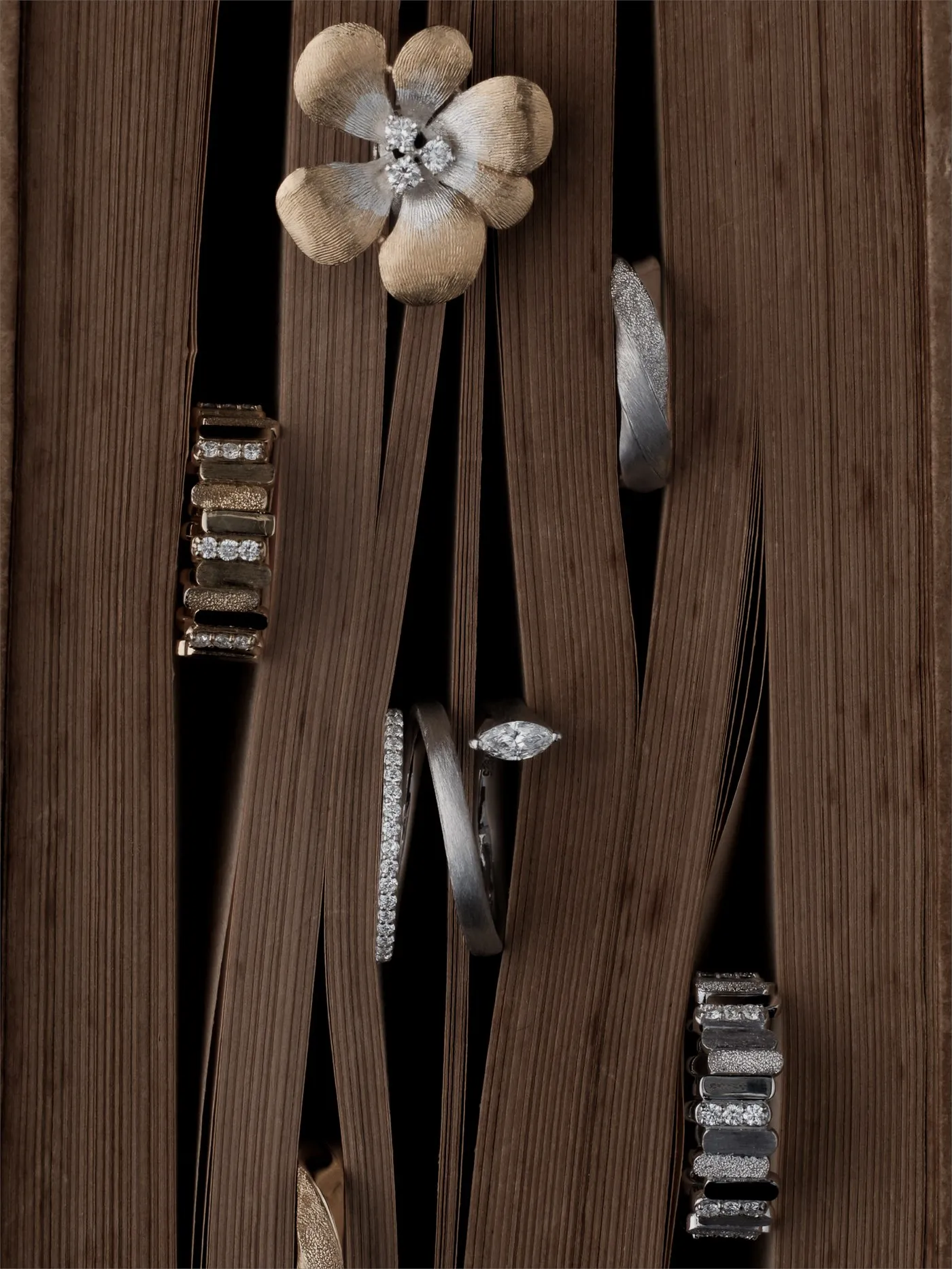
Image courtesy of ARCELF
Table of Contents
What Is ARCELF? A Japanese Jewelry Brand Launched in Paris
ARCELF is a Japanese brand that reimagines fragments of Japanese beauty—artisans’ handwork, local landscapes, inherited materials, and memories—as contemporary jewelry. Its first collection grew out of a collaboration with a tapestry workshop in Kyoto’s Nishijin district.
The brand is operated by ARCELF Co., Ltd. and led by Kyoto-born founder and designer Yukari Fujii. Its concept, “Re-Edit Fragments,” expresses the idea of bringing fragments of beauty into new relationships.
Source: About Us | ARCELF
These “fragments” encompass handwork, landscapes across Japan, and materials and memories passed down through generations. For the first collection, ARCELF also looked at tools encountered in the workshop and the structures and scenes that emerge as threads are woven.
Each collection begins with an encounter with a particular craft. ARCELF visits workshops and the regions around them, exploring materials and techniques alongside local culture and artisans’ perspectives. Those encounters inform the jewelry that follows.
“Re-editing” suggests an approach that goes beyond reproducing an existing motif. In the first collection, light moving through the workshop, overlapping threads, and the qualities revealed by handwork are reinterpreted in a different material and for a different use.
According to her published biography, Fujii grew up close to textiles and craft through her mother, a textile designer, and relatives in the kimono trade. She began her career at ISSEY MIYAKE in retail and visual merchandising before becoming an independent editor and writer. Her work for fashion publications and brands has spanned editorial planning, interviews, writing, and editing, including visits to workshops across Japan.
Fujii founded ARCELF in January 2026 with the aim of creating ongoing work for craft makers as well as telling their stories. This account of her background draws on the brand’s official profile and launch materials.
Source: Yukari Fujii, Founder and Designer | ARCELF

The Paris Debut: Bijorhca and Its BRILLIANT Section
ARCELF launched at Bijorhca Paris, the international jewelry trade show held at Paris Expo Porte de Versailles from September 5 to 7, 2026.
Bijorhca is a French international trade show specializing in jewelry, watches, and precious-metal accessories. The organizer describes it as a meeting place for brands, designers, and suppliers of materials, components, and services, where buyers and other industry professionals can discover products and develop business relationships.
Source: Bijorhca Paris | WSN Group
According to ARCELF, the brand presented TSUZURE – Loose End in BRILLIANT, a curated section for selected brands. Its official online store also launched on September 5, 2026.
Source: ARCELF Launches in Paris on September 5, 2026 | ARCELF
Choosing Paris, with its international buyers and specialists, as the setting for the debut reflects the brand’s intention to connect Japanese craft with audiences abroad.
An international launch is a starting point. The lasting opportunity lies in creating jewelry that appeals to people unfamiliar with Nishijin weaving, then opening a path from the piece itself to an interest in the techniques and workshops behind it.
What Is Nishijin Tsumekaki Hon-Tsuzure-ori?
Nishijin tsumekaki hon-tsuzure-ori is a handwoven tapestry technique in which an artisan follows a design placed beneath the warp threads and uses specially shaped fingernails to pack the weft into place, gradually building the pattern.
Woven textiles generally combine lengthwise warp threads with crosswise weft threads. In this technique, the weaver inserts each colored weft only where it is needed, then packs it down, one pass at a time, using fingernails shaped for the task.
The Nishijin Textile Industry Association also describes this as a highly skilled technique, with the design beneath the warp serving as a guide while the artisan’s fingernails bring the weft threads together.
Source: Learning About Nishijin Weaving | Nishijin Textile Industry Association
Soshitsu Tsuzureen explains that the tightly tensioned warp can produce a sound resembling a koto, a Japanese stringed instrument, when struck by a fingernail or shuttle. The fingernail is both part of the weaver’s body and a tool carefully adapted to the material.
Source: What Is Tsuzure Weaving? | Soshitsu Tsuzureen
Craft Terminology: Nishijin Tsumekaki Hon-Tsuzure-ori
This tapestry technique has been passed down in Kyoto’s Nishijin district. Working from a design beneath the warp, the artisan uses fingernails to pack colored weft threads into the pattern. Color adjustments and curved lines depend on the weaver’s judgment, so even pieces based on the same design carry individual nuances.
Tsuzure-ori is a broader weaving tradition that also exists outside Nishijin. The full term Nishijin tsumekaki hon-tsuzure-ori refers here to the particular fingernail-assisted technique practiced in Kyoto that inspired ARCELF’s collection.
Nishijin textiles are designated as a traditional craft by Japan’s Minister of Economy, Trade and Industry. That designation applies to the wider Nishijin textile category; the individual techniques used within it should be understood in that broader context.
Source: Traditional Crafts of the Kansai Region | Kansai Bureau of Economy, Trade and Industry
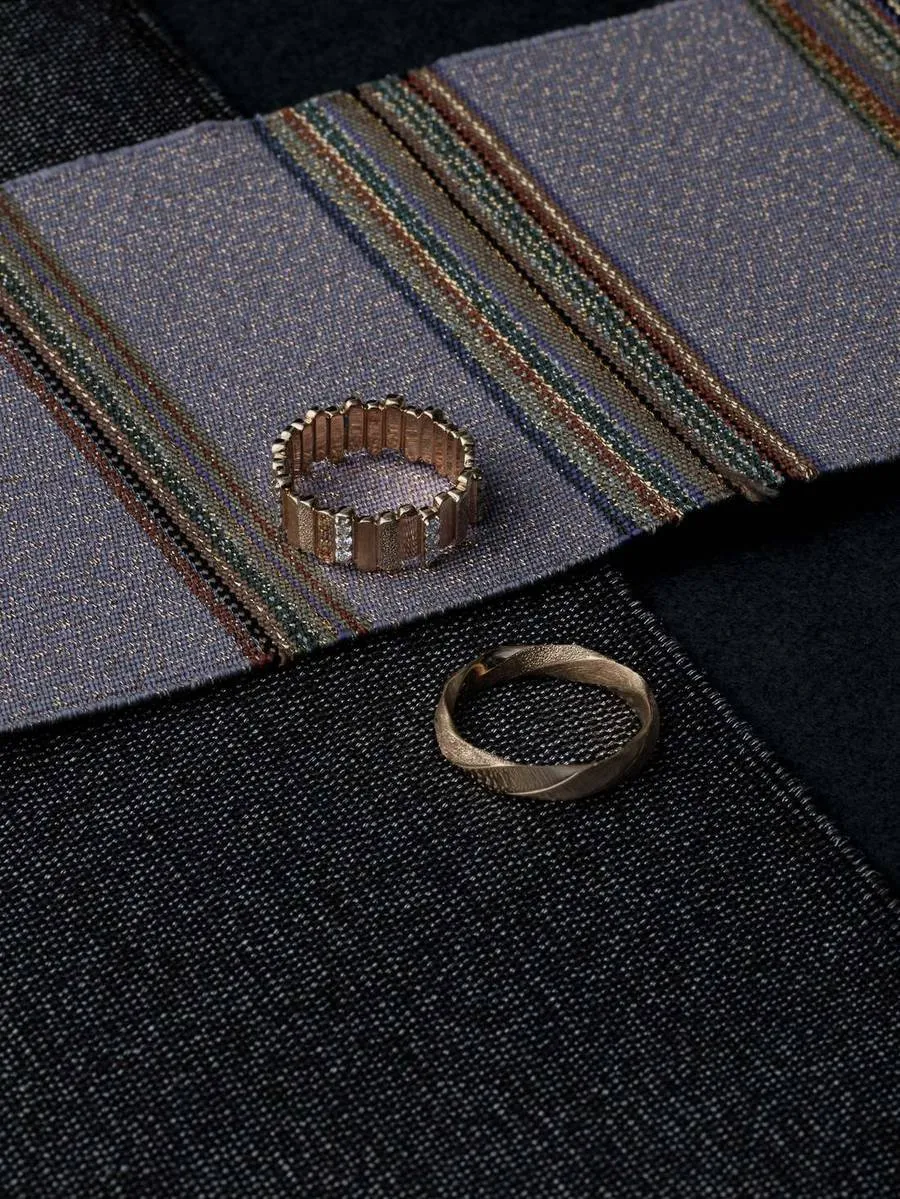
Image courtesy of ARCELF
Describing tsuzure-ori simply as luxurious or handmade misses much of what makes it distinctive. Its character emerges through precise decisions: how much pressure to apply, which thread to choose, where to change color, and how to shape a curve through the movement of a fingernail.
ARCELF’s interest extends to the process behind the finished textile: tensioned warp threads, irregular arrangements of bobbins, light emerging from interwoven yarn, and the movement of the weaver’s hands.
The name “Loose End” evokes both a thread’s free end and something still unfinished. As an editorial reading, rather than an official explanation of the name, it suggests the collection’s attention to fragments found around the finished work.
Soshitsu Tsuzureen and Master Weaver Kikuo Hirano
ARCELF’s first collection was developed in collaboration with Soshitsu Tsuzureen, a tsuzure weaving preservation association and workshop in Nishijin, in Kyoto’s Kamigyo ward.
The association brings together artisans led by Kikuo Hirano, a tsuzure weaver and certified Traditional Craftsperson. It works to preserve and develop the technique through exchanges between experienced and younger weavers, workshop visits, and hands-on weaving experiences.
Its work extends beyond obi, the sashes worn with kimono, to framed textiles, hanging scrolls, festival curtains, lighting, and accessories. This range shows how tsuzure weaving can take on new forms and uses.
Source: About the Tsuzure Weaving Preservation Association | Soshitsu Tsuzureen
According to the workshop’s official biography, Hirano was born in Nishijin in 1939 and learned from his father, who ran a tsuzure weaving business. He developed his skills over many years at Kawashima Selkon Textiles, later helped train successors at the Nishijin Textile Center, and founded Soshitsu Tsuzureen in 2011. The biography also records his certification as a Traditional Craftsperson and his receipt of the Order of the Sacred Treasure, Silver Rays.
ARCELF’s launch materials describe Hirano as having entered the craft at 15 and devoted 72 years to it. These figures and descriptions of his practice are drawn from the materials the brand released on September 5, 2026.
ARCELF records techniques and artisans’ words through photography, film, sound, and writing. A brand book documenting the workshop and the background to the collection is also provided to customers who purchase its jewelry.
Documentation cannot replace the physical knowledge of weaving. It can, however, preserve the workshop’s environment, the artisan’s thinking, and the discoveries made through dialogue across disciplines. Its value lies in helping others understand the practice and begin new conversations.
TSUZURE – Loose End: How Weaving Becomes Jewelry
TSUZURE – Loose End reinterprets qualities observed in the workshop as metal jewelry: layers of wound thread, the two faces of a textile, the fullness of silk bundles, and the light produced as threads interweave.
The collection is made to order, with each piece individually crafted by jewelry artisans in Japan. The official collection page presents rings, earrings, bracelets, and necklaces.
Source: TSUZURE – Loose End | ARCELF
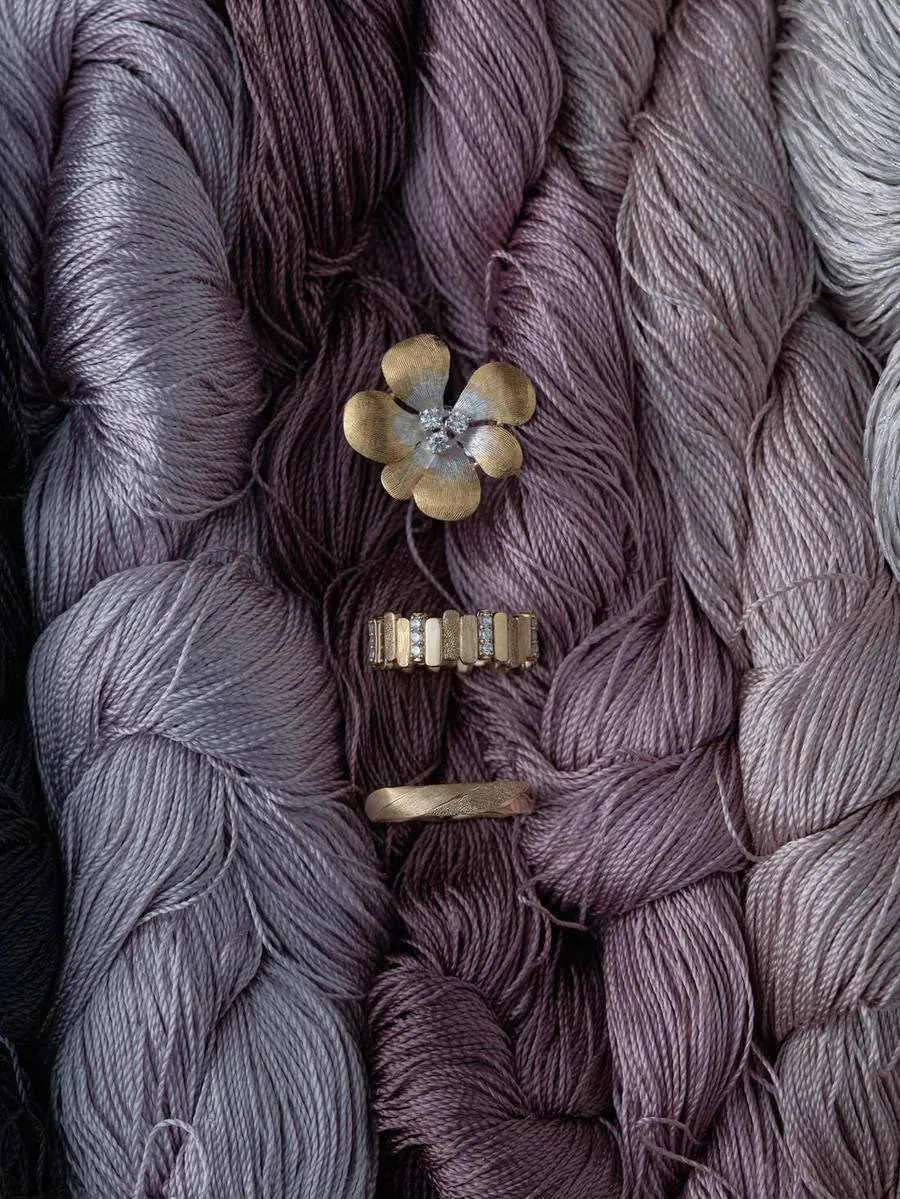
Image courtesy of ARCELF
The TSUZURE ring takes its inspiration from layers of wound thread in the Nishijin workshop and the subtle tonal variations of finished textiles.
A sequence of bars receives different surface treatments, including mirror polishing, hairline finishes, and diamond cutting, creating alternating areas of bright reflection and softer light. Diamonds set between the bars punctuate the continuous form.
The official product page describes a version in 925 sterling silver with a thick layer of 10K gold plating and lab-grown diamonds. Depending on the design, customers can also inquire about versions in 10K gold, 18K gold, or platinum.
Source: TSUZURE | ARCELF
Jewelry Terminology: Vermeil
Vermeil refers to a gold finish over a silver base. Terminology and standards relating to gold purity and plating thickness vary by market and specification. When choosing a piece, check its base metal, gold purity, plating details, and whether refinishing is available.
The ORI ring draws on the way the pattern in tsuzure weaving appears on both sides of the textile. Surfaces with contrasting textures flow into a spiral, while the inside receives the same attention to finishing as the outside.
The design explores the relationship between front and reverse as parts of one continuous structure, rather than reproducing the textile’s pattern.
ORI — Spiral is inspired by silk threads gathering into a swirling bundle and gradually taking shape. According to the official description, the band varies in width from 1.5 to 3.0 millimeters and features 18 diamonds alongside a marquise-cut diamond.
Source: ORI — Spiral | ARCELF
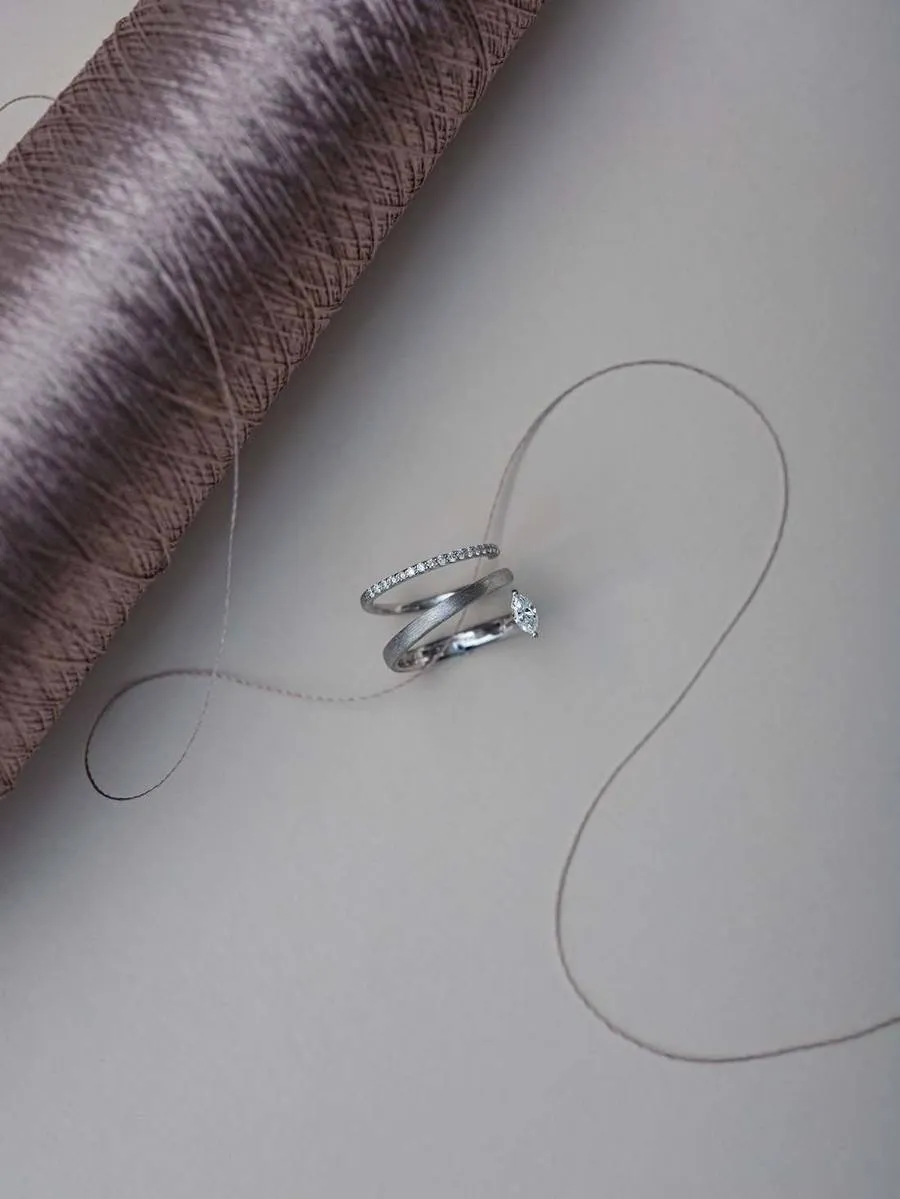
Image courtesy of ARCELF
TSUZURE — Bloom and Metalworker Katsuhiko Sakamoto
TSUZURE — Bloom began with the flower-like fullness of silk bundles piled beside an artisan in the workshop.
ARCELF explains that its five petals are individually formed by hand, with surface treatments suggesting the fine flow of silk fibers. Precious-metal artisan Katsuhiko Sakamoto developed the sculptural form, and jewelry artisans in Kofu make the ring.
The brand’s materials identify Sakamoto as a recipient of the Contemporary Master Craftsman distinction. This is the commonly used name for Japan’s commendation of outstanding skilled workers, awarded by the Minister of Health, Labour and Welfare to leading practitioners in their fields.
Sakamoto’s distinction is reported here as described in ARCELF’s announcement. Details such as the award year and official occupational category should be checked against the ministry’s recipient records.
Source: Commendation of Outstanding Skilled Workers | Ministry of Health, Labour and Welfare

Image courtesy of ARCELF
Reinterpreting soft thread in hard metal involves more than matching an outline. A designer must decide how texture becomes a finish, how overlapping strands become structure, and how the placement of stones recalls a particular quality of light. Each choice responds to what the new material can do.
Workshops hold forms of beauty that may leave no trace in the finished object: well-used tools, temporarily gathered thread, material offcuts, and shapes that exist only during making. TSUZURE – Loose End finds inspiration in those working moments as well as in completed textiles.
How Can Jewelry Help Sustain Craft?
For a craft collaboration to support a lasting cycle of value, it needs to bring work, income, recognition, documentation, and future commissions back to the workshops and makers involved.
ARCELF aims to create jewelry people want to wear today and direct the value it generates back toward craft practice. In this model, craft has an active place in contemporary life as well as a history to preserve.
The brand describes a process centered on one craft for each collection: visiting workshops, speaking with artisans, and documenting techniques, materials, ideas, culture, and aesthetics. It also states that it seeks to collaborate directly with workshops wherever possible, connecting demand for its pieces with value returned to craft makers.
Source: Sustaining Craft for the Future | ARCELF
Working with a workshop involves discussing techniques and the context of production, and sharing an understanding of each participant’s role. For its first collection, ARCELF identifies both the weaving workshop that informed the designs and the makers responsible for shaping and producing the jewelry.
Publicly available information describes the participants’ roles as follows.
| Participant | Role Described in Public Information |
|---|---|
| ARCELF | Workshop research, editorial work, design, brand management, sales, and communications |
| Soshitsu Tsuzureen | Collaborating workshop providing an encounter with tsuzure weaving techniques, working practices, and ideas |
| Katsuhiko Sakamoto | Development of the sculptural form of TSUZURE — Bloom |
| Jewelry artisans in Kofu | Jewelry production, including metalworking, polishing, and stone setting |
| Customers | Commissioning and wearing the pieces, and learning about their background |
This cycle of value is best understood as the business model ARCELF is working toward.


Editor’s Perspective
When considering a craft collaboration, we look at the beauty of the finished piece alongside the tradition that inspired it and the makers’ contributions. Its potential grows through relationships: the workshop’s background is shared, its artisans are respected, and demand for a piece leads to further work.
ARCELF interests us because it places value on dialogue with workshops and on documenting the context of making, while seeking to return value to craft through jewelry. We look forward to seeing how those relationships develop through future collections.
The following are general principles Kogei Japonica considers valuable in collaborations between brands and craft makers. They are editorial considerations, not a list of concerns identified at ARCELF.
- Are the roles of artisans and workshops clearly described?
- Are there arrangements for paying or commissioning research, advice, production, and technical contributions?
- Is the workload associated with brand growth shared fairly?
- Do documentation and communications respect the craft’s background and the makers’ perspectives?
- Are artisans and workshops consistently credited?
- Is there scope for further commissions or joint development beyond the initial launch?
- Can customers understand whose work they are supporting and what it contributes?
Sales matter to the continuity of craft. When volume becomes the sole measure of success, however, pressure on costs and production speed can fall disproportionately on makers.
A lasting cycle of value includes the conditions that allow people to keep working: time to teach, appropriate recognition, and room to experiment with new forms of expression. Revenue is one part of that wider relationship.
ARCELF has announced that its next collection is being developed with a Kyoto urushi lacquer artisan whose work includes the restoration of temples and shrines.
Where to Buy ARCELF Jewelry and See the Collection
ARCELF’s jewelry can be explored through its official online store. The brand has also announced presentations in Paris and Japan. Check official updates for venue details and admission arrangements.
The brand debuted in the BRILLIANT section of Bijorhca Paris at Paris Expo Porte de Versailles, September 5–7, 2026. Bijorhca is a trade event primarily for buyers, press, designers, and other industry professionals; admission requirements are set by the organizer.
Source: Bijorhca Paris Event Information | WSN Group
A solo pop-up is scheduled for September 10–13, 2026, at ESPACE SYLVIA RIELLE on Place des Vosges in Paris.
ARCELF says visitors will be able to view, try on, and order the jewelry. The presentation will also introduce the Nishijin tapestry weaving that inspired it, photographs and films from the workshop, and a sound work based on recordings of the weaving process.
Announced opening hours are noon–8 p.m. on September 10–12 and noon–4 p.m. on September 13, local Paris time. An invitation-only closing party is planned after 4 p.m. on the final day. Check the latest announcement before visiting, as arrangements may change.
Source: ARCELF’s First Pop-up at Place des Vosges | ARCELF
In Japan, ARCELF has announced its first domestic exhibition in Tokyo for October 29–31, 2026, followed by participation in New Jewelry TOKYO 2026 on November 27–29.
The dates for New Jewelry TOKYO 2026 are also listed by the organizer. For ARCELF’s participation details, the venue for its first Tokyo exhibition, and admission arrangements, consult the latest brand and event announcements.
Source: New Jewelry TOKYO 2026 | New Jewelry LLC.
The official store provides information on individual pieces, materials, dimensions, lead times, and care. The English-language collection page listed prices from $800 to $3,400 when checked for the Japanese edition on September 5, 2026. Prices may vary by design, material, displayed currency, and delivery region.
According to ARCELF, all products became available to purchase through its official online store on September 5, 2026. Check each product page when ordering for availability, pricing, sizes, lead times, and return conditions.
Band width affects how a ring feels on the finger. Some made-to-order designs cannot be resized after completion, so consider the ring’s inner circumference and width, as well as how it passes over the knuckle, rather than relying on a size number alone.
Source: Collection and Product Information | ARCELF
For updates, visit ARCELF’s official website and Instagram account.
Source: ARCELF Official Website
Source: @arcelf_official | Instagram
Businesses and organizations considering craft-based product development, collaboration with artisans or workshops, editorial coverage, or international communications can also contact Kogei Japonica. We help frame discussions around roles, compensation, rights, credits, and the scope for ongoing commissions.

Frequently Asked Questions
- Q1. Is tsuzure-ori the same as Nishijin tsumekaki hon-tsuzure-ori?
- Tsuzure-ori is a broader tapestry-weaving tradition practiced beyond Nishijin. This article focuses on Nishijin tsumekaki hon-tsuzure-ori, the Kyoto technique in which artisans pack the weft threads into place with specially shaped fingernails.
- Q2. How does this technique differ from other Nishijin weaving methods?
- The artisan follows a design placed beneath the warp threads and uses fingernails to pack each pass of colored weft into the required area. This demanding handweaving technique gives the weaver considerable control over color and curved lines.
- Q3. Does ARCELF use Nishijin fabric in its jewelry?
- The featured rings are made from materials such as silver and diamonds, rather than incorporating the woven cloth itself. The first collection reinterprets the workshop’s overlapping threads, light, tension, and the relationship between the textile’s two faces as jewelry.
- Q4. How does ARCELF work with the weaving workshop?
- ARCELF names Soshitsu Tsuzureen as its collaborator for the first collection and draws on workshop research and dialogue with artisans. It records techniques and artisans’ words through photography, film, sound, and writing. Customers also receive a brand book documenting the workshop and the collection’s background.
- Q5. What does ARCELF mean by returning value to workshops?
- The idea is that demand for jewelry creates work and income for makers, helping support future production and the passing on of skills. This is the business model ARCELF aims to develop.
- Q6. Where can I buy ARCELF jewelry?
- You can purchase through ARCELF’s official online store. The brand confirms that all products became available to buy online on September 5, 2026. Exhibitions and pop-ups also offer opportunities to order. Check official product information for lead times and available sizes.
- Q7. How much does ARCELF jewelry cost?
- The English-language official collection page listed prices from $800 to $3,400 when checked for the Japanese edition on September 5, 2026. Prices may vary by material, specification, currency, and delivery region, so confirm the current price before ordering.
- Q8. What materials does ARCELF use?
- Materials vary by piece and include 925 sterling silver, gold-plated finishes, rhodium plating, and lab-grown diamonds. Some designs can also be discussed in 10K gold, 18K gold, or platinum.
- Q9. Is every piece made to order?
- ARCELF describes its jewelry as entirely made to order in Japan. Product pages give an estimated production time of around one to one and a half months for representative rings, although this may vary by piece and order timing.
- Q10. What can other brands learn from this collaboration?
- Naming the workshop, maintaining direct dialogue, documenting the making process, and producing to order are useful points of reference. For any new collaboration, the participants should also agree on prototype costs, compensation, intellectual property, credits, production responsibilities, and what happens when the partnership ends.
A New Relationship Between Jewelry and Craft
ARCELF seeks to reimagine fragments of Japanese beauty as contemporary jewelry, connecting the choice to purchase a piece with future work for craft makers.
TSUZURE – Loose End takes its cues from the process of weaving: tensioned warp threads, uneven layers of wound yarn, light created by interwoven strands, and the movement of artisans’ hands. The collection gives those observed structures and qualities a new form in jewelry.
At Kogei Japonica, our interest extends beyond the launch. We want to see how ongoing commissions support the collaborating workshops, how respect for craft and its makers is maintained, and whether these relationships help create space for future practitioners. Those possibilities will become clearer as the collaborations develop.
Following who gains work from a collaboration and what it makes possible next is one way to engage with craft beyond a passing trend.
