

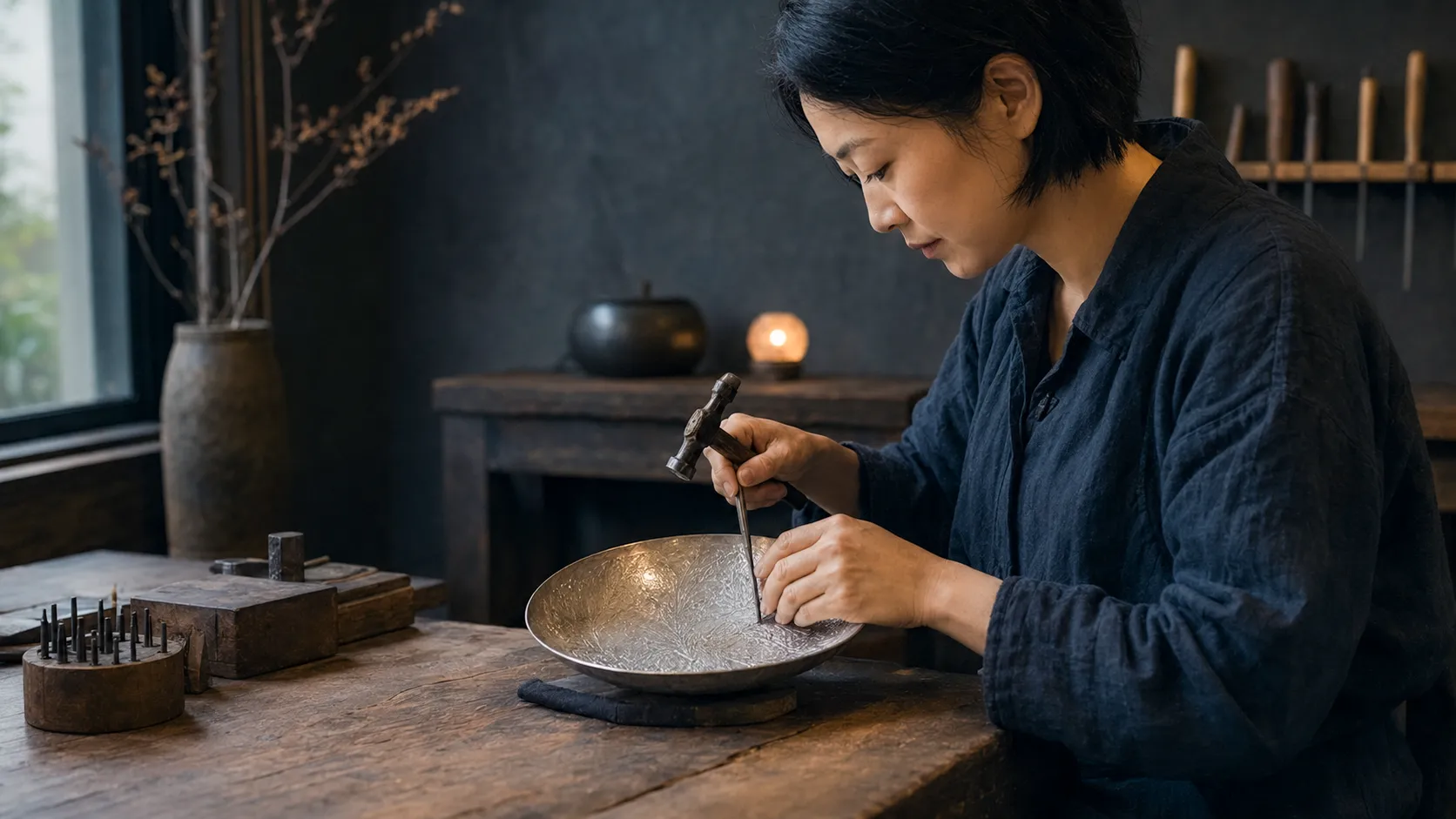
Overseas museums are drawn to contemporary Japanese metalwork not only for the precision of the hammer work, but for the artistic vision that keeps renewing alloy, color, surface, and form.
When you look into Japanese metal artists or contemporary metalwork, what you usually find is fragmented information: a Living National Treasure’s biography, a basic explanation of a technique, an exhibition announcement — with little sense of what is actually being valued overseas.
In recent years, U.S. museums have built systematic collections and research programs around contemporary Japanese metalwork, and a New York gallery has held recurring exhibitions focused on women metal artists. This is not a passing “Japan boom” but a movement toward the infrastructure that supports acquisition, conservation, research, display, and circulation.
This article compares overseas holdings, exhibitions, techniques, and teacher-student lineages through three artists: Yukie Osumi (Osumi Yukie), Motoko Oshiyama (Oshiyama Motoko), and Noriko Hagino (Hagino Noriko).
It is not simply a “three artists to watch” list. Rather than using overseas recognition as grounds for ranking, it reads what museums and galleries are choosing to collect, research, and pass on to the next generation.
Table of Contents
Why Are Overseas Museums Paying Attention to Contemporary Japanese Metalwork Now?
Interest abroad shows up not only in one-off exhibitions but as a continuous system supporting acquisition, conservation, research, artist residencies, and education.
Three factors help explain why contemporary Japanese metalwork is gaining attention overseas.
- Advanced techniques such as tankin (hammering), chūkin (casting), and chōkin (chasing and engraving) are being carried into contemporary form
- Through colored metals (irogane) such as shakudō and shibuichi, along with inlay (zōgan) and patination, the metal itself becomes a means of color expression
- The transmission of skill through teacher-student lineage and the expression of the individual artist can be seen at the same time
What matters is that this is not only about “old techniques surviving.” A handed-down technique branches, from artist to artist, into different contours, surfaces, colors, and uses. Being able to follow that change through both the works and the documentation is what gives the field its depth as a subject of research.
What Does the Smithsonian Collect, and What Does It Research?
In 2022, the Smithsonian’s National Museum of Asian Art received the Shirley Z. Johnson Collection of Contemporary Japanese Metalwork. The museum’s own announcement positions it as an acquisition without precedent in scale, not only within the museum but across the Western world.
The collection includes flower vessels and other objects made in silver, copper, and gold, along with tools such as hammers, tagane (chisels), and the ategane (stakes) used in Japanese metalwork. The works of contemporary Japanese metalwork bequeathed by Shirley Z. Johnson number more than 60.
(Source: Shirley Z. Johnson Collection of Contemporary Japanese Metalwork Announcement — Smithsonian National Museum of Asian Art)
From March 2, 2024, to January 11, 2026, the museum held “Striking Objects: Contemporary Japanese Metalwork.” Through 17 works of contemporary Japanese metalwork and 18 metalworking tools, the exhibition showed how the basic act of striking with a hammer gives rise to a wide range of forms and surface effects.
(Source: Striking Objects: Contemporary Japanese Metalwork — Smithsonian National Museum of Asian Art)
This work does not stop at displaying pieces as “beautiful Japanese craft.” The Shirley Z. Johnson Endowment supports a curatorial post in Japanese art, artist residencies, conservation and research projects, fellowships, workshops, symposia, and new acquisitions.
Note that the first Shirley Z. Johnson Assistant Curator of Japanese Art took up the post in September 2021, before the collection was received in 2022. It is more accurate to say not that “the gift prompted the curatorial post,” but that the collection joined a research structure already grounded in the endowment, expanding the base for collecting and researching contemporary Japanese metalwork.
Editor’s Note
What draws my attention in this trend is less the overseas acquisition itself than what happens after acquisition. By linking a work not only to its own display but to tools, working processes, teacher-student relationships, and conservation research, metalwork becomes a continuing subject of study. The substance of overseas recognition lies not at a single point — “the work sold,” “it entered a famous museum” — but in the fact that a structure for continuing to research the work has been created.
What Did the 2026 New York Exhibition Make Visible?
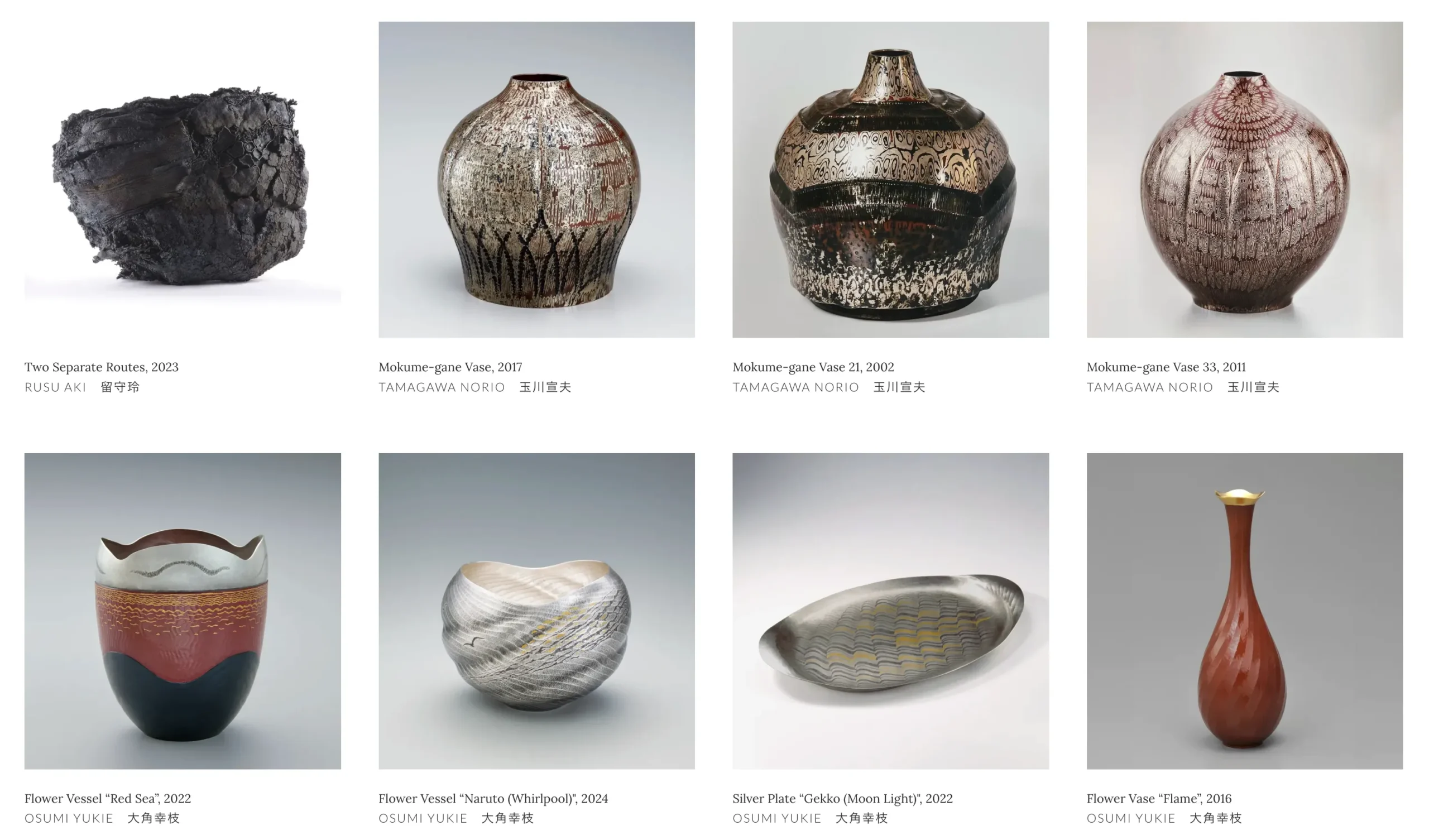
Asia Week New York 2026
At Onishi Gallery in New York, “Heated Colors, Hammered Forms: Female Metal Artists of Japan” has been held over several years, focused on women metal artists.
The 2025 exhibition presented five artists: Yukie Osumi, Motoko Oshiyama, Noriko Hagino, Yoshiko Okamoto, and Masako Otsuki. Through works in gold, silver, platinum, copper, lead, and alloys developed in Japanese metalwork, the exhibition brought women metal artists into clearer view.
(Source: Onishi Gallery Celebrates Female Metal Artists of Japan — Asia Week New York)
Then, from March 19 to April 3, 2026, the same gallery held “KOGEI Exhibition: Metalwork and Lacquerware.” In the metalwork section, works by Yukie Osumi, Motoko Oshiyama, and Noriko Hagino were shown.
The gallery’s announcement positions this exhibition as a step toward a museum touring project, “Contemporary Metal and Lacquer from Japan,” due to begin in 2027 at the Minneapolis Institute of Art. The tour is planned to travel to North American museums thereafter, though the venues and dates to come should be confirmed against the latest official announcements.
(Source: KOGEI Exhibition: Metalwork and Lacquerware — Onishi Gallery)
This exhibition matters for making visible the presence of women metal artists, which had been hard to see. But artists should not be lumped together on the single shared point of being women.
Osumi applies nunome-zōgan (textile-weave inlay) to vessels raised by hammering; Oshiyama draws a stirred pattern (kakuhanmon) out of several metals; Hagino composes color and line through hammering and hagiawase (joining). Even when they exhibit in the same show, the ways they work on metal differ greatly.
How Do Tankin, Chūkin, and Chōkin Differ in Contemporary Japanese Metalwork?
Tankin, chūkin, and chōkin differ mainly in how form is made and how the surface is worked. In actual pieces, several techniques may be combined.
| Technique | Basic method | Elements mainly involved | What to look for in a work |
|---|---|---|---|
| Tankin (hammering) | Shaping a metal sheet or ingot by striking it with a hammer | Form, thickness, curved surfaces, hammer marks | Marks of striking, the rise of the vessel, the joins |
| Chūkin (casting) | Pouring molten metal into a mold to shape it | Model, mold, cast skin, sense of mass | Surface skin, thickness, finishing after casting |
| Chōkin (chasing and engraving) | Carving, striking, piercing, and inlaying with chisels and the like | Line, pattern, relief, contrasting materials | Depth of carving, inlay, combinations of metal color |
The Japan Art Crafts Association likewise lists, as representative metalwork techniques, chūkin (placing molten metal into a mold), tankin (making form by striking), and chōkin (adding pattern to shaped metal).
(Source: Introduction to the Skills of Living National Treasures in Metalwork — Japan Art Crafts Association)


Tankin: Making Metal Three-Dimensional by Striking It
Tankin is a technique of repeatedly striking a metal sheet or block with a wooden or metal hammer to form a vessel or three-dimensional object.
Representative processes include “shibori,” raising a single sheet by hammering it upward; “uchidashi,” striking from the reverse and elsewhere to create relief; and “tsugiawase / hagiawase,” joining separately formed metal sheets.
Because metal hardens as work continues, it is heated as needed and returned to a workable state through yakinamashi (annealing). By repeating the processes of striking, heating, and shaping, the maker gradually approaches a three-dimensional form.
Hammer marks (tsuchime) are not necessarily a pattern added afterward. Some retain the traces of forming, some smooth the marks of striking to a polished finish, and some are designed for expression by varying the shape of the hammer and the way it strikes.
For that reason, when looking at a hammered work, you need to consider not just “whether there are hammer marks” but whether those traces are the result of building structure or a deliberate surface expression.
How Do Chūkin and Chōkin Differ?
Chūkin is a technique of pouring molten metal into a mold, then removing it once it has cooled and set, and finishing it. The design of the model and mold has much to do with the work’s contour and surface.
Chōkin, by contrast, is a technique of working metal already shaped by casting or forging — carving lines with a chisel, piercing it, or inlaying another metal.
Thinking of chōkin only as “the technique of engraving pictures into metal” fails to capture its actual range. There are many methods: kebori, which incises fine lines; kettobori, a series of wedge-shaped points; katakiribori, which carves one side deeply to produce a sense of relief; and inlay, which sets one metal into another.
Hagiawase is not a decorative technique that ornaments the surface, but a technique of joining separately formed metal sheets or components to build the form. It needs to be understood not in the same category as chōkin or nunome-zōgan, but as a way of building the structure of a work.
Why Do Japan’s Own Alloys and Coloring Become Color Expression?
In contemporary Japanese metalwork, the color of a metal is not determined by the material’s name alone. Through the proportions of an alloy, joining, polishing, heating, and coloring treatments, a wide range of appearances emerges — black, gray, reddish-brown, silver with a bluish cast.
Representative colored metals include shakudō, whose main components are copper and gold, and shibuichi, whose main components are copper and silver. Shakudō, with appropriate coloring, takes on a color close to blackish purple; shibuichi shows a grayish character depending on its composition and finish.
Niiro coloring (niiro-chakushoku) is a method of treating the metal surface with a chemical solution and drawing out color through a chemical reaction. It is different in nature from painting, which covers the surface with pigment: the composition of the base metal, the preparation, the state of the solution, and time all bear on the result.
What Is Contemporary Japanese Metalwork?
It is metal craft that, on a foundation of techniques such as tankin, chūkin, and chōkin, develops alloy, color, surface, use, and form as contemporary expression. It does not mean only reproducing traditional forms as they were.
What Sets Yukie Osumi, Motoko Oshiyama, and Noriko Hagino Apart?
The difference between the three artists lies not in gender but in how they compose the forming, joining, color, surface, and contour of metal.
| Item | Yukie Osumi | Motoko Oshiyama | Noriko Hagino |
|---|---|---|---|
| Main techniques | Tankin, uchidashi, nunome-zōgan | Tankin, chōkin, uchidashi, kakuhanmon | Tankin, uchidashi, hagiawase, inlay |
| Material and color character | Gold, lead, platinum and more on a silver body | Combines silver, copper, shakudō, brass | Uses color contrasts of silver, gold, copper, shakudō, shibuichi |
| Key to reading the expression | Natural phenomena, curved vessel surfaces, light and gradation through inlay | Fluid, abstract patterns produced by multiple metals | Joining lines, curved surfaces, composition through different colored metals |
| Background of training | After graduating from Tokyo University of the Arts, studied under Ikkoku Kashima, Shirō Sekiya, Moriyuki Katsura | After graduating from Bunka Women’s University, studied under Moriyuki Katsura, Hōseki Okuyama | After completing the advanced course at Musashino Art Junior College, studied under Shirō Sekiya |
| Confirmable overseas context | Residency and holdings at the Smithsonian, Onishi Gallery shows | Holdings at the Metropolitan Museum of Art and Smithsonian, Onishi Gallery shows | Holdings at the Smithsonian, Onishi Gallery shows |
This comparison is not meant to decide who is best. It is a comparison for telling apart which artistic problem each artist has chosen to pursue, within the same field of metalwork.
Yukie Osumi — Metal as Scenery, Through Hammering and Textile-Weave Inlay

Yukie Osumi is known for work in which she forms metal sheets such as silver by hammering, then decorates them with gold, lead, and platinum through nunome-zōgan.
Nunome-zōgan is a technique in which fine, cloth-like incisions are made in the metal surface with a chisel, and thin metal is then struck onto them and fixed in place. Rather than simply attaching one metal onto the surface of another, it is held by biting into the fine unevenness.
In Osumi’s work, the vessel’s curved surface and the lines and planes of the inlay are not separated. Gold and lead introduce different qualities of light against the silver ground, and scenery rises up that suggests waves, wind, clouds, and flow.
The Smithsonian presents Osumi as the first artist in its Japanese metalworking design residency. The museum’s own account describes work in which gold and lead foils are applied to a silver body through nunome-zōgan, and polishing draws out the gradation of silver and lead and the shine of gold.
(Source: Osumi Yukie: Wind and Waves — Smithsonian National Museum of Asian Art)
In 2015, Osumi was recognized as a holder of the Important Intangible Cultural Property “tankin” — what is popularly called a Living National Treasure. Her official biography from the Japan Art Crafts Association confirms that she graduated from Tokyo University of the Arts in 1969 and studied under Ikkoku Kashima, Shirō Sekiya, and Moriyuki Katsura.
(Source: Living National Treasure Yukie Osumi — Japan Art Crafts Association)

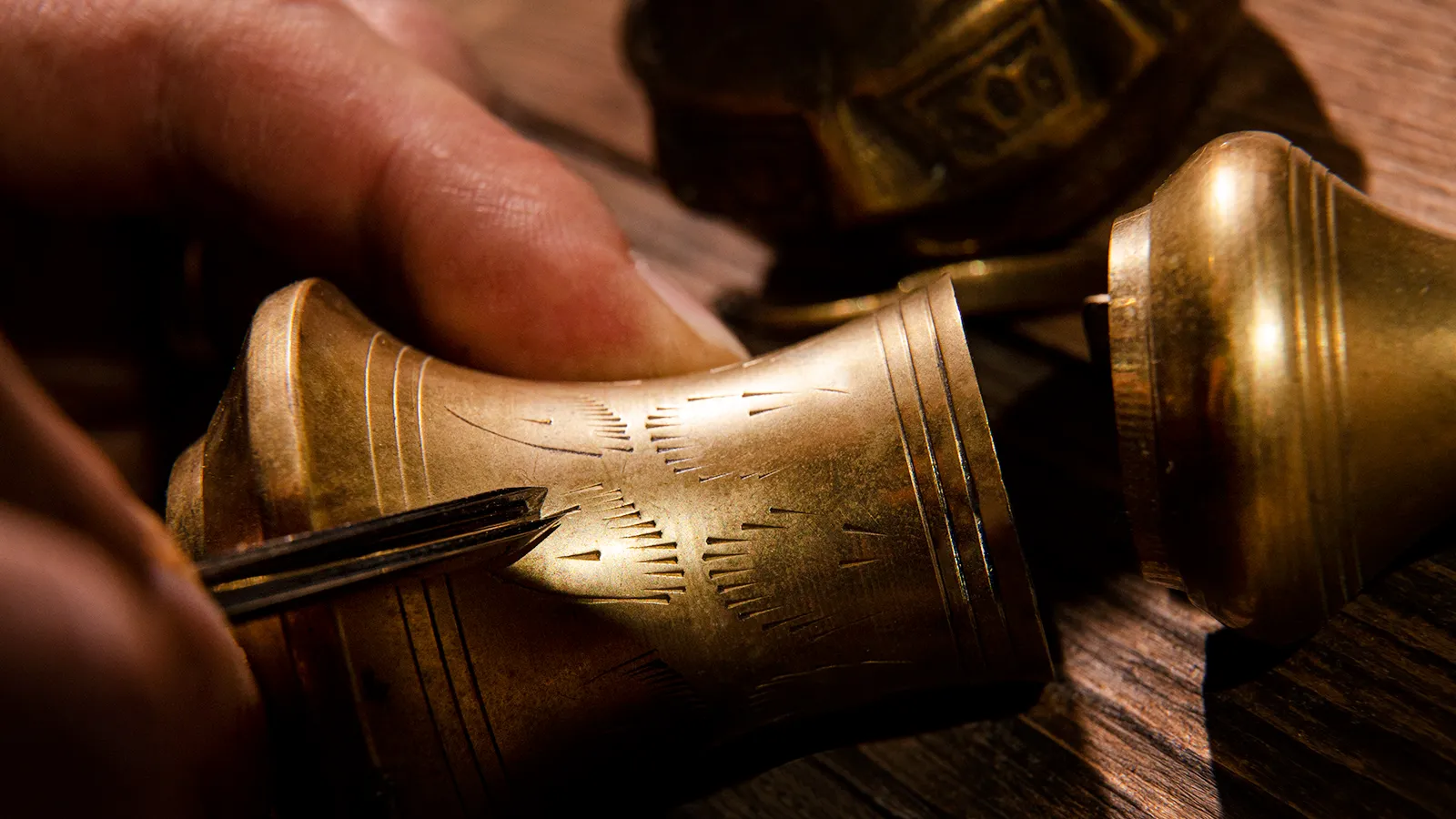
Describing Osumi’s work merely as “delicate metalwork by a woman artist” misses the point. What deserves attention is that the hammering that builds the vessel’s structure and the nunome-zōgan that fixes scenery onto the surface are integrated into a single form.
Motoko Oshiyama — How Does the Stirred Pattern Change Metal’s Color and Joining?
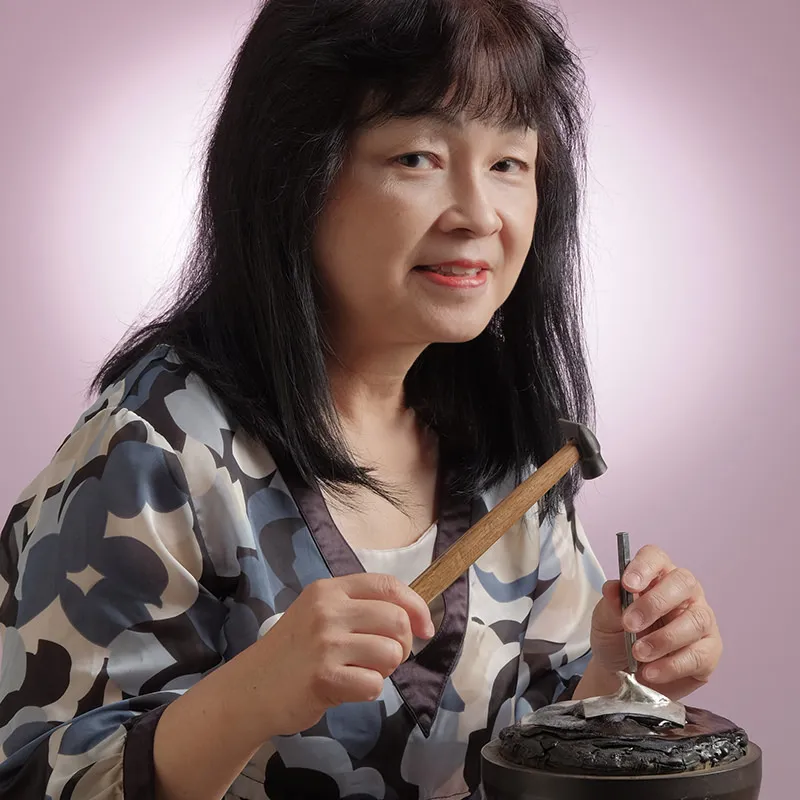
What characterizes Motoko Oshiyama’s work is an expression she herself named “kakuhanmon” (stirred pattern).
Oshiyama combines two or more kinds of metal and, through melting, joining, and forming, produces fluid metal patterns. She also combines joining and uchidashi, developing color expression drawn from natural phenomena and landscape.
Onishi Gallery’s official profile notes that Oshiyama, after graduating from Bunka Women’s University in 1981, studied under Moriyuki Katsura and Hōseki Okuyama, a holder of the Important Intangible Cultural Property “tankin,” and now teaches metalwork and jewelry making at her alma mater.
(Source: Oshiyama Motoko Biography — Onishi Gallery)
The 2009 document box “Evening Haze (Banka),” held by the Metropolitan Museum of Art, uses silver, copper, shakudō, and brass. The museum presents its fine gradation from combined metals and its swirling, abstract expression.
(Source: Evening Haze (Banka) Document Box — The Metropolitan Museum of Art)
When looking at Oshiyama’s work, it helps to look beyond the beauty of the pattern and ask where the base metal ends and where another, joined metal begins; the structure beneath the surface then comes into view.
Noriko Hagino — Color and Structure in a Forged Vessel
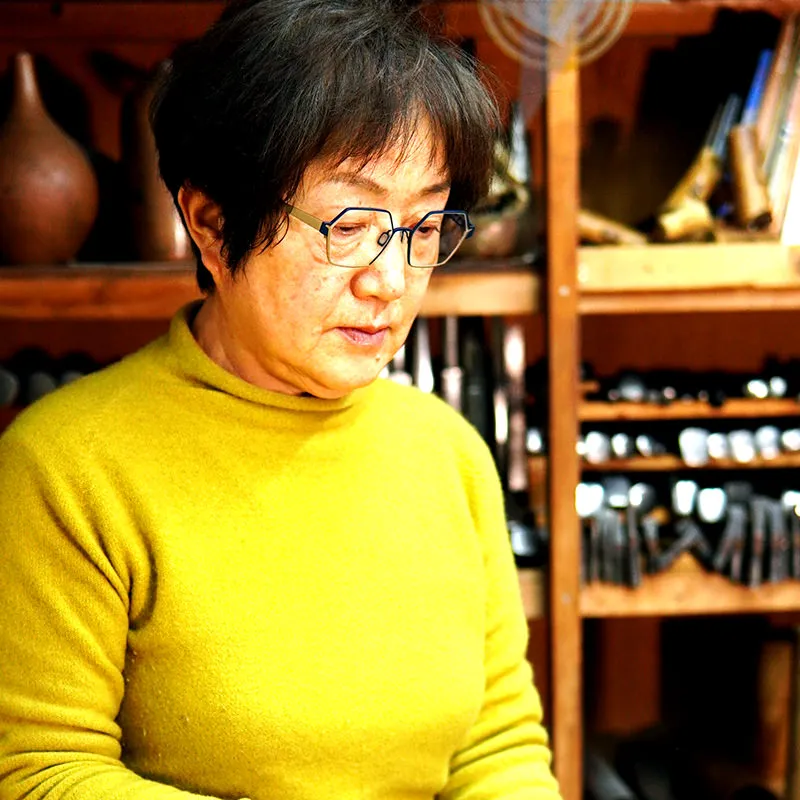
Noriko Hagino is a metal artist who uses tankin, forming by striking a single metal sheet, and hagiawase, joining separately formed metals into a three-dimensional object.
In an artist introduction produced with the Japan Art Crafts Association, Hagino herself explains that she makes her work through two methods: tankin, forming by striking a single sheet, and hagiawase, joining several metals. What matters is that even in hagiawase she does not merely join flat planes, but makes each part three-dimensional through hammering.
(Source: Noriko Hagino Artist Introduction — Japan Art Crafts Association × Asuka Cruise)
After completing the advanced course at Musashino Art Junior College, Hagino began studying under Shirō Sekiya in 1975. She joins metals of different colors — silver, gold, copper, shakudō, shibuichi — and uses their color contrasts and joining lines as part of the form.
In Hagino’s hagiawase, the boundary between different materials is not hidden but shown as a line crossing the vessel’s curved surface. The joining line is not merely a technical seam but a compositional element that creates the vessel’s movement and direction.
The Japan Art Crafts Association’s list of works confirms a long record of exhibited work, including “Forged and Joined Jar ‘Line,'” “Forged and Joined Treasure-Form Flower Vessel,” and “Forged and Joined Bowl.”
(Source: Noriko Hagino List of Works — Japan Art Crafts Association)
How Did Lineage Lead to Technical Innovation Without Limiting Individuality?
Transmission in metalwork is not imitating a finished form as it stands. It is the work of branching into different expressions while inheriting knowledge of tools, material judgment, heat, joining, and polishing.
What Was Passed Down from Shirō Sekiya
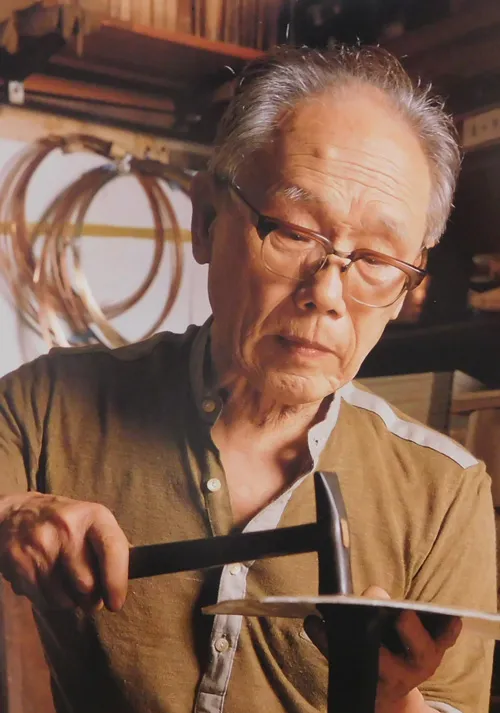
In its announcement for “Striking Objects,” the Smithsonian touches on how Shirō Sekiya taught Yukie Osumi, Chihiro Onuma, Noriko Hagino, and others, showing a network of teacher-student relationships through the exhibition.
At the same time, it explains that the works of artists who inherited the techniques each have their own distinct style, and that tools give rise to a variety of finishes and surface effects.
(Source: Shirley Z. Johnson Collection Announcement — Smithsonian National Museum of Asian Art)
Osumi and Hagino, who both learned from Sekiya, are not making the same work either. Osumi ties together hammering and nunome-zōgan; Hagino developed color and line through hagiawase.
As for Oshiyama, Onishi Gallery records that she studied under Moriyuki Katsura and Hōseki Okuyama. The Sekiya lineage the Smithsonian sets out does not mention Oshiyama, so the three cannot all be placed in the same line of descent.
Why Doesn’t an Inherited Technique Produce the Same Work?
Even with the same material and the same tools, works do not come out in the same form.
Where to strike, in which direction to extend the metal, whether to leave the hammer marks or smooth them, whether to join a different metal, whether to apply inlay. Small judgments are repeated throughout the making. The accumulation of those judgments becomes each artist’s contour.
The Japan Art Crafts Association’s records of hammering training also note that even using materials under the same conditions and doing similar work, each person moved toward a different form.
(Source: Tankin Successor-Training Technical Workshop — Japan Art Crafts Association)
What is inherited is not only the outward appearance of the finished piece. Judging the moment the metal has hardened, deciding how much heat to apply, predicting how the material will move with the next blow — the basis for those judgments is what is passed on.
Technique is a constraint and, at the same time, a shared language that lets artists move in different directions. The reason overseas museums pay close attention to lineage is likely that tradition appears to them not as a fixed form but as a mechanism that generates change.
Where Should You Look to See the Differences in Contemporary Metalwork?
When looking at a contemporary metalwork piece, following not only the overall form but the hammer marks, the joins, the metal color, the inner and outer surfaces, and the reflection of light brings the artist’s judgment into view.
Seven Points to Check When Viewing
- Is the form made from a single metal sheet?
Whether it was raised from a single sheet or joined from several components changes how you read the structure. - Where does the surface color come from?
Check whether the color comes from the base metal, an alloy, inlay, coloring, or polishing. - Are the hammer marks traces of process, or deliberate decoration?
Note the difference between a smoothed surface and one that keeps its hammer marks. - Is the boundary between different metals hidden or shown?
In Oshiyama’s kakuhanmon and Hagino’s hagiawase, the boundary itself becomes the expression. - How do the inside and outside answer each other?
Looking all the way to the rim, the inner face, and the base reveals the tension and center of gravity of the form. - What changes with the direction of light?
Under frontal lighting, raking light, and natural light, the metal color and hammer marks look different. - What does the official caption say?
Check the artist name, title, year, materials, technique, and holder. “On display,” “in the collection,” “handled,” and “for sale” are each different states.
What to Check for Display and Spatial Installation
When installing metalwork in a hotel, shop, office, or cultural facility, you cannot decide on the impression of the work alone.
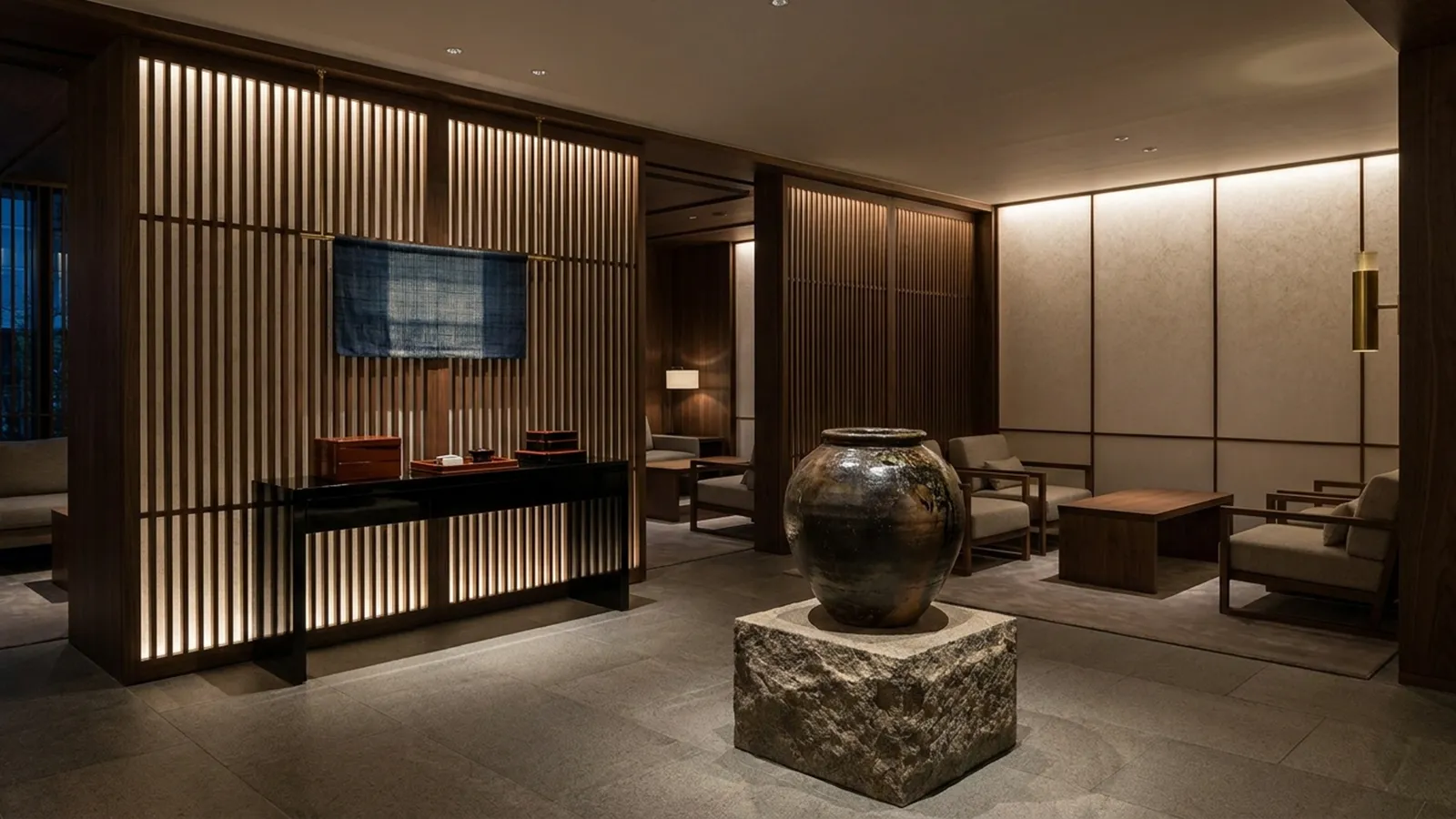
The first things to confirm are dimensions and weight, the load capacity of the display stand, the work’s center of gravity, and the method of fixing. Even a vessel-shaped work cannot necessarily be used like an ordinary flower vase. Whether water may be added, or plant material placed directly inside, needs to be confirmed with the artist or the dealer.
Lighting also matters. A work close to a mirror finish strongly reflects the surrounding lighting and people’s figures, and a dark colored metal loses its detail if the illumination is insufficient. Consider not the work in isolation but the wall color, flooring, viewing distance, and direction of light together.
Organizing the following conditions before consulting an artist or gallery makes it easier to move an exhibition plan forward.
- Display period and installation location
- Whether visitors can touch the work
- Whether a stand, case, or fixing is needed
- Handling of temperature, humidity, cleaning, and fingerprints
- Insurance and the contact route in case of damage
- Japanese and English wording of the caption
- Permissions for photography, advertising, social media, and web posting
- Whether purchase, loan, rental, or commissioned work is envisaged
How to Find Where to View or Buy Works
If you want to view or buy a work, it is safest to cross-check the artist’s own official information, the Japan Art Crafts Association, museums, and authorized dealer galleries.
A museum’s holdings are not necessarily on permanent display. Even when a work is listed as “in the collection,” whether it can currently be viewed needs to be confirmed separately.
The same goes for purchase: a work exhibited in the past is not necessarily for sale now. Prices vary by artist, technique, material, dimensions, year, and route of circulation. Do not treat a previously listed price as a general market rate; confirm with the official dealer.
For those considering the display or spatial installation of contemporary metalwork
Kogei Japonica welcomes inquiries from hotels, ryokan, shops, offices, cultural facilities, and design professionals regarding exhibition planning, spatial installation, work rental, collaboration with artists and workshops, and outreach in Japan and abroad. We also support artists, workshops, and galleries with coverage and PR placement, English profiles, and article production for international audiences. Respecting the terms of sale and the rights around each work, we help organize the necessary conditions from the concept stage onward.
Beyond “Strength” and Samurai Culture: How to Talk About Japanese Metalwork
Swords and armor are an important part of the history of Japanese metalwork, but the value of contemporary metalwork cannot be explained by force, masculinity, and spiritualism alone.
The Metropolitan Museum of Art touches on the history of forging, casting, and chasing used in swords, armor, and religious implements as the background to contemporary Japanese metalwork. At the same time, it shows that contemporary artists are developing new expression while using the techniques they inherited.
(Source: The Met Receives Significant Gift of Contemporary Metalworks — The Metropolitan Museum of Art)
Explaining historical background and folding present-day works back into the image of past weaponry are two different things.
Metal is not a material that only symbolizes strength. It extends thin, softens with heat, joins with different metals, and changes light through polishing. Hammering is less the work of conquering metal by force than the work of continually reading, through the body, how far the material will move.
What the Frame of “Women Artists” Makes Visible
An exhibition focused on women artists has the role of making visible the presence of artists who had been hard to see, along with educational opportunities, working conditions, and biases in evaluation.
On the other hand, using words like “the delicacy only a woman can bring” or “a strength that rivals any man” repeats an old framework in another form.
It is true that metalwork involves processes with physical demands. But it is not muscle alone that makes a work hold together. Knowledge and experience are needed to judge the material’s thickness, hardening, heat, the angle of the tools, joining, and polishing.
Also, the title “first woman” applies clearly to the point that Yukie Osumi was the first woman recognized as a holder of Important Intangible Cultural Property status in the metalwork field. It is not the case that all three, including Oshiyama and Hagino, are each known as some kind of “first woman.”
The point of setting the three side by side is not to prove that “there are outstanding women artists too.” It is that they can concretely show how different kinds of thinking — hammering and nunome-zōgan, kakuhanmon, hagiawase — exist within the same field of metal craft.
What Will Be Asked from Here Is Language That Reads the Work, Not Attributes
When conveying craft broadly, words like “tradition and innovation,” “the skill of the master,” and “the craftsman’s soul” are convenient. But by themselves they cannot explain why one work differs from another.
What is needed is concrete language for reading a work.
Which metal is used. Whether the form was made by striking or by casting. Whether the color comes from an alloy, from inlay, or from coloring. Whether the joining line is hidden or shown as part of the composition. When it catches the light, which surfaces sink and which lines rise.
Kogei Japonica’s Perspective
Acquisition and research programs by overseas museums are not an outside “seal of approval” certifying the value of Japanese metalwork. If anything, they pose a question back to Japan: with what documentation and what language will it record its own works.
Communicating craft needs “language that explains difference” more than “language that praises.” We believe respect is not lifting something up in the abstract, but investigating the work and the process, not confusing the judgments of one artist with another, and conveying them accurately.
Frequently Asked Questions About Contemporary Japanese Metalwork
Here are the key points, in question-and-answer form, on the differences between techniques, how metal color works, overseas recognition, and how to view or inquire about works.
- Q1. What is contemporary Japanese metalwork?
- It is metal craft that, on a foundation of tankin, chūkin, chōkin and other techniques, develops alloy, color, surface, use, and form as contemporary expression. It does not mean only reproducing traditional styles.
- Q2. How do tankin, chūkin, and chōkin differ?
- Tankin shapes metal by striking it, and chūkin makes form by pouring molten metal into a mold. Chōkin is a technique of working shaped metal by carving, piercing, inlaying, and so on.
- Q3. What do overseas museums value in Japanese metalwork?
- Not only advanced skill, but the diversity of alloy, surface, and form; the individual expression born of teacher-student lineage; and the fact that the working process can be researched and conserved on a continuing basis.
- Q4. What is the difference between Yukie Osumi, Motoko Oshiyama, and Noriko Hagino?
- Osumi is characterized by hammering and nunome-zōgan, Oshiyama by the kakuhanmon pattern from multiple metals, and Hagino by the composition of color and line through hammering and hagiawase.
- Q5. Did Japanese metalwork develop only from swords and armor?
- No. Swords and armor are an important part of the history, but metalwork was also used for religious implements, horse tack, tea utensils, vessels, and personal ornaments, and today extends to sculptural work as well.
- Q6. Why were there few women metal artists?
- Metalwork involves processes with physical demands and has historically been linked to weapon-making, so it has been discussed as a male-centered field. That background cannot be explained by physical strength alone, however, and needs to be considered together with educational opportunities and workshop environments.
- Q7. Are hammer marks a pattern, or traces of the making process?
- They can be either. They may remain as traces of forming, or be arranged as deliberate surface expression by choosing the shape of the hammer and the way of striking.
- Q8. Are the colors of shakudō and shibuichi painted on?
- Generally they are not painted. The composition of the alloy and surface treatments such as niiro coloring draw out blackish-purple and grayish tones.
- Q9. Where can the three artists’ works be viewed?
- There are examples in the collections of the Smithsonian and the Metropolitan Museum of Art, but they are not necessarily on constant display. Check the latest information from each museum, artist, and gallery.
- Q10. Can the works be purchased?
- Sales status differs by work. A previously exhibited work or a museum-held work is not necessarily available for purchase, so confirm with the artist or an authorized dealer gallery.
- Q11. How much do metalwork pieces cost?
- Prices vary greatly by artist, technique, material, dimensions, year, and route of circulation. Do not treat them as a fixed market rate; confirm individually with the latest dealer.
- Q12. What should a company or cultural facility check when planning an exhibition?
- Confirm the work’s dimensions and weight, the display method, lighting, insurance, maintenance, transport, captions, the rights for photography and publicity use, and the contact route with the artist and gallery.
That overseas museums and galleries are attending to contemporary Japanese metalwork is an important change for Japan as well. But it should not be left to end in the story of “popular abroad” or “Japanese culture rediscovered.”
What the works of Yukie Osumi, Motoko Oshiyama, and Noriko Hagino show is that within the same metal, and the same word “hammering,” there are entirely different views of material and ways of thinking about form.
What is needed to see metalwork is not a story of strength or authority. It is reading form, color, surface, joining, and light carefully and telling them apart.
Increasing that concrete language is a first step toward conveying contemporary Japanese metalwork at home and abroad while honoring the artists and their work.