




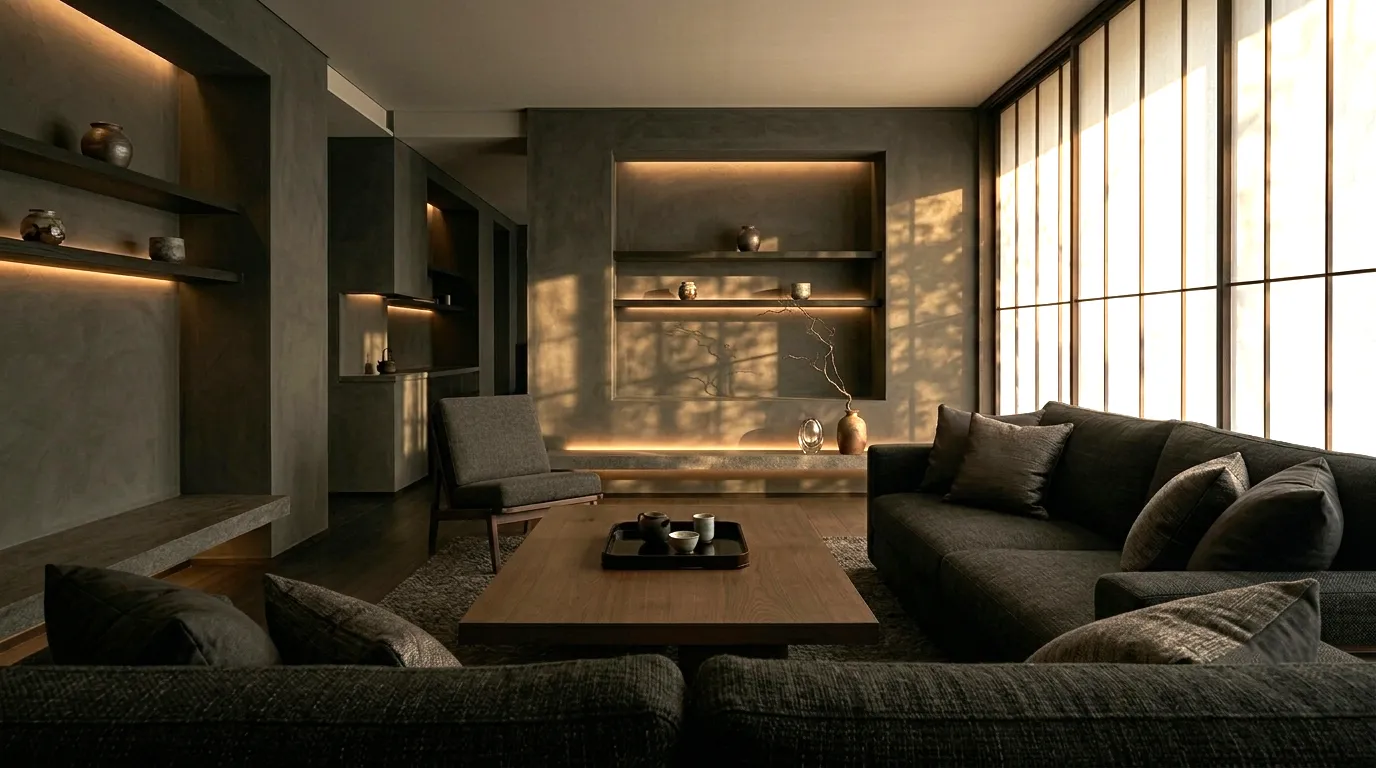
In international architecture and interior design, a noticeable shift is emerging that takes Japandi’s quietness further.
In broad terms, Beyond Japandi refers to a direction in international interior design media that moves past Japandi’s bright, uniform aesthetic toward darker tones, shadow, and a heightened interest in tactile natural materials.
That said, neither Beyond Japandi nor Dark Japandi has a single originating source or formal definition. It is more accurate to understand both as terms through which different international media and design voices are independently describing a similar shift in direction.
For those who have already adopted Japandi and are wondering where to take it next — without reducing the shift to simply “going darker” — this article works through what Beyond Japandi and Dark Japandi actually represent, and which Japanese craft materials have a genuine fit with the shadow and texture they seek. We cover color range, surface character, aging behavior, and spatial application in specific terms.
The goal here is not to trace a trend at surface level. It is to think through how materials like washi, urushi lacquer, hinoki, bamboo, metalwork, ceramics, and glass can be brought into contemporary spaces — not as markers of a Japanese aesthetic, but as materials with particular properties that serve a spatial purpose.
Table of Contents
What is Beyond Japandi?

Beyond Japandi describes an interior design context in which the minimal sensibility that Japandi established is being extended — toward darker tones, shadow, and a greater emphasis on texture.
The word Japandi entered wider English-language use around 2020 as a shorthand for residential interiors combining Japanese minimalism with Scandinavian simplicity and warmth. The Cambridge Dictionary Blog introduced it as a living space trend blending “Japanese minimalism” with “Scandinavian simplicity.”
(Source: New words – 12 October 2020 | Cambridge Dictionary Blog)
Light timber, off-white walls, natural-toned textiles, and considered negative space — this lighter, ordered look became Japandi’s signature image as it spread internationally.
From around 2025 into 2026, the terms “Dark Japandi” and “Beyond Japandi” began appearing in international interior and lifestyle media. Hackrea, for instance, identifies a 2026 direction within Japandi toward darker color palettes, stronger textures, sensory materials, and spaces designed to feel composed and settled rather than open and bright.
(Source: Japandi Style Interior Design Trends | Hackrea)
Luxury Lifestyle Magazine, covering British luxury interiors, describes Beyond Japandi as a move past uniform Japandi toward the regional craft traditions and wabi-sabi textures of Japan — the aesthetic that finds beauty in imperfection, weathering, and the incompleteness of things.
(Source: Beyond Japandi: how this trending Japanese design is shaping the future of luxury British interiors | Luxury Lifestyle Magazine)
A note of caution: Beyond Japandi should not be treated as a settled style category. At this point, multiple media outlets are describing similar tendencies in their own terms. At Kogei Japonica, we use this term not as the next trend label but as a way into thinking about how Japanese materials can be translated into contemporary spaces with genuine purpose.


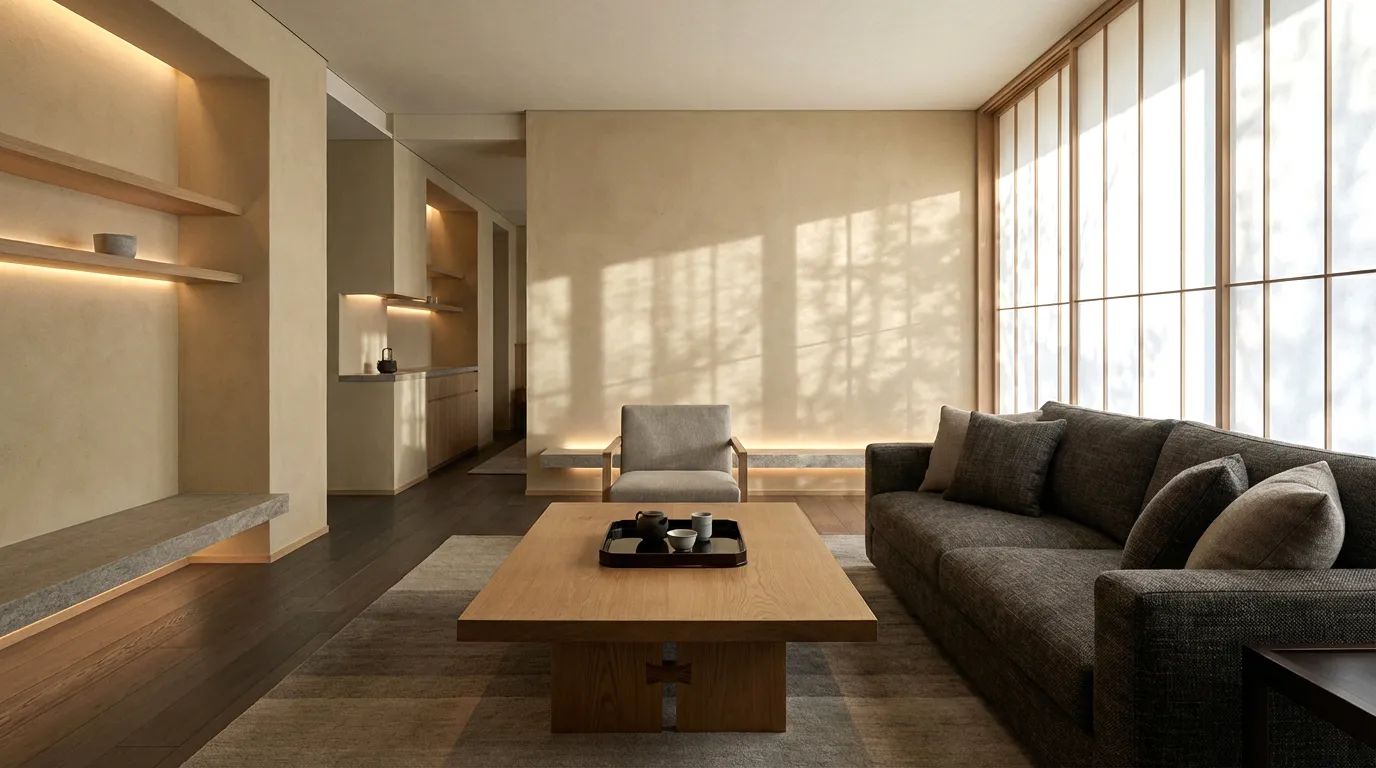
The difference between Japandi and Dark Japandi
The shift from Japandi to Dark Japandi is not simply a matter of lowering the value on the color chart. Where Japandi leans toward lightness and open space, Dark Japandi favors a more enveloping quality — shadow, material weight, and a sense of settled depth.
In practice, this means reaching for walnut, charcoal, deep olive, black, dark brown, and iron-grey where Japandi would use pale oak and off-white. The core of Japandi — natural materials, restrained decoration, functional minimalism — remains, but the handling of space and color changes considerably.
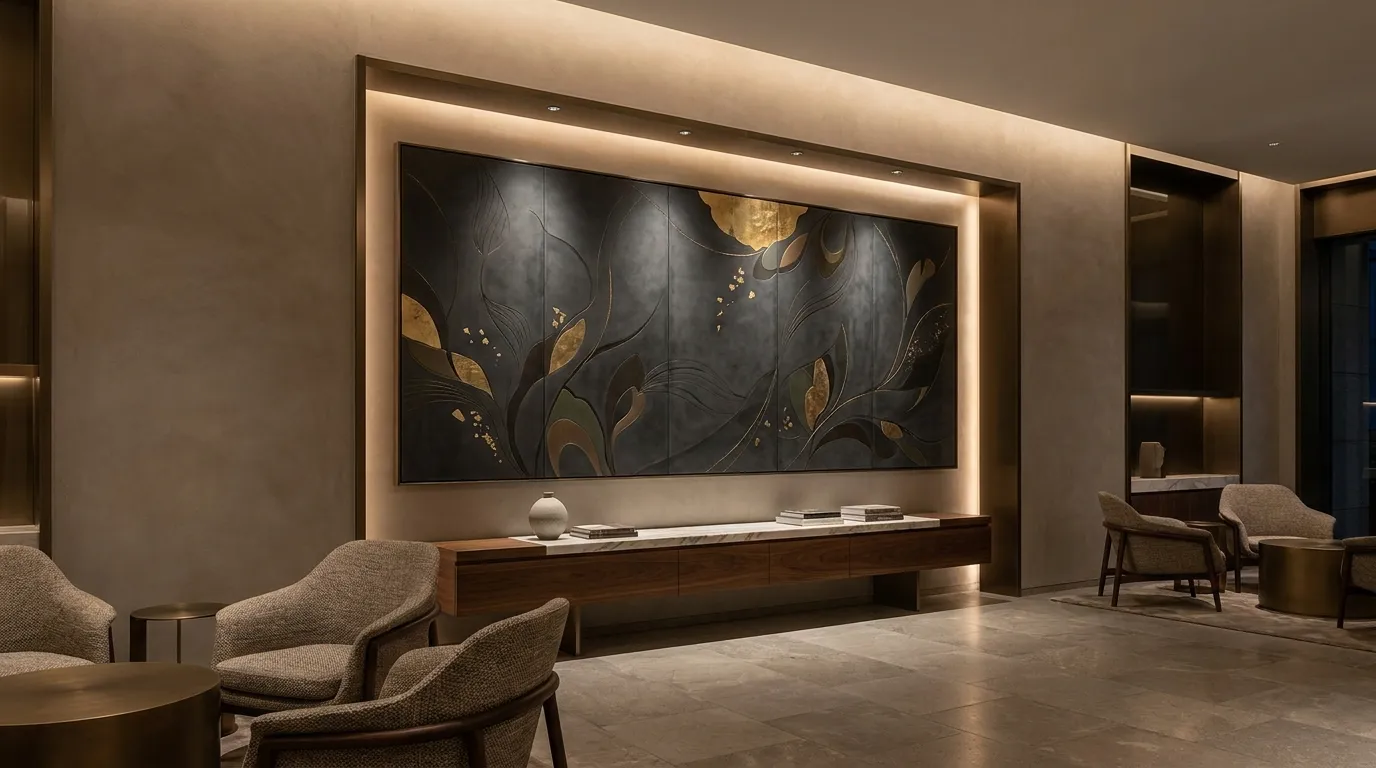
One observation worth adding here: this shift is not simply about color. It is fundamentally a question of how a space manages light and shadow. Japan has a long tradition of finding visual interest within shadow rather than competing for brightness. Dark Japandi is, in a real sense, asking how to handle shade — and that is exactly the territory where Japanese craft materials have something to offer.
Why is the interior world moving toward darkness and texture now?
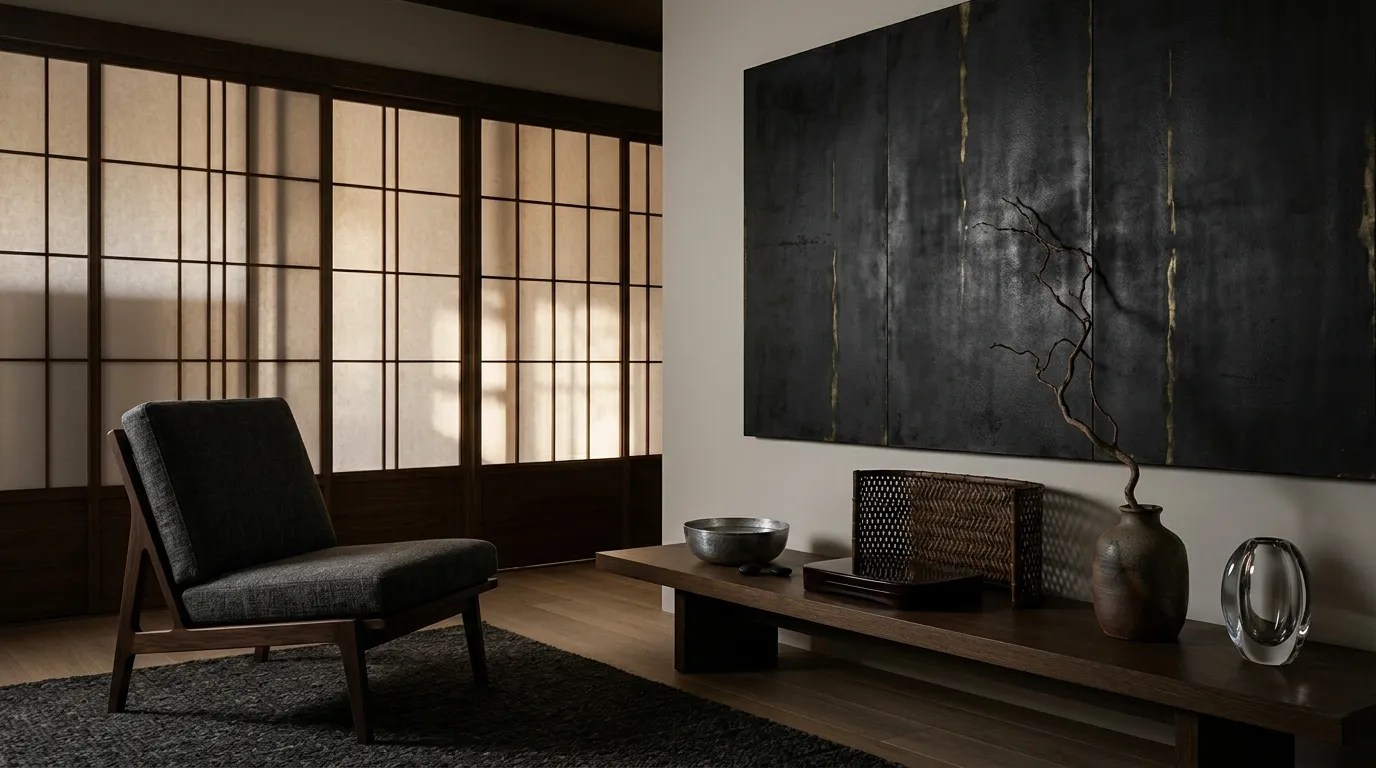
The short answer is: saturation with uniform brightness, and a growing desire for tactile surfaces and materials that register beyond the visual.
In recent international interior discourse, the terms that appear with increasing frequency are texture, patina, warm browns, and crafted objects — language that extends the experience of a space beyond sight to include touch, acoustic quality, how light reflects, and how materials age. Hackrea’s coverage of Japandi trends identifies darker color palettes, textural wall finishes, sensory design, and layered natural materials as directions the style is moving toward. This appears connected to a broader desire for spaces that feel genuinely lived-in rather than merely well-ordered.
(Source: Japandi Style Interior Design Trends | Hackrea)
As AI and CGI have made it increasingly easy to produce flawlessly composed visual surfaces, the gap between what looks good on screen and what actually registers through the body in a physical space has become more apparent.
The fiber structure of washi paper, the depth of urushi lacquer, the flex of bamboo, the weight of iron, the earthen quality of unglazed ceramics — these can be rendered as images, but they cannot be replaced as physical experiences. In this sense, the tactile quality associated with Dark Japandi can be read as a counterpoint to the digital era’s dominance of the visual.
Editor’s note
What Beyond Japandi is really asking is not what the next interior trend should be, but how precisely and with what care Japanese materials can be translated into space. Using dark colors is not the point. What matters is how a material’s inherent shadow, surface quality, aging process, and the time of the maker can be preserved in a space.
Which Japanese craft materials suit Dark Japandi?
Washi, urushi lacquer, hinoki cypress, bamboo, brass and other copper alloys, iron, ceramics and stoneware, and glass each offer distinct color ranges, surface textures, and aging behaviors that can respond to the shadow and tactile quality Dark Japandi is after.
The important caveat is not to group these as interchangeable markers of a “Japanese aesthetic.” Each of these materials has a technique developed over a long history, and behind each technique are the regions and craftspeople who carry it. Naming a material is not enough — its intended use, durability, relationship to lighting, maintenance requirements, and procurement path all need to be considered.
Whether a given craft falls under Japan’s Traditional Craft Designation cannot be determined by material name alone. The Ministry of Economy, Trade and Industry (METI) designates traditional crafts under the Act for the Promotion of Traditional Craft Industries; as of October 27, 2025, 244 items hold this national designation.
(Source: Traditional Crafts | Ministry of Economy, Trade and Industry (METI))
Material comparison table (tone / texture / aging / lighting / spatial use / maintenance)
| Material | Tone range | Surface character | Aging behavior | Relationship to light | Spatial applications | Maintenance considerations |
|---|---|---|---|---|---|---|
| Washi | Natural white, off-white, pale brown, ink tones | Soft, with visible fiber texture | Color and surface character shift over time | Works well with transmitted and diffused light | Shoji screens, wall surfaces, lighting shades, art panels | Vulnerable to humidity, abrasion, direct sunlight, and tearing |
| Urushi lacquer | Black, vermilion, tame (amber-brown), chestnut, deep brown | Smooth, with substantial depth of sheen | Sheen and color depth can increase with careful use | Indirect light reflection is particularly strong | Furniture, tableware, counter elements, art pieces | Avoid rapid humidity and temperature changes, direct sunlight, and abrasion |
| Hinoki cypress | Pale cream, white grain, honey amber | Smooth grain, with characteristic fragrance | Ages to a warm honey amber | Warm-toned lighting suits it well | Bathroom fittings, screens and sliding doors, furniture, flooring, fixtures | Monitor fragrance, how the wood responds to humidity, surface treatment, and warping |
| Bamboo (take) | Pale yellow, honey amber, charred brown | Light and supple, with woven surface expression | Color deepens with use | Creates strong shadow patterns | Wall surfaces, screens, baskets, lighting, partitions | Monitor drying, splitting, humidity, and load capacity |
| Brass and copper alloys (shinchu) | Gold, amber, deep brown-black | Hard but warm-toned sheen | Oxidizes through a range of tones | Reflective — strong interaction with lighting | Hardware, handles, light fixtures, signage, fixtures | Decide whether oxidation is treated as patina or polished away |
| Iron (tetsu) | Black, deep grey, rust | Matte and substantial | Surface character deepens with use | Provides visual grounding even in dark spaces | Cookware, heating equipment, architectural hardware, fixtures | Water and humidity management; rust protection and weight |
| Ceramics (tōki) and stoneware (sekki) | Earth tones, white, black, glaze colors | Varies considerably with and without glaze | Unglazed pieces may show use over time | Works well with natural and low-level lighting | Tableware, flower vessels, tile, lighting, art pieces | Assess glaze presence, water absorption, and breakage risk |
| Glass (garasu) | Clear, color overlay, blue, amber | Hard, light-transmitting | Relatively little change over time | Can produce both reflection and transmission effects | Tableware, lighting, screens and partitions, decoration, art pieces | Assess impact resistance, safety requirements, and installation context |
This comparison table is a starting point for material selection, not a specification. Real decisions will depend on the production region, individual maker or workshop, installation conditions, and use environment. In hospitality and commercial spaces especially, aesthetic criteria alone are not sufficient — cleaning requirements, long-term durability, repairability, and post-installation management all need to be resolved in advance.
Glossary (washi / urushi / hinoki / take / shinchu / tetsu / tōki and sekki / garasu)
Washi — Japanese handmade paper / traditional Japanese paper. Produced primarily from plant fibers including kozo (paper mulberry), mitsumata, and ganpi. Echizen Washi, from Fukui Prefecture, was designated a national traditional craft on June 2, 1976.
(Source: Echizen Washi | Traditional Craft Aoyama Square)


Urushi — Japanese lacquer. The refined sap of the urushi tree, used as both a coating and an adhesive material. Wajima-nuri, from Ishikawa Prefecture, is known for its exceptionally durable foundation made with Wajima-ji-no-ko (a local diatomaceous earth powder) and was designated a national traditional craft on February 17, 1975.
(Source: Wajima-nuri | Traditional Craft Aoyama Square)


Hinoki — Japanese cypress (Chamaecyparis obtusa). A coniferous timber valued for its fragrance, grain, and hygienic properties, with a long history of use in temple architecture, bathrooms, furniture, and fittings. Spatial applications require attention to fragrance, how the wood responds to humidity, surface treatment, and warping.

Take (bamboo) — A material characterized by lightness, flex, and the visual quality of woven construction. Beppu Bamboo Craft (Beppu Chikuzaiku), from Oita Prefecture, was designated a national traditional craft in 1979.
(Source: TEWAZA Beppu Bamboo Craft Exhibition | Beppu Municipal Bamboo Craft Traditional Industry Hall)

Shinchu (brass) — A copper-zinc alloy that moves through a range of surface tones as it oxidizes — from gold through amber to deep brown-black. For spatial applications involving brass and related copper alloys, the metalwork tradition of Takaoka Copperware (Takaoka Doki), from Toyama Prefecture, is a useful reference point. Takaoka Copperware was designated a national traditional craft on February 17, 1975.
(Source: Takaoka Copperware | Traditional Craft Aoyama Square)

Tetsu (iron) — Through forging (tanzo) and casting (chuzo), iron produces a wide range of surface qualities. Nanbu Tekki ironware, from Iwate Prefecture, involves more than 80 distinct production stages for an iron kettle alone. It was designated a national traditional craft on February 17, 1975.
(Source: Nanbu Tekki | Traditional Craft Aoyama Square)
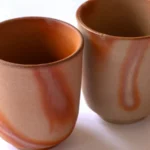
Tōki (ceramics / pottery) and sekki (stoneware) — The presence or absence of glaze (yūyaku) and the firing method create significant differences in surface character and practical handling. Bizen ware, from Okayama Prefecture, is counted among Japan’s Six Ancient Kilns with a history going back roughly a thousand years, and is technically classified as stoneware (sekki) rather than earthenware. It was designated a national traditional craft on November 1, 1982.
(Source: Bizen Ware | Traditional Craft Aoyama Square)
Garasu (glass) — In the context of Japanese glass craft, cut glass (kiriko) such as Edo Kiriko can be described as Japanese cut glass. Edo Kiriko traces its origins to 1834, when a glassmaker in Edo named Kagaya Kyubei is said to have engraved the surface of glass. It was designated a national traditional craft in 2002.
(Source: History, Patterns, Process, and Definition | Edo Kiriko Cooperative)

How should each material be brought into a space?
Selecting materials according to where light falls, how much of it, and what the ambient humidity is will reduce the risk of misapplication considerably.
Washi and bamboo transmit and soften natural and warm-toned light, making them suited to screens and sliding doors, lighting shades, wall surfaces, and partitions. Urushi lacquer, brass, and iron, by contrast, work through reflected indirect light and material weight — more appropriate for furniture, hardware, counter elements, signage, and fixtures.
Ceramics and stoneware bring an earthen presence to a space through tableware, flower vessels, tiles, and art pieces. Unglazed pieces in particular — unlike their glazed counterparts — allow the raw material quality to read directly, making them a natural fit for the tactile emphasis that Dark Japandi is seeking.
Glass offers both transmission and reflection. Where a dark space calls for a controlled entry of light, glass works in lighting fixtures, screens, vessels, and art pieces. Cut glass such as Edo Kiriko, in particular, produces intricate reflected light that introduces tension and luminosity into a darker context.
That said, none of these materials is without limitation. Washi and urushi lacquer are sensitive to rapid changes in humidity and to direct sunlight. Metalwork can discolor or corrode if moisture is not managed. Bamboo and timber are affected by humidity and drying. Ceramics and glass carry breakage risk. Material selection must factor in not just aesthetic direction but the climate conditions of the installation site and the frequency of use.
Considerations for spatial design
Introducing Japanese craft materials into commercial spaces, hotels, and offices requires a different level of planning than residential use. In spaces with heavy and varied foot traffic, durability and maintenance infrastructure need to be established before installation. In hospitality and retail, cleaning ease is a separate and essential consideration.
When combining multiple materials, leaving clear handling guidance that remains useful even when maintenance staff changes is strongly advisable. Urushi lacquer, washi, metalwork, ceramics, and glass each have distinct conditions to avoid and distinct handling requirements.
What to watch out for when introducing Japanese craft materials
The most significant risk, stated directly, is treating materials as symbols of a Japanese aesthetic and introducing them without understanding the techniques and production regions behind them.
One common misconception is reducing washi to shoji screen paper. Washi has a wide range of applications: fusuma (sliding door) panels, woodblock printing papers, calligraphy papers, Japanese painting papers, envelopes, and stationery, among others. Echizen Washi alone is documented across woodblock printing, fusuma, printing, certificates, calligraphy, and Japanese painting applications.
(Source: Echizen Washi | Traditional Craft Aoyama Square)
Urushi lacquer is often dismissed as expensive and difficult to work with, but used in an appropriate environment it is a material that lasts. Its sensitivity to direct sunlight and rapid drying does require specific consideration by application.
Ceramics vary fundamentally by glaze presence and firing method — they cannot all be handled by the same standard. Glass, too, moves across different categories: flat sheet glass, blown glass, and cut glass behave differently in space and require different handling.
One thing worth emphasizing as editor: behind each of these materials are a production region and makers’ hands. Before these materials are consumed as components of a trend, understanding where they come from, who made them, and through what techniques is what ultimately raises the quality of the space itself.
The Agency for Cultural Affairs notes that among the natural materials and tools essential for cultural property restoration, aging among producers, declining numbers, and the shortage of successors represent ongoing structural challenges. Bringing craft materials into designed spaces is not only a decorative act — it is connected to the question of what kind of demand sustains these materials and the skills behind them.
(Source: Securing Materials and Tools | Agency for Cultural Affairs, Takumi Project)
Pre-procurement checklist for Japanese craft materials
- Have the humidity, temperature, and direct sunlight conditions at the installation site been confirmed?
- Does the intended application — wall surface, screen, furniture, lighting, small object — suit the material’s properties?
- Has it been determined whether the space involves heavy public contact or is primarily for viewing?
- Is handling guidance in place that will remain usable even when maintenance staff changes?
- Have the production region, technique, and traditional craft designation status been confirmed?
- Have procurement routes, makers, studios, regional cooperatives, and authorized retailers been identified?
- Has a decision been made about whether to credit the artist, studio, or production region?
- Has pricing been individually confirmed, with the understanding that it varies by artist, piece, and distribution channel?
- If overseas shipping or international installation is required, have transit, insurance, and damage response been arranged?
- Has a decision been made about whether to provide material background information via card, QR code, or English-language description?
Editor’s note
When placing craft works in a space, I do not operate on the assumption that a good piece will improve the space by its presence alone. If anything, the stronger the piece, the less it delivers when placed incorrectly. Material, lighting, spatial distance, labeling, and visitor flow all need to be in place before craft becomes genuinely part of the space.
Frequently Asked Questions
- Q1. Are Beyond Japandi and Dark Japandi the same thing?
- There is no single formal definition that unifies the two terms. Both are used to describe a direction that moves past Japandi’s uniform brightness toward darker tones, shadow, and tactile emphasis. At this point, neither is a formally defined style category — they are better understood as expressions of a shared tendency emerging across international interior media.
- Q2. How do Japandi and wabi-sabi differ?
- Japandi refers to an interior style combining Japanese and Scandinavian influences. Wabi-sabi is a Japanese aesthetic sensibility — the finding of beauty in imperfection, weathering, and incompleteness. One is a spatial style; the other is an aesthetic philosophy. Keeping these categories separate makes the distinction easier to hold.
- Q3. What should be confirmed first when introducing Japanese craft materials?
- Start with the conditions at the installation site: humidity, light levels, and how much human contact the surface will receive. Selecting materials on appearance alone, without assessing durability, cleaning requirements, and maintenance method, is where most problems begin.
- Q4. Are urushi lacquer and washi durable? How should they be maintained?
- Both are materials that last well under appropriate conditions. Both require protection from rapid humidity changes and direct sunlight. For specific care, follow the guidance provided by the individual production region, workshop, or maker — the appropriate method varies by piece.
- Q5. Where should we go to discuss introducing Japanese craft materials into a hotel, store, or office?
- The Kogei Japonica editorial team is available for consultation on material and production region selection appropriate to the spatial type and scale of a project — hotels, ryokan, retail, offices, galleries, and showrooms among them.
- Q6. What should be checked when purchasing Japanese craft materials or objects overseas?
- Confirm procurement through official channels from production region cooperatives or workshops. Verify traditional craft designation status and production background before purchasing. Pricing varies by maker, piece, and distribution path — individual confirmation is necessary.
- Q7. Which Japanese materials are most accessible for a first Dark Japandi introduction?
- For a first move, washi-shaded lighting, ceramic flower vessels, brass or iron hardware, and small bamboo objects are relatively manageable entry points. Adding light and texture at specific points before committing to a full spatial change reduces the risk of a misstep.


Summary: Moving past the trend, toward the materials themselves
Beyond Japandi and Dark Japandi are names that international interior media have given to a tendency that is still finding its edges. But the shadow and texture those names are pointing toward are properties that Japanese craft materials have always carried — not as a response to a trend, but as the result of long development by production regions and makers.
The transmitted light of washi. The depth of urushi lacquer sheen. The flex of bamboo. The aging surface of brass and iron. The earthen quality of unglazed ceramics. The transparency of glass. These did not come into existence to serve a design direction. They were developed over time by the places and people who make them.
Responding to a trend and working meaningfully with a material are related, but fundamentally different. Adding dark tones or natural materials to a space is available to anyone. But understanding where a material comes from, who made it, and through what techniques it was produced — and how it can be maintained and used over time — is what changes the quality of the result.
At Kogei Japonica, we will continue to map the connections between international design discourse and Japanese craft materials — not at the surface of the trend, but with the attention to technique and production region that these materials warrant.


